The church's office manager is helping her former employer clear and refurbish a house in the road that adjoins the Rectory, and our bookkeeper is helping her. On Monday I got into a conversation with said bookkeeper about the former and current Rectories and how awkward it is to manage the stretching garden.
"How big is your garden?"
"It goes up the hill quite a long way."
"You know, someone's put this hideous thing in their garden, you can see it from the house ..."
"What kind of hideous thing?"
"It has pillars and a sort of roof ..."
"Ah, that'll be the hideous thing in my garden."
"Oh no! Well, I say, 'hideous', I meant 'unexpected' "
Wednesday, 11 May 2016

Monday, 9 May 2016
Innovation

It was at Lamford that we felt there was something of a missed opportunity in the Candle's unremarked passage from the front of the church to the back, and at the end of the Ascension Day mass one year I and Il Rettore solemnly carried it and its stand to the font where it would remain for the next few days. Then it occurred to me that that little motion needed something to cover it, and so decided to chant a few lines from Psalm 47:
God is gone up with a shout of triumph,
the Lord with the blast of the trumpet:
sing praises to the Lord, sing praises;
sing praises to our King, sing praises.
At Lamford the choir sang Gerald Finzi's anthem God is Gone Up to splendid effect, and I admit to pinching the first few notes of my little chant from that rather more extensive piece. This doesn't happen at any other church, so far as I know, but that's how liturgy changes - a lack is felt and something bodged together to meet it.
We are rather concerned about our Paschal Candle this year, which is burning down rather rapidly. I ended the Ascension Day mass with my hands spattered in green wax from the disappearing motif on the Candle, and I suspect the particular well-known church supplier we got it from will not get our custom in 2017.
Saturday, 7 May 2016
As You Were
 Cuts to disability benefits were absolutely necessary and right both for financial and social reasons, said the Government; and then they weren't.
Imposition of the new contract for junior doctors had to proceed and the process had gone too far to be delayed, said the Government; and then it hadn't.
Compulsory academisation of all schools was the vital step in freeing the education system from the dead hand of bureaucracy and equipping it for the future, said the Government; and now it's not.
You will recall how exercised we were about this matter at Swanvale Halt Infants. Since then the scandal of Perry Beeches Academy Trust in Birmingham has neatly revealed the potential of academisation to pour public money in huge quantities into the pockets of those who run the academies. It will be an enormous relief that we don't have to waste time and energy on working out the details of Multi-Academy Trusts and get on with educating small children instead; but one major practical argument in support of total academisation, that the remains of the local authority-controlled system is now so riddled with holes that it can't practically survive, won't be going away. We will continue to struggle, as local authorities themselves struggle, with the pressures placed on them by government and the ludicrous rhetoric of austerity, and it will be no easier than it's been up till now.
Wednesday, 4 May 2016
Spring Fair 2016


The storm clouds skirted the field on Saturday for the Swanvale Halt church Spring Fair. We had a minute's shower at about 1.45 (just as the Infants School children were massing for their country dancing), but that was it, and for the rest of the time the sun and the clouds danced around one another, the former often taking the lead role. The field was always busy; we took more in stall fees from charities and organisations than for a good long year; and although it wasn't as warm as last year that didn't seem to put anyone off. At the Messy Church stall they made a massive model of Guildford Cathedral which was, shall we say, hard to miss. It was topped by Angel Barbie, fitted with plastic wings and a cardboard crown, and sprayed gold, just like the real thing. Possibly.
Sunday, 1 May 2016
PJ Harvey, 'The Hope VI Demolition Project' (2016)

When I first heard ‘The Community of Hope’, it struck me as
a hymn of praise to the determination of people to survive in a hard situation.
Notwithstanding the reaction to that song from some political quarters in the US, I still
rather think that. But the fact that it can be read in such violently divergent
ways is indicative of the way PJ Harvey’s latest album has been received more
generally. Reviewers have hit on entirely contradictory complaints as ways of
expressing their dissatisfaction: is she opening up too much? or not enough?
Harvey’s talent has always been expressed (as I’ve pointed
out before) through the adoption of masks: she is a ventriloquist, giving voice
to imaginary souls. Even the wartime vignettes of Let England Shake, inspired
though they may have been by the singer’s research, were works of the
imagination. Paradoxically, though, you can only pull this off if your adopted
voice makes contact with something inside you, and this gives an insight into
the problem people have with analysing Hope VI.
Because here she tries something new, something of an entirely different order – to jet across the world gathering material which reflects the
violence human beings work on each other, and to express it musically. The
trouble is that her usual talent of ventriloquy is of no use in this project.
To announce yourself as the John Pilger of Alternative Music (and Mr Pilger is
mentioned in the sleeve notes) is grandiose enough: to ventriloquise the
voices of the real, concrete people you may have met along the way would be
grotesque presumption, and Ms Harvey doesn’t try, falling back, for the most
part, on reportage and observation. Occasionally she takes words spoken to her
as the starting-point for a song – as with 'The Community of Hope', or 'A Line in the
Sand', which seems to hang around the statements of an aid worker in a refugee
camp (perhaps) – but that’s also reportage rather than an attempt to inhabit someone
else’s situation imaginatively.
Sometimes the observation she offers us is telling enough to
make an impact – the Kosovan woman still looking after her vanished neighbours’
houses in ‘Chain of Keys’*, or the horrific ruin described in ‘The Ministry of
Defence’, an image intensified by the brutality of the music that accompanies
it – and sometimes it’s not. Even the weakest tracks on the album have great
points of interest, such as the lovely lilt of ‘Medicinals’, almost like a
medieval carol; but the vision only seems to clear, and the music take off,
when Ms Harvey actually abandons reportage in favour of imaginative insight.
That happens in ‘The Community of Hope’, which juxtaposes its euphoric
title-line refrain against the bleak landscape of urban decay, and in ‘The
Wheel’, where a group of playing children inspires a meditation on violence and
loss which is both reticent and passionate. The points where she actually
speaks in her own, unmasked voice, virtually for the first time musically, are the least
successful of all. ‘Dollar Dollar’ describes an encounter with a boy beggar who
appears by the car in which the singer is travelling and which is then whisked
away before she can do anything: she finds it a haunting experience. There is
no mistaking the plaintive, pained quality in the vocal, but it’s not exactly a
startling insight, unless at 46 you’ve really never before experienced your own helplessness in the face of need.
Diamanda Galás once talked about the difference between an
artist wanting to speak and needing to speak: Hope VI is definitely the former.
Bits of it work, sometimes triumphantly, bits don’t, and its failures are, I
think, down to its author deliberately turning away from her own genius: an
absolutely bold, but not necessarily fruitful path to tread.
*The recording of chant from Decani monastery at the end places this in Kosovo; and I imagine the Father Sava referenced on the sleeve notes is Father Sava Janjic, Abbot of Decani and a leading voice for tolerance and reconciliation during the collapse of Former Yugoslavia and the period since.
Friday, 29 April 2016
The Honour of the Drape
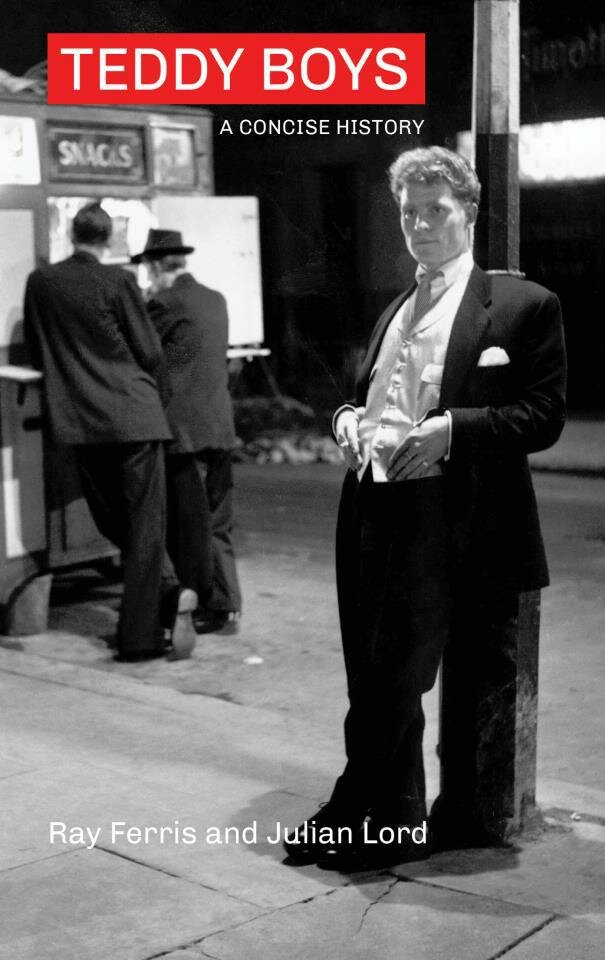
My Dad was a Ted, which was why I picked up this slim book
from the sales stall at the local library (one of my main sources of books). I
have a couple of photos of my Dad from 1956 (when he was 17-18). He didn’t have
a great deal of cash and I suspect the longish jacket he’s wearing in the photo
with my Mum was his own father’s, or something inherited at any rate. In a
little passport-type photo he has a tie and something under his jacket,
probably a cardigan rather than a waistcoat – an expedient adopted by less
prosperous regional Teds. Incongruously he’s also wearing what seems to be a
dufflecoat, which wasn’t part of the style, but there you go. Apparently older
chaps would scathingly remark about Teds ‘a spell in the Army’d sort ’em out’
and that seems to be what happened to my Dad as a couple of years later after
his National Service his quiff was a bit less obvious and he’d ditched ties for
anything but very formal occasions. ‘We were Edwardians, that was where the
name came from,’ he told me, so I knew that part of the story.
A couple of things struck me from the book. It’s written in
a more committed way than one normally expects, certainly. Mr Ferris, the
co-author, is very scathing about anyone who suggests social change in Britain
got going in the 1960s rather than during his father’s youth in the ‘50s:
‘listen to their drivel for long enough and you end up believing it’. I recall
my boss at the Royal Engineers Museum saying exactly the same thing. He
remembered his time at St John’s College Cambridge: ‘some of us had come back
from bloody Korea, and we were being told to wear silly little academic gowns
and that we had to be back in by 11pm. We weren’t putting up with that.’
Mr Ferris also maintains that being a Ted wasn’t – isn’t, for those who still are Teds - mainly about music or about clothes but about ‘a way of living and thinking’. ‘That’s just the kind of thing a Goth would say’, remarked Ms Formerly Aldgate, echoing my first response exactly. It’s a sentiment that trips easily enough off the tongue or pen, but it strikes me as a fairly empty one. In the Goth context anyone who wanders into a Goth club on more than just a one-off basis – especially if not accompanied by a regular – is expected to join in, and joining in means at least wearing black – and I doubt Teds would be any different; possibly for them it would be all the more true as Goth lacks the aggressive working-class edge that Ted had. Its brand of rebellion is very different. For both, though, insisting outsiders do adopt the style, regardless of any statement that clothes and music aren’t the point, is about maintaining the safe subcultural space where questions don’t need to be asked nor explanations given, and perfectly understandable.
Mr Ferris also maintains that being a Ted wasn’t – isn’t, for those who still are Teds - mainly about music or about clothes but about ‘a way of living and thinking’. ‘That’s just the kind of thing a Goth would say’, remarked Ms Formerly Aldgate, echoing my first response exactly. It’s a sentiment that trips easily enough off the tongue or pen, but it strikes me as a fairly empty one. In the Goth context anyone who wanders into a Goth club on more than just a one-off basis – especially if not accompanied by a regular – is expected to join in, and joining in means at least wearing black – and I doubt Teds would be any different; possibly for them it would be all the more true as Goth lacks the aggressive working-class edge that Ted had. Its brand of rebellion is very different. For both, though, insisting outsiders do adopt the style, regardless of any statement that clothes and music aren’t the point, is about maintaining the safe subcultural space where questions don’t need to be asked nor explanations given, and perfectly understandable.
Mr Ferris, son of a Ted, who adopted the style in the
mid-1970s, is an adamant champion of latter-day Teds and accordingly
contemptuous of anyone who abandoned the style; but if there ever was a
subcultural style that had its epochal moment from which the world then moved
on, New Edwardianism was surely it. Born out of the marriage of an elitist
British reaction against American culture with US zoot fashion, at a moment
when media, economics and social change favoured it, the early-to-mid 1950s was
its natural soil. Again, Goth differs from other subcultures because of its
linkage into an artistic and literary tradition that stretches back centuries
(millennia, you could argue), but the way it looks has changed at different
moments over the decades: most Goths now, if you can find any at all, don’t
look how they did in 1982. They were of their time too, and time moves on
because society moves on (one of my favourite books, Robert Elms’s beautiful
The Way We Wore, about his own journey through fashion from the 1960s to the
1990s, describes and expresses this truth to perfection). This is what makes
essentialist analyses of subculture and narrow defensiveness about what they
are and aren’t a bit daft.
At one point Mr Ferris gives an account of the 1970s
Teds who battled Punks on the streets of provincial towns: ‘rightly or
wrongly’, he says – and it doesn’t take much insight to guess which side of
that dichotomy he falls on – ‘they believed they were fighting for the honour
of the drape’, the most ludicrous sentence I’ve read in a good long while.
Wednesday, 27 April 2016
He Knows All The Secrets
People in a moment of crisis often find their way into the church, have a tear and a conversation if I (or a colleague) happen to be there, but very often - as I may have said before - that conversation may be affected and indeed prompted by alcohol and also tends to mark the end of the Church's interaction with that person as well as the start. It's far rarer for anyone to want to share important things outside those stressful moments and I always have a sense that most of my dealings with people are marked by a frustrating degree of superficiality.
So it was a great surprise to visit someone who is due to be baptised as they are acting as godparent to a young relative. We talked about the service, what it involves and what it means, and the business of being both a godparent and taking those promises on board for yourself at the same time. My interlocutor then took the opportunity to describe all the problems affecting the family, over about half an hour. Depression, money worries, tension, disability, medical negligence, all laid out in a sober and straightforward way: 'I'm sort of in the middle of all this, but you just have to get on with it, don't you?' We even prayed about it all as it seemed appropriate to do so, not something I always introduce into the conversation.
This knowledge will lend the christening service a distinctive quality, to be sure. I go to visit families and really have very little idea of what's going on as quite naturally people put on their best face when the 'vicar', or I suppose any other professional, calls. Suddenly I remember the christening I did some years ago after which one of the godparents went home and murdered his partner.
So it was a great surprise to visit someone who is due to be baptised as they are acting as godparent to a young relative. We talked about the service, what it involves and what it means, and the business of being both a godparent and taking those promises on board for yourself at the same time. My interlocutor then took the opportunity to describe all the problems affecting the family, over about half an hour. Depression, money worries, tension, disability, medical negligence, all laid out in a sober and straightforward way: 'I'm sort of in the middle of all this, but you just have to get on with it, don't you?' We even prayed about it all as it seemed appropriate to do so, not something I always introduce into the conversation.
This knowledge will lend the christening service a distinctive quality, to be sure. I go to visit families and really have very little idea of what's going on as quite naturally people put on their best face when the 'vicar', or I suppose any other professional, calls. Suddenly I remember the christening I did some years ago after which one of the godparents went home and murdered his partner.
Subscribe to:
Posts (Atom)