Showing posts with label changes. Show all posts

Monday, 3 November 2025

Growing Church

At Banvale Church along the way they've finally completed a rebuilding project that's taken twelve years from inception through argument and divided public opinion to triumphant opening. Banvale is part of the Federation of Independent Evangelical Churches and doesn't co-operate with anyone. They won't even say prayers with anyone who isn't also part of the FIEC, but I do know the pastor and many people in the congregation, so I was glad to go along for their big opening celebration on Saturday afternoon as the rain poured down outside. 

I was sat next to an elderly gentleman who I exchanged a few words with once it was all over. 'I used to be an elder here before I moved to Somerset', he said. 'To be honest I'd rather the money had been spent on evangelism', which wasn't what I was expecting. How would you spend that much money on evangelism? I forget how much the new building has cost, but it would pay for an awful lot of leaflets. Maybe a fleet of blimps with Bible verses on the side. You could employ a whole battalion of youth workers, but where would they meet? A home for a youth group and other church-based activities was why the original Banvale church got built. A church gets to a certain point, and a building becomes the most practical option, quite aside from those Christian denominations whose buildings have symbolic and spiritual meanings in themselves. There is a romantic quality to the notion of the Christian Church growing from small house-based group to small house-based group, never acquiring the inconveniences of a physical structure, but it only gets you so far. That's why we have church buildings in the first place.

Mind you, there is an argument that being fixated on growing, beyond a point, is a vanity for a church community. Pastors prove their mettle developing, managing, and bringing to fruition projects, the bigger and more expensive the better; the projects give the congregations and church leadership teams a sense of purpose and forward movement. It makes everyone feel good. But what if a church said, Actually, no, if we're full, let's decant some of us and set up elsewhere? What if it defined achievement not by size but by division? I've heard of it happening, but goodness it takes some discipline, and neither Swanvale Halt nor most Anglican churches is likely to face the question any time soon.

I nodded off during most of the sermon and didn't even notice how long it took. What most pleased me was that in a fairly big congregation of perhaps a couple of hundred people, most of whom seemed to be church members, I could only see two raising their hands during the songs, and one of those was the singer on stage. If that maddening gesture is dying out of Evangelical culture I shall be delighted beyond measure.

Tuesday, 29 April 2025

Swanvale Halt Book Club: "Gaudy Night" by Dorothy L Sayers (Gollancz, 1935)

A friend may be leaving Oxford, a city she loves, after more than two decades. The 1930s is not her favoured period, but having heard Dorothy L Sayers’s Gaudy Night described as ‘a love letter to Oxford disguised as a mystery novel’, I thought I’d buy an appropriately elderly copy as a present. I felt I should read it first, never having done any Sayers. 

Good heavens, it was hard going. The action focuses on a fictional women’s college based on Somerville, the author’s alma mater, located somewhere off Jowett’s Walk where the modern Balliol housing now stands; and many of the characters, and suspects in the crime, are the college’s academic staff, a parade of virtually-indistinguishable Misses This or That, occasionally and even more confusingly referred to by their title instead of their name. They engage in bouts of verbal sparring of the kind I thought I might encounter myself in Oxford, but never did: perhaps such displays of intellectual prowess had died out long before I arrived, around the time fluency in Latin stopped being an entry exam requirement.

And at the heart of that is Lord Peter Wimsey, quite the most loathsomely annoying character I have ever read presented as a hero. Any such person you might meet in real life, whose every other sentence is a recondite quotation and who politely refrains from making his intellectual superiority over everyone else around them too apparent except obliquely, would be an individual you would quickly learn to avoid. The romance between Wimsey and Harriet Vane is part of the story, and you cannot help feeling she has been absolutely correct to repel his matrimonial suggestions for five years and should very much carry on doing so. At one point Harriet has discovered that the antique chess pieces he has bought for her from an Oxford antiques shop have been violently smashed by the unknown miscreant causing havoc to the College’s wellbeing. One pawn has survived:

“My dear girl [counsels Wimsey], don’t cry about it. What the hell does it matter?”

“I loved them”, said Harriet, “and you gave them to me.”

He shook his head.

“It’s a pity it’s that way round. ‘You gave them to me, and I loved them’ is all right, but ‘I loved them and you gave them to me’ is irreparable …”

A quotation, with grim inevitability, follows. At this point, were I Miss Vane, the antiquity and belovedness of the chess-set notwithstanding, I would have found a use for that surviving pawn that His Lordship might have been surprised by.

Allied to the maddening quality of Peter Wimsey is the tendency of this novel – as so many of the mid-twentieth century – to drew conclusions about its characters from their physical appearance. Harriet notes that Lord Peter’s nephew, a student at Christ Church who falls a bit in love with her, has similar features to Peter’s but ‘with a certain weakness about the jaw’. Of course the dashing aristocratic detective is a master at this dubious neo-phrenological analysis, but everyone in the book whose inner thoughts we know does it, and it’s a feature you simply cannot imagine emerging in fiction now. How did it come to an end?

This all adds up to a high price for a spot of Oxford romanticism. But as the narrative builds towards the climactic unmasking of the villain, there is a certain cathartic violence which culminates in the speech that villain gives to the assembled members of the College, an attack on both academic culture and first-wave feminism so daring, violent, and all-encompassing, that it almost justifies the time you have spent reading so far: regardless of whether you agree with the character in question, which Sayers certainly does not. Whether I will in fact pass Gaudy Night on as planned having experienced it, I am not decided!

[The picture shows 'the first cheap edition' of 1936, a copy of which I purchased at a very modest price. The presence of the original dust jacket would have raised it to £200 or more.]

Friday, 7 March 2025

A Wave of the Wand at Burley

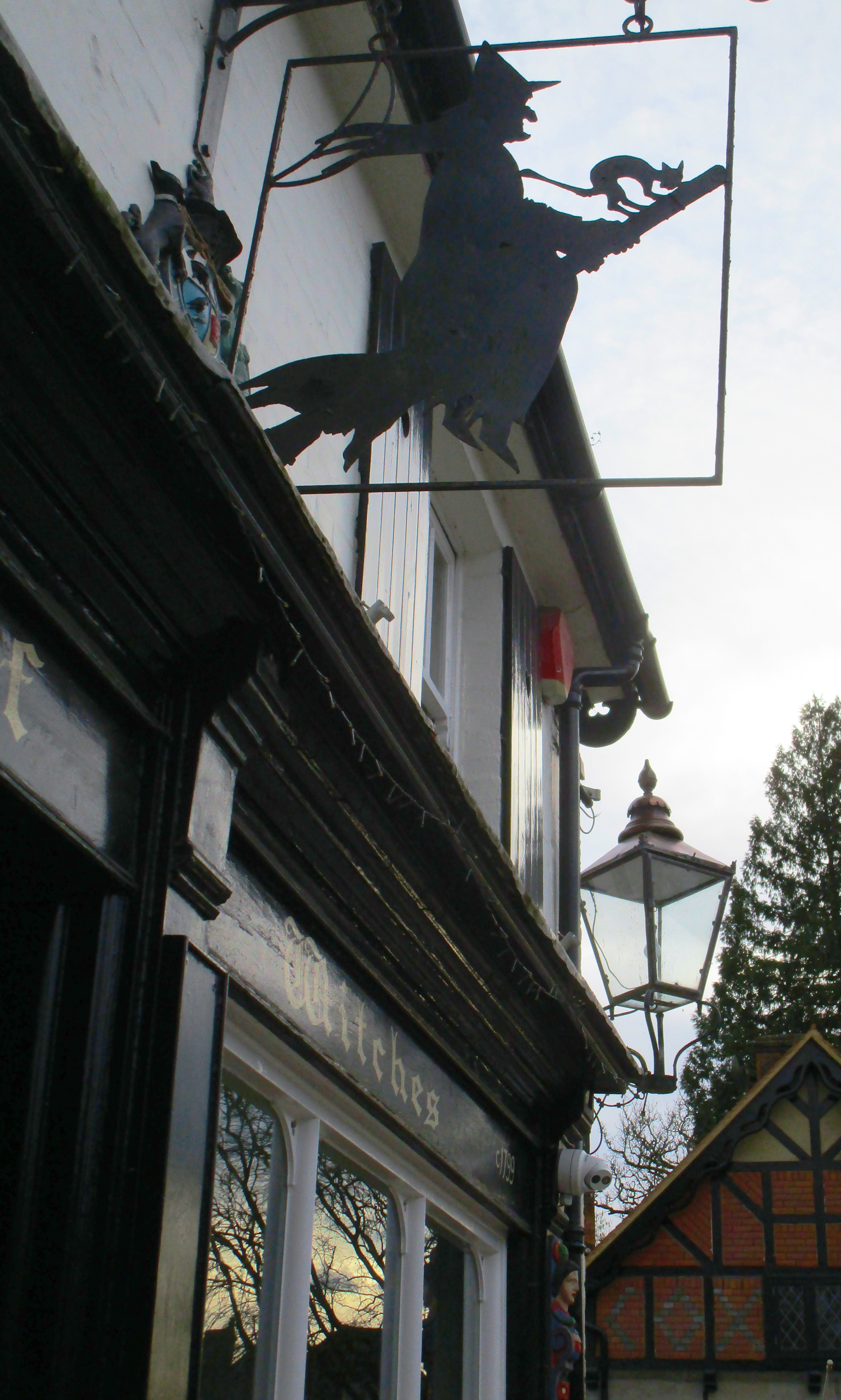
On my way back from a visit to my Mum in Dorset I called in at Burley in the New Forest, a place I haven’t visited in probably 35 years or so. It’s an odd sort of place: most of the dwellings are at some distance from the t-junction around which the centre of the village is organised, and as New Forest-style ‘commoning’ is still practised locally you can often come across ponies wandering around (though I didn’t). Two pubs, several tea shops, a couple of spas, a cycle hire outfit and a grand mock-Tudor mansion now turned into a hotel make for a collection of businesses largely orientated around tourism, or other sorts of visitors. But what most strikes the tripper to Burley (or this one, anyway) now is how witchy it is.

In what’s effectively two short streets there are four, or maybe five, witch-themed gift shops: it depends how you categorise ‘Away With the Fairies’, which has more of a fairy theme though it does overlap with the other four – ‘Witchcraft’, ‘The Sorceror’s Apprentice’, ‘Cobwebs and Crystals’, and ‘A Coven of Witches’. The last-named is the oldest store, beginning as an antiques shop run by the person responsible for all this, Sybil Leek. Ms Leek lived in Burley from some unspecified time until 1964, a familiar and flamboyant character often accompanied by her pet jackdaw, Hotfoot Jackson. In his history of wicca The Triumph of the Moon the great Ronald Hutton gives short shrift to her claims to have been trained by Aleister Crowley, or even to have met him, and even less to her historical sense, quoting a sentence ‘which manages in twelve words to confuse a nineteenth-century personality with a seventeenth-century one, and locate both in the wrong period’. Sybil Leek worked for a local TV station and for a brief period was able to promote herself as Britain’s chief spokesperson for witchcraft, before falling out with almost everyone else in the wiccan world, claiming she was under attack from Satanists, being evicted from her house in Burley, and relocating to the USA.

The stores share a family resemblance – they all have the same racks of crystals and incense and other knickknacks – but differ subtly from one another. At Cobwebs & Crystals, amongst the bottles of charged crystals and figurines I observed a vintage plastic telephone for sale not far from a small articulated toy of Matt Smith as the 12th Doctor, while Coven is clearly catering for the serious wiccan practitioner as it sells altar tables, cauldrons and wands (the kit’s small as I suppose it has to fit in teenagers’ bedrooms a lot of the time). All those items are seriously kitschy but there’s a certain seductiveness about the whole aesthetic, which overlaps with Goth although not identical with it.

In my long-distant memory Burley majored more on saddlery and leather goods, and although the witchcraft connection is clearly longstanding, it’s intensified in relatively recent years. Those horsey shops have been replaced by witchy ones, and it would be an interesting project to trace exactly how it has happened.


On the way out of Burley I stopped and walked down a muddy track to pay my respects to the Lady Well, which I certainly hadn’t seen since 1987. It hadn’t changed at all, which was a bit disappointing as I thought someone had tidied it up!

Monday, 2 September 2024

We Do Things Differently Now

Usually the safeguarding training I'm obliged to attend is run by the Diocese, but today I was at a school-based session. It wasn't compulsory, but as our parish school begins its adventure of being joined with a secular school locally I thought I would come along to show willing. The outlines are the same, but whereas in a church setting safeguarding focuses on the supervision of children and vulnerable adults, safer recruitment and the occasional interactions with children which characterise the life of most churches, in a school setting everything's all the more intense - you deal with children all the time. 

Topics came up that edged around the core of what I normally understand as safeguarding, and into areas to do more with wellbeing and welfare: drug use, underage vaping, online bullying, and so on. The contrast with my own schooling in the 1980s struck me. The teachers at my provincial boys' state grammar school were mainly decent sorts, but they saw their job as keeping order and delivering lessons. Quite apart from the tendency of some members of staff to involve the use of projectiles to carry out these basic tasks - I suppose the woodwork master must have worked out how to throw a chisel across a classroom so as to minimise the possibility of serious injury - there was really very little interest in what happened outside the school. That just wasn't its concern. Even on the premises, beyond the classroom we were left to our own devices, and the school was pretty much a feral environment of persecution, low-level violence and cruelty. I think any suggestion that anyone should look for signs of pupils being unhappy would have been met with incomprehension: of course they were unhappy. Misery was built into the experience. Even in the early 2000s, a friend told me when I talked about this, her own grammar school turned a deliberate blind eye to the difficulties she was having at home. Someone else's problem. 

It occurs to me that this is a colossal change that has happened over the last couple of decades: how the life-experiences of children has become the business of schools in particular is remarkable and would be worth someone studying properly.

Tuesday, 6 August 2024

Asking the Question

If you listen to coverage of the violent riots and disturbances disrupting various English towns and cities at the moment, one of the more powerful sentiments expressed by people who form the crowds that eventually turn nasty – whether they stick around to take part or not – is that they were never asked whether they wanted their country to change the way it has. They weren’t consulted about it becoming multiracial, multicultural, or however you want to term it, and have ended up in an unsettling and unfamiliar place, or at least that’s what they think. There are many sorts of perceived hurt and neglect behind this – as William Cobbett famously said, ‘I defy you to agitate any fellow with a full stomach’ – and, were anyone of progressive opinions ever to have a conversation with someone who thinks it, you might want to explore whether those changes have actually had any negative impact on their wellbeing at all. But put that aside for a moment. On the face of it, the complaint is true: the UK has never formally asked itself what kind of future it preferred. True; but that’s because it couldn’t have.

The biggest changes within a society are never consulted about, mainly because we don’t know they’re happening, and by the time they have it’s too late to do anything about it. We look back and, contrasting where we are now with where we were once, we can characterise the change in a single pithy phrase such as ‘multicultural society’, but we can only do so in retrospect. In retrospect, we might be able to identify a symbolic point when the shift, whatever it was, began, or even when it had taken effect. But it’s precisely that perspective that enables us to do so.

The UK was never asked in about 1962 whether it wanted to become a society in which Christianity was marginalised from public discourse and influence. The UK was never asked in about 1980 whether it wanted to move to an economy significantly powered by property price inflation with all the attendant social problems. The UK, and the world in general, was never asked, when the building of the Old Forge at Coalbrookdale in 1709 began the Industrial Revolution, whether it wanted to begin the process of exploitation of fossil fuels which would, possibly, threaten the continued existence of our civilisation. All the biggest changes that affect us are never consulted on, because we never see them happening. As far as a multicultural society is concerned, we could stop immigration tomorrow and it wouldn’t change what Britain now is, with 12% of its population non-white and an increasing proportion mixed-race. Nobody is going to undo that. During the Brexit referendum campaign, my spiritual director overheard an elderly couple talking at a bus stop and complaining that though they couldn’t see a GP it would get better once we were out of the EU because there’d be so much more money to spend on the NHS, ‘And then’, the old chap said to the old woman beside him, ‘we can start sending the darkies back’. ‘Of course’, commented the half-Indian Ms Formerly Aldgate when I related this to her, ‘because that’s where the darkies come from, Romania’. That absurdity reveals the fantasy of return to the past for what it is.

In a way, the question is asked, but it’s asked in a million tiny decisions rather than one big one. It’s asked, and answered, in the individual choices people make, and in the election of governments who don’t do anything to reverse the movement in a particular direction. As far as race is concerned, we had an opportunity to choose a National Front-dominated government in the 1970s, but chose not to elect even a single MP. Sometimes, and this is far worse, a government suggests in its rhetoric that it’s going to reverse something, it will, for instance, ‘Stop the Boats’, and then doesn’t. In that specific example there’s little excuse because there were plenty of people telling the last administration that it couldn’t succeed, which raises the question of whether it was pure cynicism or the ministers concerned managed to convince themselves that they meant it. Either way, they now find the phrase thrown back along with bricks and bottles.

Sometimes, there is indeed a moment when a society is asked a question that marks a decisive move in one direction or another. In 2015 and 2018 the people of the Irish Republic voted to legalise same-sex relationships and abortion, marking an unmistakable shift away from being a conservative religious country to being a secular liberal one. But it’s worth noting that the very majorities achieved in those referendums, about two thirds to one third, proved that the shift in attitude had already happened. I recall Malawian comedian Daliso Chaponda remarking that the UK should have learned from Africa ‘where we only ever have a referendum when the government already knows the result’. The joke has a good point: referenda whose outcome is uncertainly close don’t bring any debate to an end. The only sensible referendum is one that confirms what people already think.

You could play a game, maybe, as to what symbolic question you could ask the British public to make them feel they had indeed been consulted over whether to remain a multicultural society. Finding one that would simultaneously be both meaningful and yet bound to be answered one way would test anyone's ingenuity. But, if the research is correct to show that the British at least want to be liberal about immigration more than virtually any other country, it wouldn't break it. 

Thursday, 14 March 2024

Bottom Up (or another part of the anatomy)

The Deanery Chapter gathered yesterday to hear the head of the Mission Department at the Diocese talk about lay ministry. That's what the deanery secretary had told us, but he didn't, except in passing. Instead he said he was there to 'begin a bottom-up conversation about how we resource parish ministry in ten years' time'. 'I want to record these conversations', he went on, putting a small flashing device on the floor, 'and I'll feed it all into an AI processing program to pick out the details later'. That made sure most people didn't want to contribute anything at all. He outlined his impression of the pressures on parishes, particularly in terms of finding laypeople to fill important roles, and suggested that we were working within a structure designed for a time when 45% of the population was in church on a Sunday at a moment when that figure is more like 1.5%. The diocese would work with parishes to try to provide for the continued existence of worshipping communities into the future, 'developing creative solutions tailored for local circumstances', etc. etc. It would all have sounded more convincing did we not know that the parish of Manton, which fell vacant just before Christmas, has already been told there's no question of their previous full-time incumbent being replaced and instead they will have someone on house-for-duty. Bottom up? Certainly, if you'll excuse the vulgarity, the phrase 'my arse' comes into any response. 

Still, there's a serious question to be asked about the pattern of Anglican church life in a choppy and uncertain future. As some of my colleagues complained, worshippers simply will not willingly be relocated from one church to another, even for a Sunday, and the reason for this is not just cussed awkwardness but because their experience of Christian community, and therefore of Christian discipleship, is deeply linked to a particular place. 

The point is that we are called into community, and that community, the group of people with whom we journey and experience what it means to be Christians, has to have a degree of continuity over time. It has to be deep and committed, especially because, in the Catholic way of looking at it, it isn't something we fundamentally choose ourselves, and Christian churches are not primarily voluntary associations of people who come and go as they decide. We acquire obligations and those obligations shape who we are becoming. We enter into a something which existed before us and will exist after us. The primary way the life of the Christian community is shaped is the action of the Holy Spirit through the sacraments. Each community is eucharistic and baptismal; each community hallows time through the rhythm of its daily prayer. 

Signs of continuity are not absolutely necessary, but they are helpful. They include the buildings we worship in, which acquire their own personalities. We have a relationship with those physical surroundings and they come to shape our spiritual lives and imaginations. Ordained ministers are another sign of continuity because they are sent into the community from outside it, and occupy an office in a visible sequence unfolding across time. Bishops are the paramount mark of the continuity of the Christian community, linking together individual, local communities into an Apostolic lineage. You can imagine Christian communities persisting without historic buildings or ordained leadership, but their presence makes continuity easier to maintain. Without them, they may well drift in many directions, and the task would be all the harder. 

Sunday, 3 December 2023

Changing Times

Keeping with the principals of theological colleges, Fr Robin Ward of Staggers lately posted a link to this video of Pope John XXIII being carried to St Peter's in Rome for the inaugural mass at the start of the Second Vatican Council in 1962. What a glimpse into a long-past world. John's successor Paul VI was also borne aloft on the sedia gestatoria and fanned with ostrich feathers on ceremonial occasions with visibly less and less enthusiasm, until John Paul I refused to use them, only being persuaded to be carried on the sedia by the argument that people needed to see him, provided he could dispense with the rest of the regalia and just wear a plain white cassock. John Paul II got rid of it entirely and you simply can't imagine a pope using it again. 

But why can't you? Benedict XVI revived lots of bits and pieces of old papal kit that his two predecessors had dispensed with (including things John Paul II had gradually discarded over the course of his long reign). Here, he can be seen wearing Pope John's mitre and mantum, visible in the video from 1962 - except that the mantum has been shortened and reduced to the dimensions of an ordinary cope. Lots of trad-Roman Catholics (and the Anglo variety, too) would be very excited to think it might all make a comeback one day. No, this kind of prelatical ceremony is inconceivable now because it belongs to a version of religion that Christians have moved away from, and it's worth thinking about what is going on here, in emotional terms.

When I first saw the film, I, even I, pursed my lips in a slightly Protestant way and found myself wondering where Jesus might be in it all, what he would make of such a spectacle if he was among those watching crowds. The interesting retort to that is that this is Good Pope John being carried through the throngs flanked by ostrich feathers and surrounded by men in Renaissance uniforms: Angelo Roncalli, the peasants' son who became pontiff, and who we know was one of the humblest and holiest souls ever to occupy the throne of St Peter. He's doing it because it's part of the job. His jewelled mitre is uncomfortably rammed down on his head making his ears poke out; he's tired and even after mass has to go through the business of having his gloved hand kissed by a succession of bishops and heads of religious orders: for each of them it's a special encounter, but for him it's one in a long, long chain of bowed heads. The pomp itself is not the issue. 

The point to remember is that there's nothing religious about the grand spectacle of the papal procession, whatever might have happened in St Peter's afterwards. Before the age of film or photography, only those present would have had any idea of its existence: the audience for such an event were the people of Rome, watching their head of state in his pomp. It's essentially monarchical. If there was any kind of Christian element, it would have been the gestures of blessing His Holiness made to those on the ground. But after the Papal States were lost (around the same time, coincidentally, that it became possible to transmit images of such ceremonies around the world) it became something else - a way of declaring and dramatising Catholic identity. One poster on LiberFaciorum commented on the film 'This was spectacle - on the scale of Cecil B DeMille when I was little - 6th grade I think. It was awesome and edifying - the school sisters were filled with anticipation - we prayed for the Council - it was epic for me'.

Certainly this is what it looks like from the video; but as in any such occasion it might feel different to experience it in person. Noise, difficulty in seeing what's happening, discomfort of various sorts, indigestion distracting you from the thoughts and reflections you're supposed to have: we're well versed in the distance between image and reality now, and are a bit wry about it. 

Perhaps this why we've become very unused to expressing our sense of self-hood, even when it involves being part of a wider group, through this kind of grand spectacle. It's not just a matter of taste, or even the individualism which leads us to prefer the small and local. At least partly, it's because we know, deep down, that it doesn't really work.  

Sunday, 19 November 2023

Objection

There are many occasions when I take great comfort from not following the debates of the national Church in any detail: there are plenty of strains and stresses in ministry and life generally without adding to them, and my only interest in Synodical acrobatics is in how they might impact on what I am called on to do or not do. So there are many people more invested than me, for differing reasons, in the Synod vote this week to go ahead with experimental services to pray for, or bless, relationships in which both partners are of the same sex. I’m not entirely sure how it’s decided which measures do or don’t require an Act of Synod to enact: the admission of women to the ministry did, which was why two-thirds of Synod members had to support each measure, whereas this current change only needed a simple majority in each House of Bishops, Clergy, and Laity. And the Bishop of Oxford’s amendment to the effect that blessing services could be separate events rather than incorporated in other acts of worship only squeezed through by one vote in the House of Laity. Although some of the votes against might well have been cast by Synod members who would have preferred to go further than the proposal on the table, this isn’t a consensus, whatever else it is.

The Church of England Evangelical Council is now exploring ways of supporting dissenting clergy ‘who in some way might feel their membership of the CofE to be compromised’, including feeling unable to relate to their bishop on anything other than a legal basis. This is clearly inspired by the similar arrangements that have been in place for many years for trad Anglo-Catholics opposed to the ordination of women, but it’s odd, because Evangelical objections to these changes to do with sex arise within a different sort of ecclesiology. For those trad Anglo-Catholics, the Church itself, including its organisational arrangements, is the creation of the Holy Spirit, and fundamentally altering those arrangements is, arguably, cutting the organisation off from the Paracletal electric current. It’s not just about cohabiting organisationally with people you disagree with. But Evangelicals don’t think about the Church in that way. If you’re an Evangelical Anglican, your relationship with God is direct. It doesn’t make any fundamental difference to you what the church down the road does, or what your bishop believes. Your bishop’s opinions are probably massively divergent from yours already. It may be uncomfortable that she, or that putative church a few streets away, might be blessing or even eventually marrying same-sex couples, but you will still have the option of regarding them with the same derision and contempt that you probably do now. You may find it awkward that a same-sex couple might turn up to worship with you (though they’ll probably steer well clear), but they could easily do that already. No, my brethren who take a more conservative view on this matter won’t be forced to do anything they don’t want to do, and neither will I, so, as I have no interest in compelling anyone to fall in line with what I think, my sympathy is really very limited.

++Justin is clearly very content that he abstained on the vote, ‘to act as a focus of unity’. This too is modelled on the way the Church has accommodated trad Anglo-Catholics over women, and again it shows the same kind of misconception. A trad Anglo-Catholic objects to a bishop (or Archbishop) who has actually ordained a woman, not because that prelate thinks ordaining a woman is right or wrong: it’s not a matter of opinions, but of deeds. Evangelical objections are precisely about opinions, and we all know what the ABC thinks. That's why, I imagine, sundry Christians might find him hard to talk to from now on, if they hadn't before.

Wednesday, 15 November 2023

Reviewed

Every two years we clergy go through a Ministerial Review. I think that as one of the dwindling band of incumbents with freehold, technically I don't have to do this, but in theory it's a useful occasion to try and allow the kind of outside scrutiny of your ministry which would be absolutely standard in secular life but rather rarely happens in the Church, so I have. Reviews have, as far as I'm concerned, never been that helpful; the results have been vague and while supportive not made for any forward movement. I wasn't expecting much better this time round when I asked the churchwardens, the head teacher of the infants school ('a representative of the local community') and Giselle the lay reader ('a colleague in authorised ministry') to send in their forms to the retired canon who's moved into the diocese and agreed to do this kind of work. I wonder if they're paying him or expecting him to do it for free?

In fact I came away from the canon's nice house on the road into Guildford more enthused than I started. He'd picked up on my hankering for some kind of conversation with someone outside the parish to assess what I'm doing inside it, and perhaps deal with the endless nagging suspicion that I'm missing something. We also talked about faith-sharing and the potential of Forest Church - and what happens in the future. How exactly might I assess whether I still have work to do in this parish, or ought to be somewhere else? There will be a point at which a move will become unrealistic; it will be too late. I ought, at least, to face the question. 

Monday, 14 August 2023

A Sense of Purpose

Delving back into the history of the Church of England reminds me how we have always, it seems, believed that British society wanted less to do with us than we might wish, and how sour we felt about it. A little while ago I described poor Fr Francis Wheeler of Wheatley & Farnborough and his Primer of Pastoral Theology which assumed, even back in the 1940s, that the flock assigned to him by Our Holy Mother the Church would be mainly unresponsive, tempted by the fleshly pleasures of modernity to spend their Sunday mornings doing other things than following Mattins in their copies of the Prayer Book. Then, last week, I came across a small card given to new godparents, shoved into the pages of an old service register book from the 1920s. Hectoring and miserable, its tiny type demanded of its readers, ‘Do YOU mean the promises you have made? Or will you forget them like so many?’; it clearly assumed that most people would not want to observe their obligations, and would not in fact do so, that they would prove false and feckless. To encounter this kind of Church was to be plunged into the dank, chilly air of depression and condemnation, to be told right from the off that you had no right to be there and should be grateful for the opportunity. It was a form of religion that only stood a real chance of sweeping up the self-righteous and the neurotic.

And curiously I find few expressions of this discouraging outlook which really seem very spiritual. Instead the concerns of the clergy who voice it, like Francis Wheeler, seem more to do with moral decadence and the refusal of so many people around him to conform to his idea of what good citizenship should look like, rather than, for instance, the fate of their eternal souls. It seems to be very secular worries that really animate them. I remember speaking to Dr Bones’s father about his own dad, a priest in rural Devon in the 1950s, who, he said, ‘saw his role as making people good and useful members of society’ (Bones père became a fundamentalist Evangelical in contrast). No wonder the Church of England’s experience of the last century has been so disappointing, as it’s watched most people find perfectly serviceable ways of being good citizens without any reference to what it might do or say.

The myths Christians tell themselves are legion, if I may put it in those terms. One of my favourites is that ‘the blood of the martyrs is the seed of the Church’, a line which goes back to Tertullian. I am rather fond of quoting Tertullian’s credo quod absurdum est, but semen est sanguis Christianorum ignored the truth both in the third century and ever since. Christians were a tiny, disregarded minority until Constantine converted; and, across the centuries, from Roman North Africa overrun by the Umayyads to Moorish Spain to 17th-century Japan, to crush Christianity out of existence by either bloody persecution or social pressure short of it has proved a matter of relative ease. Again, modern Christians tell themselves that the Church flourishes most when it is at its most counter-cultural, but Dame History tells us something different: that Christianity is at its most popular when it reflects, by and large, the values of the culture it inhabits, and especially those of the class in charge; if ‘popular’ is what we want to be, of course. We might well wonder what difference we really, truly make to the society around us.

If most of us have abandoned the belief that the people around us (in any uncomplicated or predictable way) are going to Hell unless they’re in our churches; and the lesser, etiolated idea that Britain (in any uncomplicated or predictable way) will go to Hell in a handcart unless people are in our churches; what, then, brethren, is left? Where can contemporary Anglicans find the impetus to get out of bed and go down to the steeple house to say Mattins in the morning?

I recall Dr Bones’s statement, when I was approaching my ordination, that ‘You’ll be spending your time helping people enjoy their lives’ which, considering her background, was a remarkable thing to say. It’s always remained with me: because a life lived in alignment with the cosmic truth must be more capable of enjoyment than the alternative – not in a superficial, consumerist way, but in the sense of deep fulfilment and peace. Sometimes as I prepare myself for the Eucharist I look out of the vestry windows on the souls going past on the path that runs alongside the churchyard, and think how sad it is that they aren’t hearing the words that tell them they are flawed but loved, that their joys and sorrows are heard, that they are capable of glory, and that glory wants to welcome them.

Is that enough? Is it too close to self-centredness and self-help? What else might there be, once threats, guilt, and utility are sent away?

Tuesday, 4 April 2023

Informality Rules

This is a scene that can’t happen now. In 2013 we hosted the Town Council Rogation service that used to rotate around the local Anglican churches, the last time we did so before it lapsed into desuetude. It can’t happen because a few years ago the Councillors, faced with the cost of replacing their ceremonial robes which were running to the threadbare, opted to get rid of them instead. Hornington was, it was pointed out, the only town for some distance whose Council retained its robes, and you can see why it might seem very indulgent to buy a whole set of new schmutter when there are always rather bigger demands on the public purse. The officials – the Mayor, Town Clerk, and Sergeant-at-Mace – are now the only ones who have any special kit.

Rogation was always a rather eccentric observance, but when the Councillors abandoned their robes it made it less likely that they would want to do anything corporate in public at all. Today I was talking to some of the Council staff about what might happen at Christmas: last year Town Carols was a very lacklustre affair in a municipal hall, so the churches would like to revert to the civic occasion it was pre-Pandemic, gathering at the Market House in the High Street and then processing down to the old parish church. The trouble is that without their gear, the Councillors are just a bunch of people in suits, not so much processing as ambling in a fundamentally unimpressive way. In an increasingly secular world they might not care that much about Christmas, but then we have events such as the Jubilee and the Accession Proclamation last year, and rare though they are, our elected representatives certainly care about those.

And I think it’s their role precisely as representatives which is relevant here. The councillors aren’t only technocratic managers of a local authority, elected to carry through a particular set of policies: they also, by appearing en masse at a few very formal occasions, show what a community thinks is important, and some kind of distinctive dress would seem to be an element in that. It says, This group of people aren’t just a random rattle-bag of individuals, they have a role, and a relationship with you, the electors and onlookers. You might just be able to think of other folk in fancy dress to whom similar statements might apply.

Sunday, 13 November 2022

Children Present and Absent

Messy Church at Swanvale Halt has been severely impacted by the pandemic, though we aren't entirely sure why this should be. Our numbers were steady right up to the very last gathering in March 2020, and now we are getting roughly half what we could expect before the Great Disruption. Some attending now are new, some are the families who were coming before, but there are just fewer of them. Saturday's theme of 'Holy Fire' chosen by the team was a bit of a challenge to try and illustrate in my worship time, but I gave it a go and I think everyone was happy even if I didn't end up actually lighting a fire. Today Poppy (rather appropriately) joined the serving team for Remembrance Sunday and her plus two children present with another family meant we had more minors present at an ordinary Sunday mass than for a long time.

We've long since given up trying to do any traditional Sunday-School-type children's work, having tried so many configurations over the years. On Wednesday my colleagues in the Deanery Chapter shared their woes in the same area. Even the big, well-organised evangelical Tophill finds that its numbers of children have halved since the pandemic, and its vacant children's and families worker position is one of thirty-seven across the diocese. At Caringfield Rector Rebecca can't find anyone to fill her similar job, despite offering to juggle it to fit applicants who won't work with primary school children, or secondary, or work this or that time. She's propping up all her groups herself by doing all the preparation and organisation: 'I have just enough to make these groups viable in the hope that eventually someone will take them on before I go under'. At Wormton they had a very flourishing Sunday School but now can't tell whether they will get a dozen children or two, and I didn't feel like warning them that's exactly what happened to us: after few weeks where the children themselves can't be sure any more than a couple will be there, they will stop wanting to come at all. It's no fun with just the two of you, or even three. Meanwhile what parents expect, my colleagues think, is the level of children's work they are used to from schools, and there are very, very few churches who can provide that. 'Our outreach has gone back by ten years', said the vicar of Wormton. I think we are moving into a new and very different world, and there will be no going back to the old one at all - but that nobody really knows what the new will be like.

Friday, 28 October 2022

Major Considerations

The Vicar of Tophill and the priest-in-charge of Hornington described for the meeting’s benefit the process of establishing the new ‘minster’ parish that will cover them both. When we last mentioned this here, some of my readers expressed a degree of scepticism over whether the term ‘Minster’ was really applicable to Hornington church which is a sprawling and very badly organised parish church rather than anything grander. His Grace of Tophill stated that ‘minsters’ were often former monastic churches and Hornington qualified partly due to once being a Benedictine monastery. I don’t know where he got that from: it may be scrambled from the fact that there was indeed an Anglo-Saxon ‘minster’ there, but those were not always monastic and not always very big either. He outlined the current requirements for a church to be designated as a minster. The trouble with this is that what he’s talking about is not actually ‘minster status’ but ‘major church status’, something which I think has existed since about 2020. This seems to have developed from, and is still tangled up with, the notion of a ‘Greater Church’ which is about thirty years older.

In 1991 a group of big and historic churches, often former monastic ones, which were of a near-cathedral size (and in many cases bigger than small cathedrals like Carlisle and Oxford), but lacked the recognition and resources available to cathedrals, set up the Greater Churches Network to swap ideas about fundraising, marketing and management. There were more in some areas than others: Dorset had three (Sherborne Abbey, Christchurch Priory and Wimborne Minster), but Surrey, none at all. The GCN trundled on for a couple of decades and then in 2016 the Church of England issued a report discussing the idea of the ‘Major Church’. To be designated ‘Major’, a church had to fulfil several criteria: it had to be more than 1000 square metres in size, be Grade 1 or 2* listed, to have exceptional historical significance, and a role beyond that of an ordinary parish church. When the GCN dissolved itself in 2019, it had 55 members; the 2019 report had already identified 300 ‘major churches’. Not all were as big as the former ‘Greater Churches’; not all were even very old, as the number included Fr Gresham Kirby’s modernist gem St Paul’s Bow Common. It’s this designation which Hornington is being proposed for, rather than the courtesy title of ‘Minster’ which doesn’t really mean anything and which certainly carries no legal status whatever; you’d have to be very imaginative indeed to describe St Paul’s Bow Common as a ‘minster’. As I mentioned, the GCN is no more, and is now the Major Churches Network, and designated Major Churches can apply to join it (though its membership is still only 65).

It seems clear that Major Churches are just one element of a Church in a state of flux. It might be that they could indeed develop into being something like the Anglo-Saxon minsters, centres for Christian activity locally, with dependent daughter churches or communities, and organising and galvanising bodies for mission; but that’s not what they are yet. They would need to work out the boundaries between that kind of activity and the strategic role deaneries are supposed to be developing, and what happens to those churches who find themselves in the region of a Major Church with which they are out of sympathy ecclesiologically? That’s likely to be the case with Swanvale Halt and Greater Hornington. It only makes the £300K the Diocese is giving to the putative new ‘minster’ for additional staff grate all the more. If there’s that kind of money to be given away, I could make use of some!

Wednesday, 7 September 2022

A Matter of Choice

The proposal that the old town centre parish church in the probably-to-be-merged parish of Hornington and Tophill next door to Swanvale Halt be referred to in the future by the ridiculous title of ‘Hornington Minster’ is merely annoying: a more troubling aspect was brought to my attention yesterday.

Every Anglican parish has a patron, the person, or body, who has the right to propose someone to be its vicar or rector, a system which goes back to the early Middle Ages when the system of parish churches was first established; before the creation of Parish Church Councils representing the laypeople, the patron merely appointed the incumbent, and the right to appoint to a rich parish was well worth owning. When partisan activity in the Church was at its height in the late 1800s and early 1900s the societies set up to promote various aspects of either the Anglo-Catholic or Evangelical position gaily bought up ‘advowsons’ – the patronage of parishes – to embed their own viewpoint. The trade in advowsons came to an end in 1924, and, especially in rural areas where churches have been yoked together in multi-parish benefices, patronage is now often a complex matter, a patchwork of religious societies, Church authorities, Oxbridge colleges, and private individuals; Fr Barkley’s patron in Yorkshire is the local Lord of the Manor, while Il Rettore’s in Lamford was the Lord Chancellor. Since the foundation of PCCs representing the laity, the PCC has the ability to reject a candidate for the incumbency – not that it would be advisable for them to do it too often.

I learn that the patronage of the putative united parish of Tophill, Bramblecombe & Hornington is to be passed to the Church Pastoral Aid Society, an Evangelical missionary society which has been around since the 1840s.  Now, the last appointment to the united benefice of Tophill and Bramblecombe, just after I arrived in Swanvale Halt, was made by a patronage board including the Archdeacon, the Area Dean, the Lay Chair of the Deanery Synod, the PCCs of the two churches, and the Martyrs Memorial Trust; the MMT – like Simeon’s Trustees, another Evangelical body – has handed all its patronages over to the CPAS which explains their involvement. But the patron of Hornington is the Bishop. The proposal for the CPAS to take over the wholesale patronage of the entire united parish is presented in the form of a request to the Bishop to surrender his interest in Hornington, and as a tidying-up exercise. But, although our current Bishop is an evangelical, his successors might not be, and the removal of the Bishop effectively disposes of any non-evangelical influence in the appointment of a new incumbent.

Of course it makes me think about Swanvale Halt’s position. With the exception of Thorpe, whose patron is Keble College; St Augustine’s Aldershot, where the Bishop and the Society for the Maintenance of the Faith appoint the incumbent jointly; and the Clandons, where the Bishop and the Earl of Onslow alternate to make appointments, all the remaining Catholic parishes in the diocese are pretty vulnerable. Our patron here is the Bishop, making another reason for me to stick around to see whether Guildford Diocese is abolished and merged with a more congenial neighbour. I wonder how the Bishop would react to a suggestion from our PCC that he ‘surrender his interest’ in the patronage in favour of, I don’t know, the Guild of All Souls?! 

Thursday, 4 August 2022

Intimations of Mortality in a Leading London Gallery

The idea was that I would meet S.D. at Tate Britain, but at first we managed to miss one another – I had, inexplicably, the wrong time and the wrong entrance, and at one stage we were both waiting for one another in different places. Neither of us had a mobile number for the other! But we did coincide eventually, and began our lunch in the Tate cafĂ© rather hungrier than we intended to be. S.D. had a triple-bypass operation earlier in the year and two cataract removals, so feels a bit fragile and is having to get used to pacing himself rather more than usual. ‘I’ve reached the point where getting through each day, and then waking up in the morning, counts as a success’. I admitted I already felt like that, and that it would be better to leave something to look forward to in the future.

S.D. is covering for one of the Canons at Westminster Abbey as Canon in Residence (‘I only have to  read the first lesson at Mattins and Evensong, and be on hand in case the place burns down’), so as he left I looked round the shop. On the way we passed the Tate’s monumental current installation, ‘Procession’ by Hew Locke, a witty and thoroughly scary investigation of politics and social identity through something that looks like a religious event (‘Just like St Mary’s Bourne Street’ – that’s S.D., not Hew Locke) but with no liturgical content.


Usually I can be relied on to leave a gallery or museum shop with a handful of postcards but I thought 85p was a bit cheeky. I looked at the books. At the moment, as far as books are concerned, I am battling my way through three: Andrew Hickey’s The Mind Robber (one of Obverse Books’ ‘Black Archive’ volumes about individual Dr Who stories), Brian Bailey’s Great British Ruins from 1984 (a nice easy come-down bedtime read), and Airhead by Emily Maitlis, recounting the real experience of being a leading BBC news interviewer. I only got hold of that because there was a pile of copies in one of the churches I visited recently, with the instruction to take one away for free, but it has nice, short chapters and is physically light, making it an ideal train read – and very revealing of Maitlis and her interviewees. In the Tate shop there were hundreds of fascinating titles I would like to read, but I know I never would (I congratulated myself for owning a couple already). Analyses of colonialism and feminist art, of cultural trends and social phenomena: some of these are important, and in fact they might change the way you look at the world. Most of them will have been laboured over with commitment and dedication. But who will read them? Will they happen to find their way into the mind of someone who might have their worldview shifted by them, might as a result go on to do something which would affect their own life and others’?

It is no surprise that at my time of life I might think about what I have done with it. I know I’ve wasted a lot of time, but am I wasting it now? I’m not necessarily haunted by the thought that I might not have gone to the right places, had the most worthwhile experiences, or read the most enjoyable books from the Tate shop: that’s a consumerist approach to life I don’t endorse. But have I produced the most worthwhile things? Who will have listened to all my sermons, or read all the things I have written? I know what Father Somerset Ward would say, which is that our main concern should be to pray, so that our minds can be shaped after the mind of Christ: that there is no other way of pouring our own contribution into the life of the world that goes with the flow of the heavenly will. One can hope!

Wednesday, 18 May 2022

Discerning the Spirits

It's been a long, long time since we had a meeting of the Local Vocations Advisors, and even the prospect of nice sandwiches in Church House yesterday lunch-time couldn’t drag out more than three of us in addition to Ciaran the Diocesan Director of Ordinands and Tina who co-ordinates the whole process, matching enquirers up with LVAs and making sure all the right bits of paperwork are filled out. But, as she ruefully pointed out, while the number of LVAs on paper is quite healthy in fact quite a few of those aren’t at all active, and there’s a distinct geographical imbalance with most being in the east of the diocese (‘I suppose they’re just holier over there’).

The discernment process is undergoing quite a change, with what was once the scarifying ritual of the ABM or BAP or whatever it was called at the time you went through the process – a residential ordeal of interviews, exercises and checking whether you tried to eat your soup with a fork, as Fr Gooley maintained someone at his did – now split into two. The first stage will be done online, a quick-fire series of conversations with different interlocutors now focusing on the ‘six qualities’ applicants are supposed to evidence, which we couldn’t resist comparing to speed-dating.  The second is more like the traditional way of doing it but with an effort to make it less like a university entrance exam. In between comes a very in-depth examination of where an applicant is in personal and spiritual terms, questioning everything from sexual habits to substance abuse. It crosses my mind how legal some of this might be – the kind of thing, in normal circumstances, any prospective employee would be justified in telling the organisation they were applying to was none of their business – but somebody must already have thought about that, surely? The intention is clearly twofold; first, to do something to diversify the base of ordained ministry away from middle-aged, middle-class people who are used to writing essays, and second, to try and make it less likely that deeply damaged souls will be let loose on the Lord’s flock without at least flagging up ‘areas to work on’.

People sometimes complain that the modern Church is becoming too homogenous and we have lost so much of the creative eccentricity that made it work in the past. I suppose there might be some hazard in expecting people to have got themselves completely sorted as human beings before they begin their ministry: even for the ordained, a degree of holiness is usually a hard-won prize reached after years of pursuing the spiritual life, not a base position from which to start. Here I am, 52 years from my baptism, 27 from my conversion, and 17 from my ordination, and I’ve barely begun. At the same time, you don’t have to delve very deeply into the history of the Church of England, or any denomination, to come across lots of ordained people who were not just flawed souls (as are we all) but broken ones who then went on to damage others, and the tremendously laissez-faire process of discernment in the past barely did a thing to stop that happening. We were very often sending out pastors who would not so much reap the Lord’s harvest field as burn it, trample on it, roll around in it, and pee on it. A little less of that is probably all to the good.

Church House is a less bustling place these days than once it was: the axe has cut its way through the diocesan staff and all those meeting rooms and offices still gleam, but are denuded and quiet. I wonder whether the Diocese will stay once the lease is up, whenever that is. 

Thursday, 17 February 2022

Reorganising the Bishops

When he attends Morning Prayer at Swanvale Halt, Donald, the retired hospital chaplain, often brings a subject which is at the top of his mind to throw in my direction, which can be useful as he takes the Church Times and I don’t. ‘Have you seen anything about this latest report on reorganising the House of Bishops?’ he said this week. ‘They’re planning to have bishops as Church spokespeople on Brexit and the like.’ I’d been aware some news of this sort had been doing the rounds as there had been ribald remarks among friends on LiberFaciorum about bishops’ pensions, which related to the same report, but this specific matter was new to me.

The idea of ‘a bishop for Brexit’ was indeed what caught the imagination (and attracted the derision) of the non-Church media, but the actual document turns out to be less crackers and more dispiriting than that. It ponders the role of bishops in the modern Church of England, beset by financial, cultural and organisational challenges, and how the episcopal office might be exercised in a way which meets those challenges more flexibly and effectively. Much in the manner of such consultation documents it throws around a variety of ideas, including shrinking the number of dioceses, ‘enhanced regional structures’ whatever that means, early retirement and fixed terms of office for bishops, as well as those ‘specialist’ bishops to speak into particular topics; and, again much in the manner of such things, it remains to be seen how many of them may survive. The Church Times was mainly exercised by how few people had seen the document – the bishops themselves! – and demanded wider discussion.

There is a theological paper accompanying the document which hasn’t seen the light of day beyond the House of Bishops: its absence doesn’t help dispel the impression that it’s very light theologically, and the trouble is that our current bishops don’t think very theologically. They talk about being pastors but behave like managers. The document has a whole section on ‘missionary bishops’, mentioning the Celtic Church (remember what we said here about St Samson of Dol a while ago) and, in a more modern mode, the role of the Bishopric of Islington which since 2015 has worked rather well in establishing new church communities in the Diocese of London. It even cites the Flying Bishops who oversee trad-Catholic churches as a helpful example. But I am becoming suspicious of the whole language of ‘mission’ which seems to have little practical effect. The paper mentions that ‘leading God’s people in mission’ is part of the Ordinal for bishops, and so it is, but words like this appeared nowhere in the old Book of Common Prayer and crept in to do their mischief when Common Worship emerged in 2000, so we have had two decades of bishops ‘leading their people in mission’ and precious little to show for it. What I suspect will happen is that rafts of new bishops will conceive of ‘leading God’s people in mission’ in terms of writing reports and issuing goals, targets and objectives, not, say, baptising people, preaching, or going to live as hermits in derelict Roman forts like St Samson did; that is, telling other people how to ‘do mission’ rather than, in any remotely practical way, doing it themselves.

Apart from the occasional circular letter I haven’t had any interaction with our bishop in about three years: ‘good thing too’, you may cry, but even given the pandemic, it does make you wonder where the office of pastor pastorum really is.

Sunday, 21 November 2021

Recasting the Past

A zoom down to Dorset to celebrate my birthday brought the chance to revisit two museums which have been completely refurbished over the last few years. The mighty County Museum in Dorchester, which I reported on in 2017, is all but unrecognisable inside. They are understandably keen to recoup some of the enormous cost of the rebuilding, and so not only is there now a rather steep entrance charge but the one-time centrepiece of the whole museum, the Victorian Hall, its galleries jam-packed with miscellaneous social-history collectanea, is now an 'events space' - I could only peer into it and watch it being set with tables for rich people to come and eat at. The new organising space is a colossal Brutalist stairwell with the Fordington Mosaic up one wall, a bit like the Ashmolean's only rougher, with the exhibition areas opening off it: those are sleek and imaginatively laid out, and ever so slightly antiseptic. I know it's churlish to quibble at that, especially when four years ago I was complaining about it being a bit old-fashioned! I wonder whether even more of the collections could be brought out, now there is so much space to display them in. 


I have more invested in what used to be the Priest's House Museum in Wimborne and is now the Museum of East Dorset, as it was my workplace in 1991 and 1992. I was there in the midst of the great refurbishment which marked its transformation from an essentially volunteer-run, somewhat quaint little place to a more professional set-up whose arrangements were shaped around historical and architectural knowledge. Stephen, the curator, had a vision of exploring the very varied history of the building through the people who had lived there, decorating a series of rooms to fit in with those themes based on the fragments visible in them. Expensive handmade mannequins were purchased and displayed. So the entrance area became an old-fashioned ironmonger's; grumpy Victorian Mr Low glowered behind his counter in the stationery shop; in the Georgian parlour, Mrs King consulted with her plumber whose initials had been found on the lead rainwater heads; and in a 17th-century back room an anonymous woman we all called Harriet sat sewing against a background of painted wallcloths based on those surviving in Owlpen Manor. Every day the first and last jobs (which fell to me when I was on duty) were to take down or replace the wooden shutters along the bow-fronted windows: Stephen had had these reconstructed to recreate the 18th-century shop frontage.

Thirty years later and all of this has gone. Mannequins are certainly not flavour of the day any more, notwithstanding how well-made they are; the bow-fronted windows have been replaced by a plate-glass panel. Not only has a lot of the reconstruction been driven by the need to provide a fully-accessible space, but the whole display philosophy is different - instead of a succession of period rooms, the construction of the building is highlighted. Upstairs there is a massive stone fireplace I don't even recall existing, which must have been covered up behind later plasterwork. I can't work out where the Tinsmith's Forge was: it was an horrendous mess, but still part of the history of the site, so I'm surprised it's gone completely. I spent several freezing days listing all the objects, and on my last visit, with Ms Formerly Aldgate back in 2013, was able to point out the little tags I'd put on them in 1991, left undisturbed, so it's probably understandable that they are all gone. The only things that remain from those far-off days are the Victorian Kitchen, and the mummified cat, which inhabits a tiny case upstairs and, I suspect, always will, as long as the museum survives!