Showing posts with label holy wells. Show all posts

Tuesday, 22 July 2025

Evensong At Binsey

My week off has coincided so far with an attack of sciatica which hopefully won't stop me doing too many of the things I've planned. Those began with a prelude on Sunday, in which I zoomed from Swanvale Halt as far as appalling traffic along the M25 would allow to Binsey on the west side of Oxford, where, MissT had alerted me, Evensong was to be celebrated on the feast day of the chapel's patron saint Margaret, and a ceremony of blessing held at her well in the churchyard. The tiny lane to Binsey also leads to The Perch, one of the area's most popular pubs among the class of people who can afford its prices, and tends to be lined with cars. I parked at some distance and despite my discomfort found myself running towards the chapel as the bell rang, only to discover I could have left the car quite close by. I arrived panting seconds before we began. There were ten of us including the Rector of Osney and two students, one of whom was studying the ecological role of churchyards and the other doing a DPhil in mining including the possibility of lithium extraction in Cornwall. Amazing the people you meet. 

The holy Office concluded (and my obligation fulfilled) we moved out into the churchyard to the well. Although it's dedicated to St Margaret, the well is supposed to have arisen at the prayers of St Frideswide, Anglo-Saxon princess and founder-abbess of Oxford Priory, now the University's patron saint. By the mid-1800s there was nothing remaining, until 1874 when the perpetual curate of Binsey, TJ Prout - a classics lecturer, university reformer, mountaineer, and, according to legend, so prone to fall asleep in meetings that his friend Lewis Carroll turned him into Alice In Wonderland's Dormouse - rebuilt the well. He may have tapped the original source of the water, but on Sunday after weeks of dry weather there was so little remaining (and you wouldn't have wanted to be aspersed with what there was) that Revd Clare brought some finest Thames Water tap fluid in for the purpose. The Baptismal blessing of water, the Collect for St Margaret, a modern poem inspired by the churchyard and a blessing concluded the ceremony. 

Unlike some holy wells, St Margaret's Well operates in a predominately Christian context, but all sorts of people visit it. On a previous inspection in November I found rosaries, saintly prayer cards, and a candle bearing the image of the Indian Roman Catholic devotion of Our Lady of Vailankanni; on Sunday there were more pagan feathers and stones, a few coins, and a little pair of china shoes from somewhere in Holland. 


Saturday, 7 June 2025

St Michael's Well, Sopley - or Not

Some time in the summer of 1986, I was driving with my family along the B3347 between Christchurch and Ringwood as we passed through the village of Sopley. As we negotiated a tight left bend over a little bridge next to the Woolpack Inn, I spotted an arch over an alcove in a redbrick wall beside a gateway on the right-hand side of the road. We stopped, and I found what seemed to be a holy well. This was only a year after visiting my very first holy well, St Trillo's Well at Rhos-on-Sea in north Wales, and I was full of excitement to find more. There was a metal spout on the back wall of the well in the shape, as I later described it, of 'some fabulous animal' (my mind, I think, going back to David Attenborough's TV series of that name in 1975). I even dared to taste the water which I thought was chalybeate, and I certainly wouldn't risk that now. 

This week I found myself back on that road again, stopped, and took a picture of the well as the only one I had was very poor. The water, bright green with pondweed, completely submerged the Fabulous Animal up to the tips of its iron ears. There was as much mud and leaf-mulch in the basin as water, and the image on the back of Christ (presumably) offering a jar to a kneeling figure, flanked by Alpha and Omega signs, seems less distinct than when I first saw it forty years ago. Forty years! Well, 39. 

I find that there's quite a lot online about this well now, which there definitely wasn't in 1986. In fact I think I am responsible for most of it. I wrote up my visit, among a set of similarly slightly dubious wells, in the old holy wells magazine, Source, then run by Mark Valentine. I called it 'St Michael's Well', because Sopley's ancient church is dedicated to St Michael and I had the belief in those days that once upon a time every holy well would have shared a dedication with its parish church, as they appeared to in Ireland. Now, of course, I know that this is not the case and the history of holy wells is complex and fascinatingly multifarious. But I find that everyone refers to this site as 'St Michael's Well'. Members of the New Forest Wells and Springs group on LiberFaciorum organised cleaning the well out in 2024, following an earlier tidy-up in 2008; the Parish Council also knows the site under this name that I entirely made up. The strange spout is now almost universally described as a dragon which makes perfect sense for a holy well dedicated to St Michael. The well's real history is obscure. It sits opposite a Picturesque Gothic lodge built between 1870 and 1896 to judge by the Ordnance Survey, and its wall seems designed to look like a ruin; the Kemp-Welch family of Poole owned the big house, Sopley Park, at that time, though what led either John Kemp-Welch the Schweppes magnate or his son (also John) to build this remarkable structure is anyone's guess. The pipes that convey the water from a spring in the park seem to have collapsed, and what fills the well now is probably just rain run-off. 

Provided everyone understands (as I've tried to ensure) that the name of the well is of no great antiquity, I see no problem with its new general title. Oddly at Bisterne nearby there is a story of a 'real' dragon that once menaced the neighbourhood, and on the widespread assumption that dragon tales encode struggles between Christianity and paganism people have told me this fits in rather well with 'St Michael's Well'. Who knows? Did I mysteriously understand more than I knew back in 1986? Remember St Catherine's Well at Guildford, another wild guess that turned out to be entirely true!

Friday, 21 March 2025

Oxford Springtime

I couldn't have picked a better day to visit Oxford than yesterday. The pellucid blue skies framed the golden-coloured buildings, reminding me of our trip to Florence many years ago (I'm not a very good traveller so it remains a rare foray beyond these shores). Here's a view of one of the Clarendon Building muses (which have an interesting history), seen beyond the Bridge of Sighs along New College Lane.

Although I did get to see some friends, the centrepiece of my day was a visit to the Holy Well of Holywell Manor. The Manor is the graduate block of Balliol College, and although I studied at Balliol it was only as an undergraduate so I never went there, and had only glimpsed the Well through a window in the gate of the Praefectus's garden. Yesterday I was allowed in to examine the site itself - though apparently my request had prompted the Manor's health-and-safety manager to examine the well and decide that it isn't as safe as it could be and needs to be added to Balliol's lengthening list of works! There is a horribly corroded-looking set of steps leading down to into the well-chamber and as Mr H&S had been down there to look that morning I was perfectly happy to rely on his photos. I am still picking through the tangled history of the Well so won't go through it here, but the chamber still seems to contain the stone tub identified by the Clewer Sisters who occupied the Manor in the late 1800s as an Anglo-Saxon font, rather dubiously I fear. The Praefectus's PA gave me a copy of the history of the Manor by Oswyn Murray, who I overlapped with at Balliol all those years ago but who I didn't have anything directly to do with. It has some useful details of ghosts and folklore!

The 'Oracles, Omens and Answers' show at the Bodleian is fun (the central African custom of divination using land spiders was news to me) and I went into St Mary Mag's, rather scandalously for the first time ever considering I lived yards away from it for three years. There is a dramatic statue of St Catherine on the high altar reredos.


Friday, 7 March 2025

A Wave of the Wand at Burley

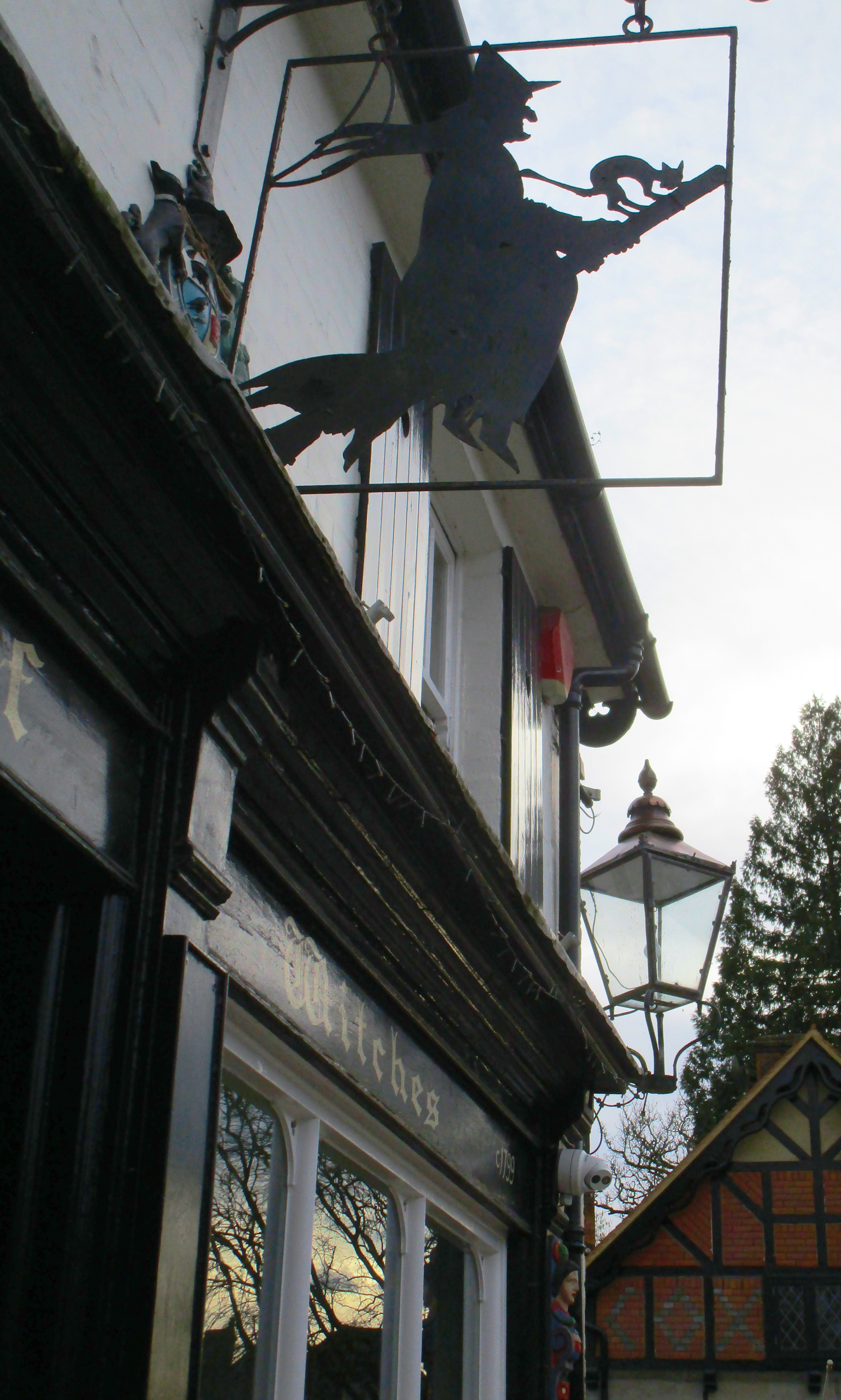
On my way back from a visit to my Mum in Dorset I called in at Burley in the New Forest, a place I haven’t visited in probably 35 years or so. It’s an odd sort of place: most of the dwellings are at some distance from the t-junction around which the centre of the village is organised, and as New Forest-style ‘commoning’ is still practised locally you can often come across ponies wandering around (though I didn’t). Two pubs, several tea shops, a couple of spas, a cycle hire outfit and a grand mock-Tudor mansion now turned into a hotel make for a collection of businesses largely orientated around tourism, or other sorts of visitors. But what most strikes the tripper to Burley (or this one, anyway) now is how witchy it is.

In what’s effectively two short streets there are four, or maybe five, witch-themed gift shops: it depends how you categorise ‘Away With the Fairies’, which has more of a fairy theme though it does overlap with the other four – ‘Witchcraft’, ‘The Sorceror’s Apprentice’, ‘Cobwebs and Crystals’, and ‘A Coven of Witches’. The last-named is the oldest store, beginning as an antiques shop run by the person responsible for all this, Sybil Leek. Ms Leek lived in Burley from some unspecified time until 1964, a familiar and flamboyant character often accompanied by her pet jackdaw, Hotfoot Jackson. In his history of wicca The Triumph of the Moon the great Ronald Hutton gives short shrift to her claims to have been trained by Aleister Crowley, or even to have met him, and even less to her historical sense, quoting a sentence ‘which manages in twelve words to confuse a nineteenth-century personality with a seventeenth-century one, and locate both in the wrong period’. Sybil Leek worked for a local TV station and for a brief period was able to promote herself as Britain’s chief spokesperson for witchcraft, before falling out with almost everyone else in the wiccan world, claiming she was under attack from Satanists, being evicted from her house in Burley, and relocating to the USA.

The stores share a family resemblance – they all have the same racks of crystals and incense and other knickknacks – but differ subtly from one another. At Cobwebs & Crystals, amongst the bottles of charged crystals and figurines I observed a vintage plastic telephone for sale not far from a small articulated toy of Matt Smith as the 12th Doctor, while Coven is clearly catering for the serious wiccan practitioner as it sells altar tables, cauldrons and wands (the kit’s small as I suppose it has to fit in teenagers’ bedrooms a lot of the time). All those items are seriously kitschy but there’s a certain seductiveness about the whole aesthetic, which overlaps with Goth although not identical with it.

In my long-distant memory Burley majored more on saddlery and leather goods, and although the witchcraft connection is clearly longstanding, it’s intensified in relatively recent years. Those horsey shops have been replaced by witchy ones, and it would be an interesting project to trace exactly how it has happened.


On the way out of Burley I stopped and walked down a muddy track to pay my respects to the Lady Well, which I certainly hadn’t seen since 1987. It hadn’t changed at all, which was a bit disappointing as I thought someone had tidied it up!

Saturday, 14 December 2024

Lion Head Spring, Forest Row

Down a muddy lane in the Wealden village of Forest Row lies the Lion Head Spring. It’s a very fine well indeed: stone walls and benches surround the round spring basin on three sides, while the eponymous lion’s head pours water into the pool. When I saw it this week, there were (relatively) fresh flowers lying in front of the basin, remains of candles around, clootie ribbons tied onto the yew tree that overshadows the well, and even some printed Buddhist prayer flags. You can find online lots of lovely pictures of the well decorated with flowers in jugs and vases, or with petals gently circulating in the water (here, for instance, here, or here). This is clearly a well-visited site. But why, and by who?


There wasn’t much to Forest Row apart from an inn beside the turnpike road and a few cottages until the railway arrived in 1866. The well doesn’t appear even on the largest-scale Ordnance Survey maps; though strangely the recess it’s set in does, at least from 1897 – it isn’t shown in 1873. Between those two dates we have Queen Victoria’s Jubilee in 1887, a good date for monuments of this kind to be erected, and the fabric of the well, as well as the lion’s head, looks right for that sort of time. However we might have expected some kind of inscription or dedication if it was indeed a Jubilee memorial.

You will come across suggestions online that the lion inspired CS Lewis to create Aslan, the Christ-figure of the Narnia stories. Naturally I pooh-poohed this at first, but in fact it isn’t beyond the bounds of possibility. Among Lewis’s early Oxford friends were the artist Cecil Harwood, who later became associated with the Steiner educational movement which, after WWII, was established at Kidbrooke Park in Forest Row, yards from the well. Harwood died at the house in the village he shared with his second wife Marguerite in 1975. Lewis was also friends with the philosopher Owen Barfield, who spent his last years in the late 1980s at a residential home in Forest Row, an odd choice if he had no existing connections with the place. Both Harwood and Barfield were Lewis’s executors, and The Lion, the Witch & the Wardrobe is dedicated to Barfield’s daughter. Lewis was conceiving of the Narnia narrative in 1948, just enough time for him to make a trip to see Harwood at Forest Row and find the lion’s head. However, Lewis always claimed he didn’t know where the idea for Aslan had come from, and as he had no reason to obfuscate, the lion at Forest Row is probably a coincidence.

The Parish Council owns the well, and also a plot of land at the top of the lane: they call it Gilham Spring, rather than referring to the Lion in any way. Many people seem keen to drink the water, even if the Council very much say they shouldn’t, at least not without boiling it, and the Friends of the River Medway advise the same. Some enthusiastic souls saw fit to vandalise the sign near the well telling them not to drink it (a sign which I didn’t see on my visit). This is an issue that regularly pops up on the LiberFaciorum Holy Wells page, among those anxious to avoid drinking what comes out of the tap, to the extent of claiming that a spring filtering through a disused graveyard in a city centre ‘can’t be any worse than tap water’, which of course it very, very much can be.

Not far away from the Lion Head Spring is Plaw Hatch Farm, which has its own filtered spring where visitors are welcome to fill up their bottles. Plaw Hatch is a biodynamic farm operating under the aegis of the St Anthony’s Trust, closely linked to the Steiner set-up at Kidbrooke since the 1970s, and some visitors clearly make a joint pilgrimage both to the Lion Head Spring and to the rather safer supply at the farm. I wonder whether this gently alternative spiritual presence is why the well has achieved its prominence, when its history is so obscure and probably not very long at that.

Tuesday, 9 July 2024

Swanvale Halt Book Club: Guy & Catharine English, 'Holy Wells Cornwall, Odyssey & Memorial' (Culture & Democracy Press 2024)

In 2014 Guy and Catharine English began a retirement project of visiting the holy wells of Cornwall. They acquired copies of the books that have surveyed them and started listing, cross-checking, and trudging around lanes and across muddy fields to find out what was there. Sometimes they discovered an entirely unlisted ancient well, which was a special excitement. Then came the covid year of 2020, which separated the couple from the wells and ultimately from each other after fifty years of marriage – not a direct result of the pandemic, but of Catharine’s cancer which they thought had been dealt with. Once the world reopened, and Guy could bear to do so, he carried on their mission – as the book’s title suggests, an ‘odyssey’, which had become a memorial. He acquired a new travelling companion in the form of holy wells photographer and author Phil Cope, who would help pull the book together.

For holy well hunters the corrected map references and descriptions of wells’ current conditions in this book are useful, even if some of the directions are a bit indistinct; necessarily so in the case of St Michael’s Well at Roughtor which, according to Guy English, mysteriously appeared and then was unfindable again from visit to visit. You have to squint a bit at some of the smaller photographs. But, in any case, this isn’t a book to go to for a lot of information as such. Instead it’s an account of Guy and Catharine’s pilgrimage, and together they make it easily the most moving description not just of Cornish holy wells, but sacred waters anywhere. They battle with the weather, sit in the car and eat a pasty, visit a friend while out looking for this or that site, and dry off in a tea room or a pub. Described in very few and unflamboyant words – as is Catharine’s illness and departure from their shared odyssey to go on one of her own – this is the kind of thing we all do when going well-hunting: ordinary, small actions, contained and framed within the very extraordinary action of looking for holy wells, engaging with their deep and powerful history, and moving through their landscapes. Yet nobody has ever thought to describe them in print before.

Captured almost unawares by the strange magic of the wells, Guy and Catharine English are all of us. How gracious of them to share with us their gentle, hopeful journey.

Book website here. 

Thursday, 23 November 2023

Cleer View

For some reason this day off has coincided with a low mood, and I know that there's no deliberately shifting it once it arrives - not the satisfaction from doing a succession of little jobs, seeing a friend for coffee, food or drink, or even the diversion of reading. It sucks all the pleasure out of these things, and will only move off when something unexpected moves it, like a breeze blowing away the cloud.

I think it was the right thing to do to go out of the house for an hour to the antiques centre, where I haven't been for a long time. I wasn't intending to buy anything, but along an obscure hallway (and they're all obscure at the antiques centre) found a print of a Cornish holy well. Acquiring new stuff doesn't necessarily make me any happier either, but at least this was a nice, small surprise. St Cleer's Well is a familiar one, but I've never seen this particular image before.

Friday, 13 October 2023

Hastings - Wells and Others

Until yesterday I'd never been to Hastings, but decided to go at least partly because of the number of interesting wells of different kinds the town has, and have therefore jokingly referred to it as 'the Other Glastonbury'. Not that it shares the Somerset town's hippie/New Age side: its alternative scene is more punk if anything, a bit like Brighton just along the way. The town centre falls into two parts - the 19th-century resort to the west of the Castle, and the old town to its east, which is surprisingly old and picturesque.


My first stop wasn't a well but the Town Museum, on top of the hill in a castellated folly-house. It's free to go in, imaginatively laid-out and full of surprising things. I hadn't expected the ethnology displays, derived from various collectors not all of whom were Victorian adventurers, but whose bits and pieces, the museum is keen to stress, were acquired by means as ethical as they could be given the time. Mods and Rockers appear in the history galleries as do bathing costumes, fishing gear, and scary puppets, culminating in artefacts from the Green Man Festival which friends of mine attend.


Down in the old town, based in the former church of St Nicholas (patron saint of fishermen) is the Fishermen's Museum, mainly one big room with a little annexe, housing a boat, fishing paraphernalia, a wartime Doodlebug dredged from the bay, stuffed animals, and some fantastic photographs from the amazing 1890s archive of George Wood. Although the church no longer functions as such, children can still be baptised in the font (there were three last year). The Winkle Club is a Hastings charitable institution, providing the context for the suit of silver-painted winkle shells worn by 'Slugger Hoad the Winkle King'. I'm not making this up, I promise. 

I found the wells generally quite hard to find: all the online descriptions are a bit unhelpful. The Roman Bath lies in Summerfield Woods (cross the grass next to the Leisure Centre, into the woods, go left down a flight of log steps and then left again past the pools and you should find it). It's a folly that seems to have been the work of Wastel Brisco of Bohemia House nearby: there were several Wastel Briscos, surprising though that may seem, and the family derived at least part of its money from Jamaican slave plantations. The Roman Bath was once a much more extensive structure, as this full account shows, and is a bit run-down at the moment with its nasty municipal gratings. I gave it a bit of a tidy up. 

In Alexandra Park there are two mineral springs. They lie right in the north-western half of the park: follow the path past the miniature railway, keep the stream on your right and you will find them, but I wouldn't have without directions from one of the Rangers. Dr McCabe's Well is the earlier - Peter McCabe, so a plaque tells us, was an Irish doctor who became Mayor of Hastings in the 1830s and was 'a committed campaigner for clean water' - and the other Chalybeate Spring was incorporated into the park in 1880 though it was presumably identified earlier. These are both separate from St Andrew's Spa, which lay in the corner between St Helen's Road and St Helen's Park Road to the north. 


Along Rock-a-Nore in the old town lies East Well. This impressive temple-like building was also built by Dr McCabe: the museum has a painting of people drawing water from it and George Wood took a photo of children around it in the 1890s though I suspect it's a bit posed! You can still take perfectly safe water from it and I presume there is a spring that feeds the well structure. Along the seafront is a modern Wishing Well - the Rotarians manage these things in several places. Finally, next to Holy Trinity Church is the very grand if disintegrating Waldegrave Fountain, a big Gothic structure opened as a memorial to the philanthropist Countess Sarah Waldegrave in 1861, and designed by SS Teulon. 


The hardest well to find was what may be the area's original holy well, St Helen's Well about a mile and a half north of the town centre at Ore. I spent an hour wandering the roads and woods west of the ruins of the old St Helen's Church being misdirected by well-meaning locals and misinterpreting three maps before I got accurate directions. What I should have done was walk down the misleadingly-named St Helen's Park Road (it's a track) south off The Ridge, branch off left into Dunclatha Road (another dirt track at this point), and after a few yards look out for little paths leading to the left over a stream and uphill, and that's where the Well is. It's a pair of stone-lined basins, one small, one large, emptying into a pool. It's a nice spot, and its restoration in 2011 was a journey of self-discovery for one soul, though there's a slight question mark over it as it only seems to be named in Graham Jones's 1986 Landscape History paper, 'Holy Wells and the Cult of St Helen'. I also missed by yards what some local people call 'the Monk's Well', which is probably what's marked on the 1878 OS map as a 'drinking fountain', fed by the same spring. 


Finally I drove out east to the Hastings Country Park to find the Dripping Well. This turned out to be comparatively straightforward! You simply follow a marked footpath running south opposite the car park, turn right and then left, and in the little wooded glen at the bottom you'll find it, a rock in a dell with water, as the name suggests, dripping down into a shallow pool from above. It was a popular 19th-century tourist spot and there are lots of photos and prints to see online: when I worked at the Priest's House in Wimborne there was one from 1889 in a random box of stereoscope slides, and on my wall I have a much earlier print. 

But what is perhaps, just for historical reasons, the most interesting holy well in Hastings lies at the moment inaccessible in the crypt of the former church of St Mary-in-the-Castle, whose temple-like portico looms incongruously above the seafront. This is one of those bizarre Georgian churches built in the round rather than with a traditional east-west orientation, and it had a font which tapped spring water coming out of the cliff face. Even more anomalously in terms of Anglican Church history, in 1929 St Mary's created a tiled baptismal pool utilising the same spring water, and at some point the rock basin of the spring itself became a holy well complete with Biblical verses, a cup for drinking the water, and a box for donations. The church became an arts centre, but Hastings Council pulled the funding last year, and until that gets sorted, the spring will remain unseen. 

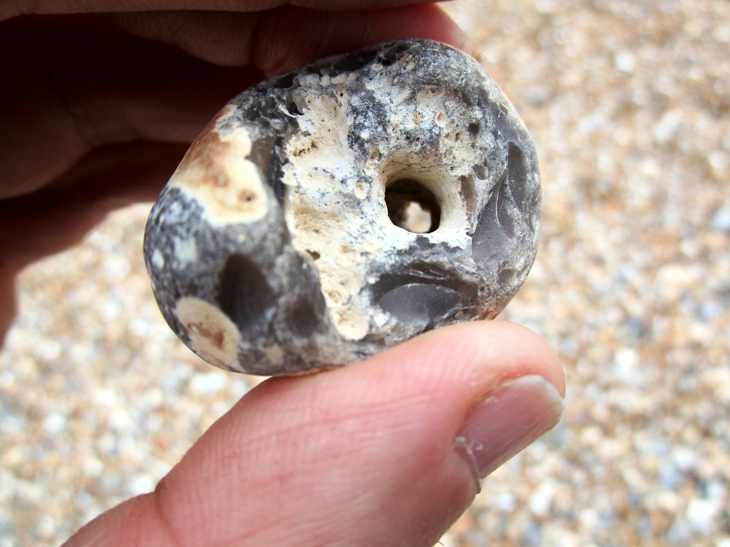
Until visiting the Museum I'd forgotten that Aleister Crowley used to live in Hastings. He allegedly said that you had to carry a hagstone if you wanted to leave the town safely, so it was just as well I found one on the beach. 

Wednesday, 11 October 2023

Aquae Avaloniae

Among those of us who discuss these things, Glastonbury's wells have been a topic of conversation over recent months. The Slipper Well and the Blue Spring have been mentioned, apparently new names for sites we knew about, while St Edmund's Well has been revealed to anyone who doesn't live locally as a really rather important site. But while the esoteric history of Glastonbury has been written about ad infinitum nobody has put all the details of the wells in one place. I thought this might be another little project to work on, so yesterday on my way back from Dorset I diverted north to what turned out to be a misty marshland town, the weather only turning sunny several hours after it had been supposed to.

The journey had been wearying enough to make me fall desperately into the cafĂ© at the Rural Life Museum as soon as I arrived and only walk around afterwards. The Museum occupies the site of Abbey Farm and provides as much of a prosaic contrast as you could imagine with the alternative life of modern Glastonbury. I say 'prosaic', but that's hardly an appropriate word for the mighty medieval Tithe Barn which the farm inherited from the dissolved Abbey. I found the great 18th-century cider press the most charismatic object in the collection. 

In the wall around the Museum site is the first well. This tiny alcove was, as a newspaper sketch from 1888 reveals, once much taller and was probably lowered when the farm closed and the wall was rebuilt. I remember seeing it years ago - in fact, I remember running across the road from my parents' car in the pouring rain to look at it, but paying it little attention because it didn't seem to have a name or any traditions associated with it. In fact that 1888 newspaper article calls it 'The Holy Well' - but not the Slipper Well, the name it seems to have now. It's said to be where pilgrims washed their feet before entering the Abbey precincts. That sounds to me like an idea borrowed from Walsingham, where pilgrims take off their shoes at the Slipper Chapel to walk the last mile to the shrine. 

What of the Blue Spring? That's another relatively recent way of describing Bride's or St Brigid's Well at Beckery to the west of the town, a very important site which may very well represent the oldest Christian monastic settlement in Britain. There's nothing there now, and even the little stone marking the 'traditional site' of the well is hard to find, as my visit demonstrated, and may have been moved from where it used to stand which means we ought perhaps to have another stone marking the traditional location of the marker stone ... The 'Blue Spring' name comes from the complicated story about a blue medieval glass bowl which I'm not going to go into here. I imagine the whole area looks a bit more welcoming in the sunshine!

Back in the town, I called in at the Magdalene Almshouses, a place I'd never visited before, because of a reference someone made to another sacred spring there that pours out of a spout onto the road - indeed it does, though I'm not sure anyone identified it as a holy well until very recently. But the Almshouses are a deeply moving site, a row of tiny one-room 15th-century cells whose last resident died in 1958, and a quiet chapel. I spotted the icons of SS Margaret and Mary Magdalene and recognised the work of John Coleman from his images of the Dorset well-saints Whyte and Edwold. 'Ikon John' was the name the Almshouse volunteers recalled: he had a workshop in one of the cells and talked to visitors about icon-painting and the spirituality behind it.

From there I toiled up the hill, over a stile, and along an overgrown path to St Edmund's Well. This is a site I've known about for years, and in fact have argued that it was the original holy well of Glastonbury, but until about six months ago assumed was lost - until people began to post about it on LiberFaciorum, revealing a well which can hold its own with the best of Cornwall or Ireland, a well-house of some antiquity which is only now coming to anything more than strictly local attention. Additionally, I'd presumed a group of 'Holywell' names north of the Tor referred to St Edmund's Well, but that's not what they say at Holywell Farm, pointing to a spring down the hill as the eponymous Holy Well; I'm not convinced I found the right site, but I'm glad to know it's there.

After that it was a relief to be going downhill to the more famous Glastonbury springs. I've been to Chalice Well plenty of times but it's always pleasing to see people using the site as a tool for their own spiritual lives, drinking the water, wading in it, leaving offerings at the well-head, or sitting in meditative silence ...

... though silence, as such, was a rare commodity across the road at the White Spring, which I'd never visited before. Chalice Well was founded by a group of souls, including Dion Fortune, for instance, who held Christianity and paganism in balance: it's reticent and well-mannered. At White Spring the alternative is much more up-front: people mill about outside playing drums and parting to let vehicles up the road when they need to pass. In the 1870s the town authorities built a waterworks to tap the calcium-rich springs here, but the minerals clogged up the pipes and eventually forced a rethink, leaving behind a building which over the last 20 years has been turned into what anyone can recognise is a deeply powerful water-shrine with an eclectic spirituality. I found entering its dark vaulted space, lit with candles, a bit challenging at first as waves of discordant sound washed over me, and I had to avert my eyes from the people stripping to bathe in the chilly waters of the rear plunge pool! (This is partly why photographs are ruled out at the White Spring). I had a good conversation with Annwyn Avalon who was welcoming visitors to the Spring and who has relocated from the USA, summoned by the call of the Glastonbury springs. This is, of course, not a path I follow, but I know many friends who do, so I lit a candle for them at the Peace Shrine which seemed from its icons of angels to be the most Christian bit, and quietly recited the Magnificat. 

(What was I doing by that? I don't see it as 'reclaiming the space', any more than a pagan coming into my church and offering a prayer to the Goddess alters the nature of that location. Some Christians might argue it did, that some act of counter-reclamation or cleansing might be in order; but the God I believe in doesn't need my defence or anyone else's. He's already in control and there is no power in earth or heaven that can depose him. We can relax). 

Ms Avalon pointed me back into the town for one last visit - the fountain outside the Methodist Church which, so it's said, was built to tap three springs which rise beneath the church itself. Its neo-Norman arch recalls the one well I didn't visit yesterday, St Joseph's Well in the Abbey (I wasn't going to pay another entrance fee just to photograph something I took a snap of 3 years ago). Look at that carved hand pointing towards the Tor! I didn't climb up there, either, and I was very glad to make it back to the car after a long day chasing wells. 

Marcher Land Adventures 5

For this final stage in the journey we stretch the definition of 'Marches' a bit to include the land well into Gloucestershire! But as I made my way home from Rose Cottage I called in at Welsh Newton parish church, to which the term still definitely applies. It has an original stone rood screen dating from about 1320, a most unusual feature for a little village church, and also the grave of St John Kemble, one of the Roman Catholic Forty Martyrs of England & Wales: although he was found to have nothing to do with the Titus Oates conspiracy (not hard to have no connection with something which hadn't happened) he was executed anyway. This is all mentioned in the church. What they don't mention is another grave within a yard or two of St John's which I spotted from a distance. Is that the Jake Thackray, Yorkshire songster and humourist, I thought? He died in Monmouth, and it is. 

I'd visited Gloucester Cathedral, but many years ago, so it was time to return. St Catherine appears in glass twice, once in a medieval treatment, once in a Victorian.


Gloucester's museums carried on the pattern of not being open. The City Museum was - a nice ground floor of palaeontology and archaeology accompanied by medieval music, which becomes a rather fragmented and bitty account of later times on the upper storey - but the Folk Museum, which is the social-history branch, appears to have erratic opening times at the moment and the staff at the City Museum couldn't even confirm when they were despite being part of the same setup.


Two wells to finish with. Nobody seems quite sure how the Crocodile Spring at Compton Abdale came to be, though Historic England says a local builder, 'George Curtis of Hazleton', made it in the mid-1800s. Its crocodile-snout spout was a bit obscured when I saw it, but it was flowing very merrily indeed. I met a woman washing in the water. A little further on is a very important site to the history of well-reverence in the British Isles, the Roman Villa at Chedworth. The octagonal spring-fed pool in its Nymphaeum seems, from nearby finds, to have been converted to Christian use at some point, and then converted back again. Recent excavations have uncovered mosaics that appear to have been laid down in the villa as late as the mid-400s, which rather changes our view of sub-Roman Britain. Unfortunately when the Victorian excavators originally dug the place up they not only stuck a little shooting lodge right in the middle of it, but also preserved the Roman walls with twee little tiled roofs that don't help when you're trying to envisage what the two-storey buildings would have looked like. 


That got me back home, but I still had a week of holiday to go so there are more travels to come!