... is the mild response I find myself sometimes making when what I would prefer to say is anything but mild. A little while ago I had a message thus:
Hello, I'd like to enquire about having my son christened at the church. We live in the village and it's such a beautiful church, I wouldn't want to have the ceremony anywhere else!!
So we arranged to meet and discuss it. There's no long process of preparation for prospective baptism parents to go through at Swanvale Halt, nothing to put people off. Then some days after the fulsome endorsement quoted above I received:
Hi, after careful consideration we've decided to go to a church in Hornington for the christening. Thank you for your help.
I know, or suspect I know, exactly why this is, and I suspect I know it because other people have mentioned it in similar circumstances. It's because car parking is easier in town than it is here. Short of having the sheltered housing next to the church demolished and a car park put in its place, there is little I can do about this; but what grates, and if I'm honest grates quite hard, is the lack of frankness. I wouldn't mind so much if people felt they could be open about the reasons for their choices in these matters; we all know baptism parents with little connection to the Church treat churches as couples looking to get married do, as 'venues' with competing facilities, advantages, and considerations. There's something deeply corrosive about the way people feel they need to pretend.
My own irritation, as such, is of course due to Clergy Insecurity Syndrome and that's an entirely separate matter!
Saturday, 22 August 2015

Thursday, 20 August 2015
Slapdashness
I went to see my S.D. and told him about a funeral I did recently. It presented a few organisational difficulties in that the deceased gentleman actually lived in Kent and was being buried in Swanvale Halt only because he used to live here and his son, who died a long time ago, is buried locally. I met with his widow and talked through all the arrangements, and thought I'd got it all sorted. Then when they actually turned up, I discovered there were all sorts of things I should have known but didn't, such as whether the family wanted to follow the coffin into the church, who was doing what readings, and whether the biographical details I'd been given were supposed to be read or were covered by what someone else was saying. Someone delivering a tribute who I thought was the gentleman's brother turned out to be a friend. It meant it was all far more stressful than it should have been, made worse by matters such as a jamming CD, and not having much time to conclude matters before catching a train.
'When you start out,' I told S.D., 'you dot all the i's and cross all the t's and are obsessed with getting everything right. Then once you've got it all more or less right for some time you rely more and more on your ability to wing it. But it's not just that: I think that because I don't find interacting with people very easy I'm subconsciously wanting to finish any encounter as quickly as is decent to do, and this leads to a temptation to cut corners.'
S.D. said, 'I think this is actually very common, and it relates to the priestly life. We do so many different things that we're never quite sure what's going to be happening next and what we're going to be asked to do or say, so we live in a state of constant mild tension, always looking ahead to the next thing. That leads to a desire to want to be free of that tension as soon as we can and go home and flop. That creates the risk of giving people less attention than they have the right to expect from us, and the kind of person you might be exacerbates the situation. I don't think this will ever go away; all you can do is try to counteract it, by going very deliberately back to dotting the i's and crossing the t's like you used to do. I observe quite a number of lazy priests, but there's a sort of spiritual laziness which is different from mere bodily laziness.'
He came out with this with such facility I suspect he's thought about it before ...
'When you start out,' I told S.D., 'you dot all the i's and cross all the t's and are obsessed with getting everything right. Then once you've got it all more or less right for some time you rely more and more on your ability to wing it. But it's not just that: I think that because I don't find interacting with people very easy I'm subconsciously wanting to finish any encounter as quickly as is decent to do, and this leads to a temptation to cut corners.'
S.D. said, 'I think this is actually very common, and it relates to the priestly life. We do so many different things that we're never quite sure what's going to be happening next and what we're going to be asked to do or say, so we live in a state of constant mild tension, always looking ahead to the next thing. That leads to a desire to want to be free of that tension as soon as we can and go home and flop. That creates the risk of giving people less attention than they have the right to expect from us, and the kind of person you might be exacerbates the situation. I don't think this will ever go away; all you can do is try to counteract it, by going very deliberately back to dotting the i's and crossing the t's like you used to do. I observe quite a number of lazy priests, but there's a sort of spiritual laziness which is different from mere bodily laziness.'
He came out with this with such facility I suspect he's thought about it before ...
Tuesday, 18 August 2015
Iconic

This began to change, I think, when I was looking after Goremead some years ago and realised there was no representation of its patron saint, Jude, anywhere in the church. I ended up buying a south American painting of Jude as a gift. There's a tradition of depicting holy people in that part of the world which is very different from that of Orthodox icons, but also follows its own strict convictions and, certainly in the case of this image, produced something which had an equivalent sense of 'presence' rather than being merely a picture. I sat and prayed with the painting for a while and the more I looked the more I saw in it.
Nowadays I rather prefer the icon to the statue. We have a very nice statue of the BVM and Christ Child at Swanvale Halt, a sweet and even winsome image which originally came from a convent, but very often indeed religious statues are mawkish and camp, and despite their three-dimensional physicality actually have less presence than an icon. The icon silently watches and invites the onlooker into relationship with the person to whom it is bound, and to Jesus. Statues are a bit dead in comparison.
A retired priest who lived in Swanvale Halt and worshipped with us died last year, and his widow would like to give something to the church in his memory. We decided perhaps a couple of icons would be appropriate, using remaining boards from the old pews which were removed three years ago. I had contacted a well-known icon maker but then I was told that one of the Roman Catholic congregation locally was an icon-painter: it would be easier to deal with her, certainly - and she might even be a bit cheaper, if only on postage costs. However in view of my experiences outlined in the first paragraph here, I was rather nervous about what approach she might be taking.
In fact I need not have worried. Her house and studio are full of peace and light, and she is strictly traditional in her approach, insisting rightly that painting an icon is a matter of working within established conventions and not a creative act in a modern sense. What a relief!
Saturday, 15 August 2015
A Different Way

I took Ivan with me: he's an ordinand based at an Evangelical Anglican church not far away and is with us on placement at Swanvale Halt to experience another brand of worshipping community. Astonishingly for a middle-aged gentleman, to me, he'd never attended a civil service before. 'I found it a bit 'thin' ', he commented, which is what I always think, too, when I attend civil rites of passage, whether weddings or funerals. I don't think this is simply a matter of my own particular ideological framework being absent; it's to do with the whole thing resting on the individuals concerned, rather than connecting them with something bigger (even eternal). Even if you know them that's a bit limited in comparison.
You could argue that I shouldn't have been there at all. I know clergy who wouldn't have been. You could regard my presence as adding a gloss of legitimacy to an occasion whose assumptions and understandings are far removed from God's, or even salving the conscience of people who would be better off having their conscience pricked a bit. I prefer to think that, if a thing is capable of working for God's purposes, it can be blessed in his name, and his presence acknowledged. I did do a little preamble to explain what I was doing there and the different natures of the two halves of the ceremony, which the standard Order for the Blessing of a Civil Marriage actually does quite well.
But those differences are ever clearer. The words the Registrar now uses are even less personal than before now they have to incorporate the marriage of same-sex couples: 'the State regards marriage as the union of two persons ...'. There is no open mention of sex or family life, while the Anglican ritual proclaims both, and apart from the statement that the couple are uniting 'to the exclusion of all others', which does sort-of imply a sexual relationship, it strikes me that this is a contract which could be entered into by siblings, or by more than two people (as some of my non-Christian friends would like to see). I now wouldn't object to that happening, as it would clarify further the distinction between what the State now sees marriage to be on the one hand, and the sacrament of matrimony on the other.
'I prefer 'thin' weddings', said Ms Formerly Aldgate later on. 'Most weddings can do with losing a bit of weight.'
Wednesday, 12 August 2015
Memories
I went to see Colin at the hospital, and take him communion. The chaplains could do it, but he preferred me to, which is fine. He said:
"Have I told you about how we had communion the day before the Battle of El Alamein? The padre spread a white cloth on the bonnet of a jeep and that was our altar. I must have been the youngest one there, and he prayed for me specially, 'Lord, look after this lad and protect him'."
"And here you are."
"And here I am."
"Have I told you about how we had communion the day before the Battle of El Alamein? The padre spread a white cloth on the bonnet of a jeep and that was our altar. I must have been the youngest one there, and he prayed for me specially, 'Lord, look after this lad and protect him'."
"And here you are."
"And here I am."
Wednesday, 5 August 2015
Horsham Museum
I'd never been to Horsham before last week. It has a museum, and here are some photos of it. It's an unusually heterogeneous collection of bits and pieces, some vaguely organised, others apparently randomly crammed together into display cases overflowing with a variety of old tat.


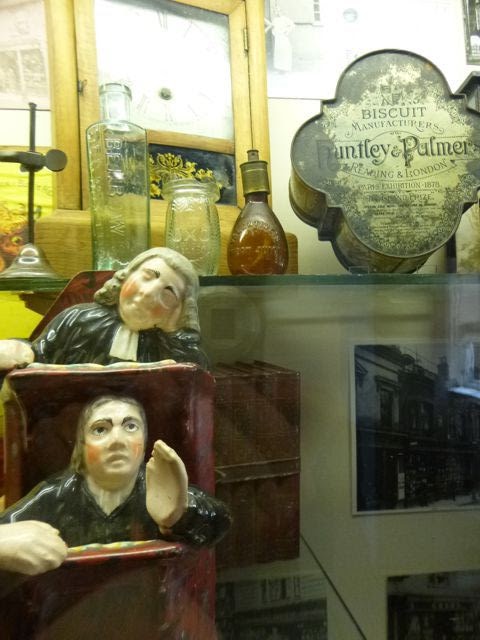
I'm not sure you get much of a picture of how Horsham and its history have developed, but you do get the delightfully bizarre conjunctions and juxtapositions that so often characterise local museums.


And you can't go wrong with a Victorian apothecary's cabinet.

There are also some strange collections of objects the Museum has acquired for different reasons: a selection of ethnographic material looted from different bits of the world by imperial travellers, and a variety of horse furniture displayed as though it was in a jeweller's shop.


Finally there are a couple of flashes of very imaginative display work. The Museum has a Cabinet of Curiosities ...

... a selection of antique shoes each in its own drawer ...

... and lastly and most beautifully, a wonderful shrine to the poet Shelley, whose family lived nearby, with a selection of books looking for all the world like strange butterflies about to take off.

Monday, 3 August 2015
Oi
Yesterday we had no main morning service at Swanvale Halt: there was an ecumenical open-air service in Hornington town, following a precedent from a couple of years ago (although last year got missed out). These joint-church events tend to be sort of Evangelical-lite in tone, so it's not to my taste particularly, but there was nothing especially objectionable and I didn't have anything to do except stand in the park and join in.
I stood in the park because, although I decided to take a folding garden chair strapped to the back of my bicycle, while I was helping fetch more seating from the parish church hall someone sat on it. That was all right; I can stand up for an hour without suffering too many ill effects. What was more startling was that at the end of the event the lady who occupied my chair folded it up, put it under her arm, and began to leave the field. The chair was green, stripey and polyester, and clearly not one of the steel contract chairs from the church. Were I a saint I would of course have let her take it, but I'm not there yet.
'There was some research', commented Ms Formerly Aldgate, 'that kleptomaniacs aren't actually aware of what they're doing.' She always puts the most generous construction on things.
I stood in the park because, although I decided to take a folding garden chair strapped to the back of my bicycle, while I was helping fetch more seating from the parish church hall someone sat on it. That was all right; I can stand up for an hour without suffering too many ill effects. What was more startling was that at the end of the event the lady who occupied my chair folded it up, put it under her arm, and began to leave the field. The chair was green, stripey and polyester, and clearly not one of the steel contract chairs from the church. Were I a saint I would of course have let her take it, but I'm not there yet.
'There was some research', commented Ms Formerly Aldgate, 'that kleptomaniacs aren't actually aware of what they're doing.' She always puts the most generous construction on things.
Subscribe to:
Posts (Atom)