Showing posts with label climate emergency. Show all posts

Saturday, 22 April 2023

No News

Unless something goes dramatically wrong tomorrow or Monday - say, as my friend Ms Mauritia suggested, the London Marathon runners find their way through the capital impeded by people glued to the pavement - you won't see much in the news about the latest Extinction Rebellion events in Westminster, which have been specifically designed as big-tent traditional demonstrations rather than direct-action stunts designed to cause disruption: nobody's much bothered by even tens of thousands of people doing legal things. They were the focus of the last day of my break yesterday. I arrived in the rain to listen to someone from XR Cornwall talking about their experience of getting the Council there to work alongside citizens' panels: he struggled boldly against the lack of a working microphone and the better-amplified efforts of other attractions against the railings of the Palace of Westminster along Abingdon Road. For no very good reason I'd decided I would join the picket outside the Department of Transport, and found a crowd being led by a gentleman from Greenpeace in the cry 'We're from South Yorkshire and we want better buses!', while across the road a similar mass blockaded DEFRA (though not so much the staff couldn't get in or out, obviously). After about 45 minutes in which my most active contribution was helping someone get her cardboard placard pinned to her backpack, I decided to go and seek lunch, and found that someone I knew from London Gothic and who I last met at a birthday gathering had been standing right behind me. All the protests in all the world ...

A visit to the Astral Café as recommended by Comrade Tankengine (all the clientele, including me, being grumpy old chaps until a couple of schoolgirls came in seeking chips and broke the uniformity) and a call at Westminster Cathedral later, I found myself again at the Citizens' Assembly Hub outside Parliament. this time the speaker was a fellow from Reboot Democracy who described the group's plan to refashion our political system by replacing parliaments and councils with randomly-chosen Agenda Groups and Consultative Assemblies, although I was sceptical how this could cope with the short-term crises which are the lot of government most of the time. 'We aim to put up candidates in every council seat and every parliamentary constituency, who will have no policy but to introduce this system', he said. 'Unfortunately when a friend of mine did this in a local council seat, her intervention let the Conservative candidate in, so we have to work out how to avoid that'.

As always, it's XR's commitment to imagining, and in so far as possible, enacting, an alternative vision of society that impresses most (especially on the day when the UN stated that, effectively, saving the world's glaciers is no longer feasible). If only that vision didn't involve so much drumming.

Thursday, 21 July 2022

The Church amid the Heat

At the very moment at tea-time on Tuesday that I was listening to a BBC reporter talking about the fire at Wennington in Essex, and mentioning the parish church there, I was watching this aerial footage on Sky, showing that very building. The church was safe in the end, though as you can see the flames came very close, the scorched grassland just a yard or two from the foot of the tower. The image reminded me of the famous photo of St Paul's Cathedral emerging from the smoke of the Blitz, although SS Peter & Paul's, Wennington, is not the grand cathedral of the diocese of London: this doesn't look like an image of defiance, but of vulnerability. The photos of burning houses from Wennington that appeared in the newspapers were more terrible and violent than this, and people live in houses and not in churches, but for me this picture is about the fragility, not merely of the Church, but of the whole of human society in the face of the chaos our hydrocarbon-based economies are unleashing. Of course there are always wildfires in heatwaves. Accounts of holy wells and other folkloric springs often refer to water-sources which 'kept running even in 1921', a once-proverbial time of drought when, again, crops spontaneously caught light in the fields; but as we know the temperatures are significantly higher now.

Here in Swanvale Halt I had a number of tasks on Tuesday which took me out into the heat. There was a mass in the morning (attendance: 4), and then, just after lunch, the Infants School Leavers' Service. The church felt relatively cool when we started and less so after 150 people had been in it for an hour. I stood outside to say goodbye to everyone as they left; there was quite a breeze, but it just felt like being in a fan oven rather than a conventional one. Finally I was at the Air Cadets in the evening. Turnout was unsurprisingly low but the remaining youngsters sat dutiful and even engaged through my presentation on Change. They had the option of leaving the hut if it became unbearable but none of them did. I did cut it a bit out of compassion, though. I'm coming up to a week's leave which means I am psychologically winding down somewhat, but even putting that to one side the heat hardly encouraged me to do anything more than I absolutely had to!

Tuesday, 9 November 2021

Coals to South Kensington

It isn't often that museums get into the news and when they do it tends not to be for positive reasons: museums doing their job happily and uncontroversially isn't news. It seems to me self-evident that the mighty Science Museum shouldn't be going to fossil-fuel companies to fund its exhibitions, but the matter doesn't appear to be quite so clear-cut to its leadership, no matter how many of its trustees or advisors resign, or prospective trustees refuse to go near it. Director Ian Blatchford's argument that taking money from Indian energy conglomerate Adani is somehow about 'editorial balance' is, I think, risible. The Museum could mention their viewpoint without being paid to do so. Am I missing something?

Mind you, were I still in the museum world I think I would be resisting any attempt by donors of artefacts, no matter how I agreed with their outlook, to determine how they might be used and displayed. You give something to a museum and it enters into a different conceptual space from yours. It becomes an interpretive device, an element in other stories than you might have imagined. You don't control it any more. 

Wednesday, 18 August 2021

Gone Shopping

'It's busy', the manager at the Co-Op told me, 'we have lots of new staff though the empty shelves take less time to fill ... Yes, not enough lorry drivers, problems with suppliers, all that's going on.' Not much is being said publicly about shortages in shops, possibly sensibly given what tends to happen when people think there are. 

Meanwhile I have something to transform my shopping experience, a pair of bike pannier bags. I consulted Dr Abacus over the purchase as I knew he would be the right person to go to and as predicted he came back with advice within ten minutes of my email. I think what I will do in future is pack my shopping into separate bags - probably those hemp fabric bags we all seem to acquire these days but whose provenance is often mysterious - and pop them in the panniers. They make the bicycle somewhat less racy-looking but it was never that racy with the basket on the back anyway.

One of my amendments to my life prompted by climate concern has been not to use the car if there is a viable alternative, and that means cycling to do my main shop if possible. The panniers allow me to carry more and bring other benefits. There have been times when I have teetered about with a heavy bag in the basket and another on my back, balancing on the really quite small area of tyre actually in contact with the ground. Lowering the centre of balance makes the whole journey feel slightly less perilous.

Tuesday, 10 August 2021

Hortus Conclusus

In his phantasmagoric 1984 art collection Hallelujah Anyway Patrick Woodroffe includes the haunting image of the 'Hortus Conclusus', a ‘melancholy mediaeval prophecy’ depicted as a sprawling and ruinously ancient tree rooted onto a tower of rock, islanded above a cataract in a poisoned and desolate landscape. The real medieval hortus conclusus, in contrast, was the ‘Enclosed Garden’, a walled would-be paradise designed to recreate Eden for the delight of ladies in hennins and escoffions, but Woodroffe’s is – he has a learned and fictional folklorist declare – an apocalyptic vision:

When all things come to an end – as some day they surely must – then shall the very last man shut himself away in the Last Garden on Earth. There he shall hide and care for the last tree and the last flowers, while all around him the world shall be swallowed up. … And one day even the Last Garden shall be swept away and with it the very last man, and the Earth shall have no husbandman, and shall run savage like the Wilderness. And of Man there shall remain no trace, neither memory nor regret.

Sometimes, when it’s all in full leaf and hung with bees and butterflies, my garden feels like the Hortus Conclusus, as though nothing exists outside it but ruin; as though the waves of desolation are lapping at its walls (or chainlink fences overgrown with bindweed and bramble). The water trickles in the pond and the marjoram flowers provide multitudes of bees in umpteen varieties with plenty to keep them going. The burning world is a long way away.

Of course it’s not. As the earth warms some plants will retreat and others will advance, and insects or birds we find familiar in southern England will be ousted in favour of others, new fauna which will cause us different problems. In fifty years, when I am long gone, my garden, if it still exists, will look different, and not because this little bust and the other statuary will be absent. A younger generation will accommodate itself to changes like this, and will mourn the past no more than I am especially affected by the lack of elm trees in the English countryside, which all vanished in my childhood thanks to ophiostoma ulmi. I fear that will not be the worst they have to deal with.

Wednesday, 31 March 2021

Dramatic Chromatic

There is no reason to share this photograph of our amazing and towering rhododendron bush in the church grounds other than its beauty, dramatically placed against a perfect blue sky yesterday. Of course the splendid weather comes with a slight tremor of worry at yet another near record-breaking temperature (though not quite), but put that to one side and enjoy the stunning sight.

Friday, 23 October 2020

Think Big

'It's so good that you're back', said Sheila when I dropped round her newsletter this morning. 'You make us feel safe, spiritually.' That was nice, and a warming thought when the rain began and soaked me as I cycled the parish.

The rain had cleared a bit by the time I got to the house of our Pastoral Assistant Sarah, who delivers a wodge of newsletters for me. She and her husband had watched a conversation I'd recorded and uploaded with a Green councillor and XR activist about the environmental implications and possible consequences of the epidemic. 

'I know we're all recycling and trying to use our cars less and things to help the environment', said Sarah, 'but is there anything bigger we can do, as a church?'

'Well', I answered, 'apart from the global overthrow of capitalism I'm not sure.'

'Hmm', Sarah thought, 'that might be a bit big. I mean, on our own.'

Sunday, 23 August 2020

Constructively Obstructive


It is said that one of the topics which radio news programmes can always count on to arouse rage and vituperation is cycling. In fact just a few days ago I did hear an entire feature on this phenomenon, which the presenter put down to the way cycling is perceived in Britain as a sport rather than a means of getting human beings from one place to another. Like in fact quite a lot of people, I am both a cyclist and a motorist and conscious when I am on my bicycle of not getting in the way of motor transport, because I know how stressful it can be when you are in a car, and late.

Yesterday, I'm afraid, a modest amount of obstruction was part of the point when I went out with Hornington's chapter of Extinction Rebellion, cycling round and round the town's roads. It reminded me I need to buy a new bell, and have done for quite some time: there was no chance of me joining in with the mass bell-ringing. Mind you, my brakes are possibly an even higher priority even if, yesterday, I ended up cycling slower than I ever thought possible.

Monday, 16 March 2020

Smiting Times

It is very fortunate for me that the Rectory in Swanvale Halt and its garden are so ridiculously overlarge for my requirements, as I will be seeing very little else for the next week. I have had a tickle in my throat for a couple of days – though nothing more – and today this turned unmistakably into a cough accompanied by intermittent tightness across the chest. I will be the first test of the church’s ability to help those in isolation! The symptoms are fairly ambiguous and if it turns out to be nothing at all and I get the Plague at some future point instead I will be most annoyed. Humans being what they are, I spent the time while I had the tickle trying not to cough in an attempt to justify not taking any action, and now find myself consciously coughing to justify doing so.

Equally, at the moment we don’t know whether the Church will interpret the Government’s advice to avoid ‘unnecessary social gatherings’ as including public church services. I can’t see why it wouldn’t.

‘I’m not telling you what to say in your sermons’, said Margaret, who lives in the sheltered housing flats next to the church, ‘but I spoke to someone about the epidemic and they thought it was God’s punishment on us and I don’t think that’s right!’ I may now not get a chance to deliver any such sermon in person, though it might emerge in another form. I wonder whether she might have spoken to Sandra who made some remark about the Horsemen of the Apocalypse as we were setting up for Messy Church on Saturday, and has a habit of coming out with the odd provocative statement. ‘I’ve decided I will die of a stroke’, she happily informed us once as we were getting ready for Church Club at the Infants School.

The ancient Israelites looked at their history and interpreted it in terms of their rocky relationship with God: they were unfaithful, they got smited. Gradually their views became less simplistic as they realised that not all disasters that befell human beings could easily be interpreted in terms of their own sinfulness. They did, though, retain a sense that divine justice lay beneath cosmic events, holding both beliefs in tension.

The sense that disaster is not a visitation upon sin but a consequence of it is there in the story of the first sin of all; ‘Cursed is the ground because of you,’ God tells Adam, ‘through painful toil you will eat of it all the days of your life’, and so on. The disruption in the fabric of creation results from the humans’ action, not God’s: it arises from the violation of the very nature of the Garden, and God doesn’t need to sit outside the event, sending down thunderbolts from a distance.

Many of our epidemics, and not just the current one, arise when viruses which are endemic in animals make the leap to human hosts. Our relationship with animals, as with the whole of the natural world, is deeply awry. We caused the earth to be cursed, and spent most of our history regarding it as an adversary from whose grudging hands we had to wrest the means of our survival. We have kept on behaving that way even though our increased numbers and power mean we have greater and greater scope to damage the world which alone sustains us. Someone eats a bushmeat chimp in Kenya and contracts the virus that turns into AIDS; a seafood market in China packs together animals in tiny cages that would never normally be anywhere near each other and another microbe makes the jump from them to the humans using them. Neither of these things should be happening.

And the global economy we have created over the last sixty years or so transmits the infections around the world at lightning speed. I and former BBC economics correspondent Stephanie Flanders overlapped at Balliol by a couple of years: the other day I heard her remarking that the coronavirus hits the modern world precisely at its most vulnerable points. The international system of trade and, in fact, culture, rests on lengthy supply lines, swift and inexpensive travel, consumer demand, and cheap food: the virus feeds on all of them. Our vulnerability is the dark side of the benefits of the global economy, and though we may protest that we haven’t imprisoned pangolins in a marketplace cage, we haven’t treated the world as our cesspit, we haven’t regarded the entire globe as an entertainment played for our benefit, our individual innocence cuts no ice: we are, individually, part of the race that has, and as a race we stand or fall.

I have a suspicion that the economy which emerges from this crisis will be, in significant ways, ruined. Vast areas of demand and supply will have been sucked out of the system: people won’t be spending as much money or making things for them to spend it on if they had it. Airlines, manufacturers, entertainment and catering companies, will have gone under in their thousands and their tens of thousands. We will, probably, find ourselves having to remember that money is a useful fiction, and that we can only rebuild by governments agreeing to change the rules of the game of money quite radically, and by the rest of us discovering the unsustainability of the system we built. ‘There is nothing hidden that will not be disclosed’, I read this morning in chapter 8 of Luke.

‘I do genuinely think this is the best fighting chance we have had yet. We needed a miracle and this just might be it’, commented my eco-campaigner friend Lady Metalmoomin on LiberFaciorum, looking forward to the virus's more salutary effects. I wonder. We have had epidemics before and usually we are so relieved to get through them that once they're past we begin trashing the world again with renewed energy. The situation is different this time – we have never lived in quite this kind of world before – but human beings are the same as ever.

Ah well: here in Swanvale Halt the magnolia is coming out. The blooms blaze. My little magnolia seems to be thriving, though I will see no blossoms this year. 

Monday, 17 February 2020

The Trouble With Humans

At some point I'll be able to write something upbeat here - but not today! A few months ago I put together a short pamphlet on the relationship of the Church to the climate emergency and the theological issues it raised, mainly because nothing I heard tackled it the way that concerned me. In it, I thought about the danger the politics of climate change seemed to pose of anti-humanism, of falling into a misanthropic rhetoric which viewed human beings as a polluting presence, a disease that nature would be justified in wiping out.  That wasn't very present just a short time back, but it seems to be now. My LiberFaciorum feed is full of it: often brutal and violent, accusatory, angry not with categories of human being (like the Brexit debate), but with humans as such. The Earth would be fine if they weren't around. It's hard to read, and often comes from people I care about and who are even, in at least one case, engaged in work which concerns saving people's lives. 

One of my favourite little stories involves Metropolitan Anthony of Sourezh who, on his first trip back to the Soviet Union from which his family had fled during the Revolution, was welcomed at the airport by a commissar from the Ministry of Religious Affairs. 'Do you believe in God, my child?' asked the archbishop. 'Certainly not,' replied the official firmly, 'As a member of the Communist Party I believe in human beings.' 'Good!', said Anthony, shaking his hand, 'So does God!'

There is a misanthropic strain in Christian spirituality, with disgust at the depth of human sin as its justification, but it's marginal. Rather, we are used to the tension between the fact that human life cannot be radically bad if the eternal Son came to share it and we are to carry on his work, and on the other hand the inescapable truth that humans' response to the arrival of absolute goodness was to turn on it and attempt to destroy it. The liturgy consistently rehearses both. I don't know whether the atheistic sort of misanthropy, released by the climate crisis, has long roots in people's thinking - was it always there - or whether it results from being surprised at how humans have failed? Christians have always known we are Fallen; perhaps non-believers are only now really finding out.

There's a more philosophical question below this, which is how far we should think of humans as part of the natural order, and how far we are separate from it. This is a complex matter for both Christians and non-believers. Traditionally Christians could maintain that humans were set radically apart from the beasts, but accepting evolution muddies those waters: we become both, part of a natural continuum but also endowed with something else, something which makes us capable of great good and also great evil. Our animal nature can be bent in either direction. However, if you're an atheist, everything we have is part of our genetic inheritance, and the way we behave must also derive from it. Whatever selfishness and short-sightedness we display must come from there. If we act badly, it can't be because we are too distinct from nature, but precisely because we are part of it: not because we are insufficiently like your pet cat, but because we're like it too much. If that's true, there's no great sense in castigating humans for being what they can't help. 

The conclusion a Christian must draw is that, if our imagination, the aspects of us that are 'the image of God', can be used positively or negatively; though it be ever so hard, we can choose to exercise the better side of what we are. And we must, for disaster lies otherwise. And without us, Creation returns not to a state of goodness and grace, but to chaos, to inarticulacy, to nothingness; beauty, perhaps, but with nothing capable of discerning, describing or enjoying beauty. Try Romans 8.19-22, which our holy mother the Church made us read last Sunday, if you don't believe me. Blessed Paul, of course, got there ahead of us.

Saturday, 25 January 2020

Confronting Countered Truths

Ms Trollsmiter was on her way home from her regular Friday protest slot outside Liverpool Street Station yesterday and at Harrow Station got into quite an altercation with a gentleman who took exception to her climate-change placard. To quote her:

His first sentence was: “You don’t believe in that, do you?” Pointing accusingly at my poster.
“Dude.” I gave him a prolonged look. “I am really tired and I have no interest in being in an argument with you right now. Come back some other day.”
“But you carry that poster, DON'T YOU? And you don’t believe in that, DO YOU?”
The brawliness was still somewhat tempered for about 2-3 minutes in which I tested his claim that the planet has gone through temperature changes before by asking him if he knew ‘why’ the planet had gone through these changes in the past, which he, naturally, didn’t … there was a point during the brawl when he started citing my poster loudly: ‘You’re a SCAREMONGERER!’ Now, at THIS glorious point, I was the LAST-PERSON-EVER-to-stop-him, because he was literally making every single person on the platform want to know what was on my poster …

You may recall my only encounter with a climate-change sceptic was more polite and centred on his bizarre assertion that carbon dioxide isn’t a greenhouse gas, a position which I suppose might be true but, if so, would demand the overturning of quite a lot of science; however, the conversation finished with the same assertion of irresponsibility on my part. I wonder whether all such meetings follow the same trajectory.

Of course we had the same thing from POTUS at the Davos summit a few days ago. It would be a waste of time to pick apart Mr Trump’s assault on ‘prophets of doom … alarmists’ and ‘fortune tellers’; but I have heard similar sorts of sentiments even from people who say they accept the scientific consensus, let alone those who don’t want to think about it. The conclusion you have to draw is that the motivation for this comes from somewhere other than the evidence; its source is, I suspect, not even primarily self-interest, but a facet of individual psychology which no amount of argument is going to shift. I mean, as a Christian priest I am used to dealing with apocalyptic and am very much aware of all the sorry souls who down the centuries have concluded that the End is Nigh based on the interpretation of ancient texts and current political events; but what we are facing presently is not that, it’s the result of decades of measurement across a variety of scientific sub-disciplines which all appear to point in exactly the same direction. For the record, I don’t yet think this is The End, as there are elements of the picture in the Book of Revelation which don’t seem present. It might not be the preliminary to Judgement Day, but merely to an unprecedentedly disruptive and damaging episode in human history involving the deaths of untold millions of people and the breakdown of our current civilisation, no worse than that. No biggie.

Given there is a persistent human constituency inclining towards ‘irrational scepticism’, perhaps we ought to be grateful that Mr Trump is there to articulate it so thoroughly: it shows it vividly for what it is, and as a result might dislodge some of the waverers and float them in the direction of reason. Others will find their attitudes confirmed. I suspect they will not number many in this country, but any at all challenge the belief most of us dreadful liberals have most of the time, that reason counts for a great deal in human affairs.

Saturday, 19 October 2019

Rebellion!

Before I set off for Warwickshire last week, the first act of my Autumn break was to stand very awkwardly in the drizzle outside the Council office in Hornington at 8am with a sign expressing my support for the Extinction Rebellion action beginning in the capital that day: 'I'm not at the Rebellion, but people I respect are.' At that point not only did we not know that anyone would be daft enough to obstruct Tube trains in Stratford and, as some XR members said, put at jeopardy everything else the movement was trying to do, but I wasn't at all sure that the action would last the full intended fortnight, given the harder line the police were almost sure to take compared to the event around Easter. For all I knew, everyone would have been driven away long before I could play any practical part.

Only two people spoke to me, a little girl who knew me from the Infants School and a gentleman whose opening gambit was to ask me what the Church thought of XR and its tactics. He then said he was a plant biologist working for a company advising on the growth of trees and crops, and in his opinion it was irresponsible to spread alarm about climate change when nobody can be sure what's going to happen: 'I remember watching An Inconvenient Truth and Al Gore said that all the Arctic sea ice would be gone by 2012, and that wasn't right, was it?' I agreed that it was rash to be very definite about dates, but that the overall direction of movement was fairly clear. He then told me carbon dioxide 'isn't a greenhouse gas anyway', that because conifers evolved when atmospheric CO2 was twelve times what it is now the climate could easily absorb similar levels without anything bad happening, and that his greatest fear was that someone would invent a way of extracting all the CO2 from the atmosphere and kill all the plants. At that point I decided not to worry too much about his ideas, great though I'm sure he is at growing trees. I did only last a few more minutes before the rain got the better of me and I cycled home.

By the end of this week, of course, the protests were still going, so I did travel up to London to join in. I don't mind admitting that part of my motivation is to support my friends Ms Trollsmiter and Lady Metalmoomin who are far more active in the cause: if they're prepared to take the risk the very least I can do is to back them up. There is nothing wrong in being influenced (in what you do, if not what you think) by people you respect. Quite apart from the climate issue itself, I felt the Metropolitan Police's blanket ban on all Extinction Rebellion activity in the capital was so sweeping (and has yet to be proved legal - opinion is that they were just chancing their luck in the hope that demonstrators would be put off) that for the sake of freedom of assembly if I was going to do anything, it ought to be this, and now. As I turned into Whitehall Gardens and found what was then a few hundred people but which became probably a couple of thousand I was extremely nervous at how I might be received but in fact nobody paid me any attention. I spotted a figure in a clerical collar who turned out to be from another Surrey church (though in the Southwark Diocese) and of course clergy always at least pretend to be glad to see each other. That put me a bit more at my ease.

It took ages to set off. Ms Trollsmiter turned up at 12.25 and warned she could only stay an hour: I said that at the rate we were going, we'd be lucky if we'd made it out of the gardens by then. As it turned out, the march was so slow that by the time we got to the Trafalgar Square end of Whitehall and then turned round to head south towards Downing Street, she and I were able to go and have coffee and a sandwich, and when I emerged I could still catch the procession up along Tothill Street which was where I met Lady Metalmoomin ('Yah, apart from the end of the world, things are really good at the moment'). We halted in Petty France outside the Ministry of Justice for a couple of very short speeches and not long after that I peeled off to go home, via what turned out to be a most circuitous route as the police had closed off Westminster Bridge, presumably to stop anyone protesting on it: like the famed Vietnam War general who stated 'to save the village, it became necessary to destroy it', the bridge had to be closed to stop it being obstructed.

It was an odd occasion. Technically the whole thing was an illegal gathering, but there the police were, facilitating it, and talking perfectly amicably to the XR liaison people. Admittedly, they did seem to be picking demonstrators at random for arrest, just to make the point, which was why I tried to be as inconspicuous as possible, but it was all quite good-natured otherwise. I was struck by the levels of preparedness and organisation: this is not just a group of people turning up in a London street. Whenever someone was arrested the cry would be passed down the line 'Legal observer! Legal observer!', sometimes in call-and-response form: Legal Observer (Legal Observer!)Up the front (Up the front!), On the left (On the left!). And you know you're not in a normal political demonstration when, as the police lay hands on someone or other, everyone around the spot cries 'We love you! We love you!' to the officers of the Law. You could also tell because - in contrast to every other political demonstration I have ever taken part in - the obligatory couple of Socialist Workers Party activists making sure as many people as possible are given their SWP placards to wave were nowhere to be seen.

Of course I have my quibbles with the XR approach, both its style and aspects of its rhetoric, but I am also a representative of the Church of England and I don't go along with all of that, either. Wait until you find an organisation which suits you in every detail, and you'll wait a long time. Some people don't like XR's Red Brigade, who symbolise the destructiveness and suffering of climate change, but I find their sombre presence a masterstroke. Doing nothing but walk slowly and make simple hand-gestures, they manage to be an intensely powerful visual and emotional focus. But, watching them in the flesh for the first time, as an old Dr Who aficionado my mind flies back to The Fires of Pompeii, and I speculate whether there's a Whovian in the XR design department. Spot the difference.


Friday, 20 September 2019

It's in the Air

Marion our curate co-ordinates our efforts to comply with the Eco-Church scheme. As today was the day of global climate strikes she put up a poster pointing out our solidarity with the strikers.

Marion: My son said it was pathetic and we should do much more than that.
Me: And is he striking from school?
Marion: Ah no. He had laryngitis this week so he felt he'd used up his strike allowance.
Me: It's such a moral conundrum.

I did go to London to join my friend Ms Trollsmiter at her placard vigil on a traffic island outside Liverpool Street Station. She had a friend today, but is usually on her own and I thought today of all days she could do with a bit of support, especially as her efforts to mobilise local faith communities to turn out had run into the sand. I decided to go in my cassock and cape, to be extra visible, though it did occur to me far too late that perhaps I should have asked the Vicar of Shoreditch - or would it be Spitalfields - to pardon the incursion into their parish. I am usually a bit trepidatious at wearing full gear out and about but I needn't worry. Nobody bothers someone dressed as stupidly as that.

I was back in Swanvale Halt in time to throw a group of underage drinkers out of the churchyard. Verger Rick and Rob who helps him out managed to located both the compost bin lids which they'd been using as frisbees. I returned later in the evening to have a swift cycle around and found nothing happening; the police who came cruising along the street had also found everywhere between Swanvale Halt and Hornington dead quiet, so where the youngsters had all gone we weren't sure. Their absence didn't stop the stench of weed drifting across the centre of the village periodically as I rode back home. Apparently it's now so ubiquitous that it doesn't require the presence of actual human beings. 

Wednesday, 18 September 2019

A Climate of Conversion


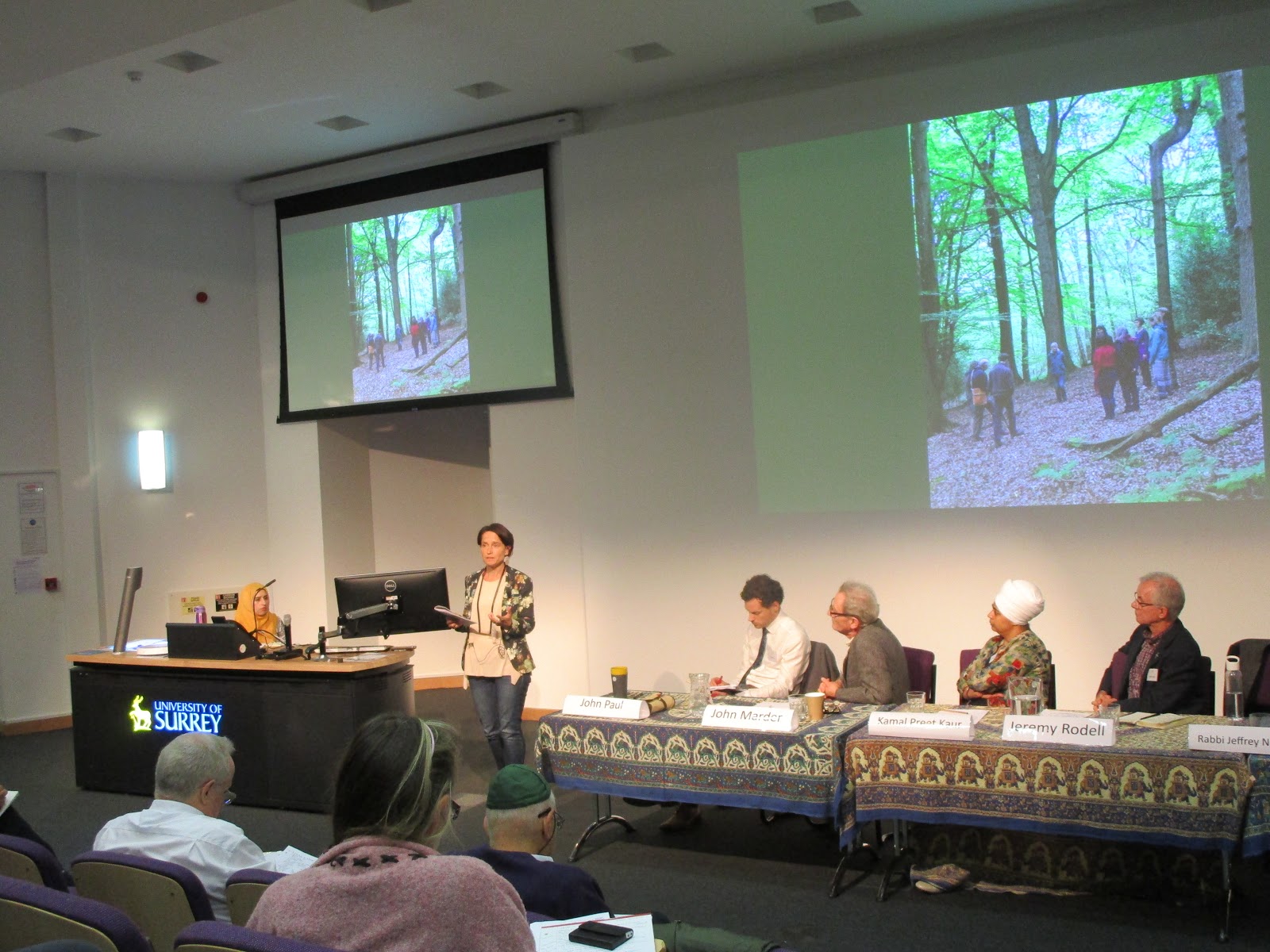
The South East England Faith Forum meeting at the University on Monday was about religious responses to the challenge of climate change. It was all polite enough as a Catholic Christian, a Buddhist, a Sikh, a humanist and a Muslim described their own faith positions’ approaches to the issue, and relatively chirpily outlined initiatives such as EcoSikhs and Green Islam. An elderly rabbi who is on the steering group of Extinction Rebellion changed the tone by asking us to examine our feelings about the prospect of the great changes pending for human society, and he was followed by Dr Justine Huxley, director of the St Ethelburga’s Centre for Reconciliation and Peace in London, who really led the hall down a dark path. The Centre was studying ‘how we operate within a landscape of approaching social and economic collapse’ and ‘mapping out the journey between “There are no courgettes in the shops” and mass starvation’. Thinking about the spiritual aspects of coming to terms with climate emergency, she drew a parallel with her father’s death from cancer and the way the clarity of his situation changed his whole life for his last couple of years: ‘humanity has had a global cancer diagnosis … Through this breakdown we will come to know our dependence on each other and God, but we don’t get there unless we go through the darkness.’ I was quite favourably impressed that another group of Christians was at least tackling the apocalyptic implications – using the word theologically – of what seems to be happening. At least it’s not just me.

At the XR meeting the other evening, and again on Monday, I was struck by the parallels between the emotional journey climate activists want people to go on (and to an extent which I have travelled too) and a very traditional Christian evangelistic technique – bringing an audience to a place of despair and then offering a way out. This is very explicit: I’ve now heard a whole variety of speakers describing precisely the same transition from grief and anguish to determination and engagement, activism as an antidote to hopelessness. I do question the notion of campaigning as therapy – if it only affects how you feel rather than what’s likely to happen, you may as well take up stamp collecting as a response to Armageddon, so I suspect the people who say that don’t really mean it.

Rabbi Newman and Justine Huxley both cited – independently of each other, because the speakers on Monday hadn’t vetted each others’ contributions first – Professor Jem Bendell’s 2018 paper Deep Adaptation, which predicts the collapse of Western civilisation in as little as ten years' time. Dr Huxley described how she’d taken a group of her staff on retreat into a wood to read it and talk about it together, and had gone through tears and terror before reaching a sense of resolution – exactly the process others are describing. Now she’s concentrating on helping groups take the same journey, she said.

Amazingly I'd never heard before of Dr Bendell's paper, 'the article that drives people into therapy' as it was reported. It’s a sort of confessional narrative, explaining how he took a sabbatical from his chair in Sustainability at the University of Cumbria to read up on the scientific literature around climate change and found himself horrified, and outlining the stages of his grief. I gather its tone, at least, is not universally supported among climate science specialists: Michael Mann, the geophysicist who developed the famous 'hockey-stick' graph illustrating the rise in global temperatures over centuries, succinctly summarises it as 'crap'. Dr Bendell’s response seems to be to characterise his critics as, for different reasons, 'social collapse deniers' in the same way those who support the climate change consensus term their now-tiny but sadly influential number of opponents. But thinking merely about the scientific element, Deep Adaptation is very open to criticism: it is citation-light in a way that, for instance, the Breakthrough centre's 2018 paper on the risks of extreme climate change, which I did read, isn't. It's really a work of rhetoric, not science. If XR and St Ethelburga's have imbibed their sense of terror and crisis from Deep Adaptation, and I and many others are picking it up from them, might the basis on which we are being plunged into existential anxiety be questionable?

I am no scientist, and therein lies the difficulty. The science of climate change isn't the kind of science which counts molecules and observes what happens when you burn a bit of magnesium in a Bunsen flame. It's about estimating how immensely complex processes will interact over time: an exercise in relative probabilities. I'm an historian by training; Dr Bendell is a sociologist; Dr Huxley, a psychologist. The truth is that we, like most people, have nothing like the necessary scientific grounding to be able to assess the validity of one research paper or another. I could sit Googling reports from Nature until I was blue in the face and it wouldn't turn me into a climate scientist: I did actually skim the 2018 IPCC report and could barely make anything of it apart from the summary. It's a different language and we don't have the apparatus to begin understanding it: so we rely on others to interpret it for us. Even within the scientific community the subdisciplinary knowledge required is daunting. Take one small example: the doomsday climate scenario relies to some extent on the generation of runaway heating as a result of natural processes achieving an escape velocity beyond which nothing human beings do will affect them. One of these might be the release of methane, currently trapped in deep permafrost, as that ice reserve melts, thus accelerating the heating. That was a theme reported several years ago, Jem Bendell talks about it, and the XR meeting I went to last week mentioned it. But I gather that the latest thinking (over the last couple of years) is that this 'feedback loop' is virtually impossible for various complex reasons. To grasp what they are, and to keep up with changing opinion, you have to be not just a scientist, not just a climatologist, but a specialist in that particular field. The rest of us just blink.

The same is true when we turn to what should be the more concrete matter of what human beings have actually managed to do to mitigate the crisis so far. For many climate activists, this amounts to 'nothing', and you can see why they say this. Despite decades of supportive words from governments and international conferences, global carbon emissions are still rising, forests are still being felled, pesticides are still killing off the very insects that keep the ecosystem going. European governments obscure the facts with statistical flannel, Mr Trump and Mr Bolsonaro rubbish the whole thing. On the other hand some point out that the Indian economy (covering a significant chunk of the earth’s population) is already compliant with a 2o rise in temperature and set to reduce that further, while China is likely to achieve its goal of peak emissions by 2030, and so on with more encouraging statistics. Neither side of the balance is untrue, and most of us don’t have the time or knowledge to be able to critique each position effectively. Which we might pick is, dare I say, a matter of faith, or of predilection. As a moderately conservative Christian I am predisposed to spot apocalypses, and if, like Jem Bendell, you're a leftish academic who's spent your entire career arguing that capitalism is about to implode, you are also liable to leap on a scientifically-underpinned narrative that seems to offer more justifying evidence than the elevated guesswork you usually deal in. On a human level, you might have to ‘go through the darkness’ on the way, but what you win is validation.

So as a slightly bitter entertainment en route, I can't help but see the religious instinct poking through the surface of the secular and the scientific. See what’s happening. For some, it’s not enough to accept that anthropogenic climate change will cause great social disruption and that it would be a good thing to mitigate it as best we can. It isn’t even enough to accept that there is a chance, maybe a substantial one, that such disruption would be civilisation-breaking and perhaps even threaten human survival. Believers now insist that this is not just a possibility but an inevitability, and outline a process of conversion by which people can accept the truth. Religious movements, too, tend to express their truth in a progressively more extreme fashion to raise the emotional stakes and generate commitment. ‘You’ve got the facts but you’re not feeling the truth, you’re not internalising it’, XR founder Roger Hallam told a BBC interviewer a few weeks ago. It’s a statement of the same sort as ‘you haven’t really repented’ or ‘you don’t really have a living relationship with the Lord Jesus as your personal saviour’. The way Dr Huxley and others have found their own engagement with climate science being shaped by what Jem Bendell underwent exactly parallels how conversion works in evangelical Christianity. That doesn’t mean it’s wrong or irrational, but it does make it something other than straightforward.

So this one specialist in nothing attempts to weigh up all the conflicting claims and concludes that the direction of travel is certain: what's debatable is how far we've gone, how far we have yet to go, how fast we’re moving, and how feasible it is to turn aside from that trajectory. This would in itself justify facing at least the possibility that our diagnosis might turn out to be terminal. I recognise the developing pattern – shaped by a religious impulse based around one emotional response to one interpretation of a set of data – too well to swallow it whole. But perhaps it’s the thing people need to open up their thinking; which is what conversion is.

Thursday, 12 September 2019

Levels of Concern

Although Extinction Rebellion gets stick from some commentators for its supposedly narrow rent-an-activist base, the crowd at the  meeting yesterday was moderately diverse for Surrey, at least in terms of age and race which are the most obvious characteristics. They seemed to be exactly what the group says its supporters are, an agglomeration of concerned citizens of various types most of whom have never been involved in politics of any sort before, let alone anything that contemplates illegality.

The talk was the standard one XR delivers, and delivers again and again, laying out the science of climate change in an accessible way (and pretty much exactly as I've done in a leaflet about the spirituality of climate change for this coming 'Creationtide', which I did because nobody else seems to have done), and introducing its politics and approach. We finished with a call to 'go out from here and get involved'. 'And stop eating meat!' a woman called out to the support of a flurry of voices and applause. One of the spiritual aspects of the climate emergency that occurred to me is the everlasting tendency of human beings to excuse their own vices and condemn those of others: I've regularly come across misanthropy dressed up as environmental concern, for instance, and it's always a misanthropy addressed towards other people, not oneself. How could it not be? It's not what motivates me: I have a great fondness for human beings and think it would be a shame if we ended here, just as we were beginning to get somewhere as a species.

XR's commitment to non-violence is absolutely right and morally impressive, but discussions around this always miss out the way the standard examples of change driven by non-violent direct action took place within a context of violence. Gandhi and Martin Luther King were both able to point out that if the authorities they confronted did not heed their demands, others would adopt more extreme measures, and in fact in both those cases some did. At the meeting the example of the Suffragettes was raised more than once, the speakers perhaps unaware of the campaign for women's suffrage's resort to bombs and arson, acts which, while certainly not intending to hurt anyone, couldn't be guaranteed not to. But you might argue that the violence threatened if XR is not listened to is the harm which the planet will inflict on us.

Another commonly repeated theme in XR's thinking is the vanguard model of social change, that it takes, roughly, 3 1/2% of a population to effect a shift in its attitudes. I hope that's true. Today I went walking to the north of Guildford and the sheer quantity of rubbish in the verges of a quiet country road struck me more forcibly than ever. What does someone who chucks a plastic bottle out of the window of a car think is going to happen to it? There is here, surely, both an insensitivity to aesthetic ugliness combined with an unconcern with anything which isn't immediately around you, a sort of lacuna in imagination. I wonder whether anyone has ever studied it.

Friday, 9 August 2019

For What We Are About To Receive

One of the legacies Ms Formerly Aldgate left with me has been at mealtimes. She had a fascination for Japanese culture and we ended up watching a variety of variously silly but in their different ways delightful TV shows on Netflix, hailing from the Land of the Rising Sun, which one way or another revolved around food. I noticed characters saying something before and after eating, usually with a little bow, and asked her what it was. ‘It’s itadaki masu,’ she explained, ‘it's a sort of grace. It roughly just means “thank you for the food”.’ So that has become my grace. It has no explicit religious content, but if you’re a Christian it inevitably makes you reflect who it is you are thanking.

When I and Ms Brightshades went to Brighton a little while ago, we ate in a vegan pizzeria (apart from the little greasy-spoon I ate in on my previous visit, I shouldn’t think there’s much else in Brighton). My pizza came with some vegan cheddar, a gloopy substance which was tasty enough in its own right but which clearly wasn’t cheese. Several of my friends are great foodies but also want to eschew meat and dairy, and so they swap reports of the latest available vegan cheeses (for instance) and how close they may be to milk-based Stilton, or Cheddar, or Brie, or Halloumi.

I am not sure that I see the point of trying to imitate animal-based produce. I have used meat substitutes in the past, mainly because I was too mentally lazy to rethink my repertoire and work out more vegetable-based meals, but to me they never seem to get that close to the experience of meat. The various plant-based milks I tried some time ago were nothing like cow juice, though I would very much have liked them to be.

Not that how food feels should be the final deciding matter. I have had some very agreeable meat meals, and occasionally when I get a steak from the butcher even I manage to cook it properly so eating it becomes delightful; but it’s a sensual pleasure I could easily live without. I continue to consume meat now and again, not particularly because I like it, but firstly as part of what I tell myself is ‘a balanced diet’, and perhaps even more importantly as a sort of ritualised symbol of my belief in sustainable farming. Far from what I think some non-meat-eaters imagine, I know exactly what that lamb chop, for instance, is. It’s a section from across the back of a lamb, chopped with a cleaver: it comprises skin, fat, muscle, nerve, and bone. My minute or two of consumption is also a time of meditation on where it’s come from and the processes that brought it to my plate. But perhaps I am wrong.

As far as dairy is concerned, it’s more a matter of what animal fat does in culinary terms: I could manage with my fridge empty of Stilton, or Cheddar, or Brie, or Halloumi, or my pint of milk or pat of butter, but cooking without them would require quite some reorganisation, and I’m not sure vegetable fat behaves in the same way. Again, perhaps I should work at it a bit more.

Thinking about this, I realised that the pleasure I derive from food is in fact a variety of different pleasures. I like cake and ice cream, but they are both a long way removed from their constituent materials, and the delight I draw from them is mainly sensual. They are nice to eat, and something that’s plant-based but trying to behave like cheese as a result of a lot of technical ingenuity might fall into the same sort of category. If I make a cake, or someone I know makes one for me, the pleasure that comes from eating it is mixed with satisfaction at what I’ve done or gratitude for someone else’s kindness. But when I sit and dip a piece of bread in a bowl of olive oil, and cut apart an apple, the simplicity and relative proximity to the natural products generates a sort of spiritual pleasure, a thankfulness and receptivity. It takes me away from myself, and into a world I have not made. There is a glory in a plate of roasted vegetables, for the same reason: they have not had that much done to them that removes them from their natural state, so they remind me of my own nature, my own limitation. And I think that’s there, albeit with some ambiguity, even in the bloodiness of a lamb chop and the miraculous quality of an egg. Itadaki masu.

(The UN IPCC's report on food and land use is here). 

Thursday, 25 July 2019

Mortification by Numbers

'Go to this website,' said my friend Professor Abacus, 'it's run by the UN, and you can calculate your carbon footprint and buy offsets'. So I did, dutifully entering all sorts of data about my energy consumption and lifestyle. To my horror, my individual output of greenhouse gases is nearly twice that of the Professor's household of three people, and four times the UK average. This is despite being able to walk to work, struggling to the supermarket and back on foot or bike up a number of steep hills and going out on the train to avoid using the car, not flying, switching my energy to a green supplier, and so on. I might as well have a fracking plant in the back garden. I am presuming that because I have a monstrously big house, the UN assumes I will be heating it to the sweltering UK average during the winter months, rather than sitting shivering in a cassock in my study, which is what actually happens. 

I'm not completely sold on the business of offsetting, either, though it's better than nothing. Some of the projects the UN's offsetting scheme supports actually concluded some years ago, which makes the whole process a bit abstract and strange. I can just about get my head round the idea that prayer might work retrospectively, God being outside time, but I'm not sure the same is true of bank transfers.

Anyway, even though the online calculators may be highly dubious in detail, it emphasises how limited the role of consumers is. I won't be saving human society any time soon. And they didn't even ask how nice I'm being to the bees.

Monday, 17 June 2019

It's All A Question of Choice

'You haven't been made to feel guilty by some of your friends, have you?' asked Ms Brightshades the other day as we discussed the likely demise of Western civilisation as a result of climate change and what if anything anyone might do about it. I'm not sure guilt is the right word as it seems, strangely for a priest, to be an emotion I am virtually free from. I do feel responsibility, though, and have begun reviewing some of my consumer habits, shifting to a green(er) energy supplier, cutting back on some of my most wasteful regular purchases, and trying to use the car less. Every time I climb behind the wheel now, I imagine Greta Thunberg scowling at me. Walking to the supermarket and back for my weekly shop is quite physically demanding but I will attempt to keep it up. I have also tried cutting back the amount of dairy produce in my diet.

I remain committed to the slightly romantic belief that a properly organised farming system is a holistic one, involving animals, crops and not very much in the way of chemical intervention. As an organic farmer pointed out on Farming Today the other morning, you can't have organically-grown crops without animal poo. I suppose you don't actually have to eat the animals, and it is indeed wasteful, for instance, to feed the pigs that go to make the sausages in the village butcher with grain instead of the scraps they are perfectly happy with, but still, my minimal amount of Sunday meat is almost a matter of principle. I have far more dairy produce, though, and I could easily reduce that. Or can I?

I've tried soy milk in my tea, and now oat milk, and both are pretty unpleasant to my palate. I tried particularly hard with the latter, hurrying to use up the carton I'd bought, but when I'd had a particularly tiring time, awarded myself a cup of recuperative tea, and went back to the cow juice, oh, it was so lovely. And, looking at the oat milk carton, I see that it was packaged in Germany and made by a Swedish company. There's no information where the oats and other ingredients come from: for all I know they may have been grown on some intensive monoculture farm, and the soya beans that made the milk I tried before almost certainly had, as well as being transported thousands of miles from Indonesia or somewhere. I am not convinced that its carbon footprint is any less than that of a pint of cow juice from an organic farm in Somerset. Plant-based products may as a rule be better for the Earth than animal-based ones, but that doesn't mean any particular one is. 

As with other sorts of altruistic decisions, as consumers, anything we can do is good, and nothing we can do is enough, so we should not berate each other, but avoid the temptation to castigate anyone for not doing what we are doing while ignoring the things we are not. And of course our consumer choices are a relatively small part of the picture: the bigger share belongs to the world of politics, and that may be easier or harder to tackle. It remains to be seen. 


UPDATE: Professor Abacus (whom God preserve, of Surbiton) has pointed out that in fact sea transport is such an exceedingly efficient method of moving goods, disgusting though shipping fuels are, that driving a mile and half to a farmers' market to buy a litre of organic milk produces more carbon dioxide than bringing a litre of soy milk 10,000 miles from Brazil to the UK. But, as he stresses, that doesn't take into account the conditions under which products are made, and it's nowhere near the most important thing consumers can do to reduce their carbon footprint: 'Unless you bathe in milk, it really doesn't make much difference'.

Wednesday, 5 June 2019

In Financial News

My annual leaflet from the Church Commissioners shows that they haven't done hugely well over the last year. The 30-year growth trend is down half a per cent and the yearly return dropped from 7% to under 2.

How that relates to the Commissioners' attempts at ethical investment I'm not sure. All the stuff about disinvesting from companies that don't take their carbon-reduction responsibilities seriously is all well and good, but the Commissioners still have plenty invested in fossil-fuel extraction firms. They quote examples where 'active engagement' has helped encourage ExxonMobil and Shell to put concrete carbon reduction targets in place. They argue this provides 'greater leverage and influence than by acting alone or by forced divestment', in line with a decision in General Synod two years ago that they should be threatening complete disinvestment by 2023 unless the fuel companies complied. 

I'm sure it does, but that doesn't change the fundamental truth that we need these industries to cease. Basically, they can't be 'fixed'. The Commissioners probably said the same sorts of things about cigarettes and arms manufacturing, but they eventually got out of them, albeit kicking and screaming.

Thursday, 23 May 2019

The Proper Meaning of Apocalypse

The Church of England has recently borrowed the idea that there should be an informal liturgical season dubbed 'Creationtide', falling around the traditional Harvest season at the end of September and start of October. It is really Bartholomew, Orthodox Patriarch of Constantinople, who is responsible for this theme, and the Anglican Church now produces its own material for churches which decide to observe it. 

Statements about human beings acting as stewards of God's creation are venerable enough, and might seem more apposite than ever now we are living in what we are to think of as a Climate Emergency. However, there is another theme in Christian thought - that this world is impermanent, that it is passing away, and that we are not to hold onto it. The Bible, of course, concludes with a terrifying and occasionally bizarre vision of the process by which this order of things comes to an end, in wars and disasters, in deceit and conflict, before Jesus returns to judge the whole of creation. I am far from optimistic about the ability of human beings to manage the changes they will need to avoid the collapse of Western civilisation and very possibly the end of humanity itself; perhaps the narrative Revelation reveals is at hand, and how can any Christian not welcome it? When you see these things begin to happen, says Jesus, then lift up your heads, for your redemption draweth nigh.

I struggled for a long time to work out what to think about Revelation and the picture it paints. Eventually I began to think like this: ‘Judgement’ means working out what is good and evil, what is false and true, and a ‘last judgement’ would mean deciding that once and for all. Revelation is describing how good and evil become finally separated and seen for what they really are: it suggests that human history is on a journey towards that point, of seeing things truly and clearly, as God sees them, rather than the mess we experience now. But that hasn’t been an easy process in the past, and wouldn’t be in the future. It would involve pain and conflict, and would culminate when good and evil, truth and falsehood, could no longer be held together in this world. And then would come the End. That’s what I came to think, and I discovered I wasn’t alone because proper theologians had concluded something similar decades ago.

We do seem to stand at a turning-point in human history. For the first time we can really see how our God-given creative energy, our ability to make things, also involves destruction. In the past it didn’t matter as much, but now there are so many of us and our activities are so all-pervading that unless we deliberately make different choices, we will very soon destroy the resources we rely on. Those choices involve how we make our energy, what we consume and what we throw away, what we eat, how often we use the car or travel by plane, even the size of our families; how we will deal with the changes that will probably begin happening by the middle of this century, as millions of people move around the world in search of mere survival: whether we react with justice or with fear.

Seen from a Christian point of view, the climate emergency is about whether we are willing, as individuals and as a society, to live by what have always been very basic Christian virtues: truth, love, and sacrifice. Even if, as seems to me quite likely, we don't make it through, it brings us towards that last moment when good and evil are revealed in complete clarity. It will be the greatest, and maybe final, test of what human beings want to be.