Showing posts with label castles. Show all posts

Sunday, 15 October 2023

Dover - a Long View

The last holiday post this time comes from a trip to Dover with Lady Wildwood, MaisyMaid, Ms DarkSeville and Madam GreenWitch. The town did not delay us long and instead we spent the entire day in the castle. I'd been there 35 years ago or more but had forgotten the sheer size of the place - the keep, or Great Tower as they call it there, is a match for several of the castles I visited in Wales on its own. I wasn't sold on the gaudy pseudo-medieval decor in the castle, but conceded that without them it would be a succession of big bare rooms. The thing that struck us all was how close France seemed to be: on this beautifully clear day the Port of Calais and the features of the cliffs were easy to see. I would have guessed they were ten miles away at best, rather than the twenty-odd they are. On the tour of the World War Two command centre tunnels we'd seen a blown-up photo of Goering and a row of Nazi colleagues gazing across the Channel in 1941, and it was easy enough to imagine them regarding us from the other side right now. A kestrel hovered over the ramparts to welcome us, while back at Waterloo waiting for my train I watched a pigeon savage a couple of chips, chopping them into bits and improbably gobbling the lot before trotting off with what can only be described as self-satisfaction.


Tuesday, 10 October 2023

Marcher Land Adventures 4

Thursday's itinerary wasn't that involved as I was heading to the Valleys in the evening to see Cylene and Deri. It was no surprise to begin with a castle, though, on this occasion White Castle, completing my circuit of the Three Castles. There's nothing all that remarkable about White Castle, nor is it noticeably white. It does have a waterfilled moat, though.


Raglan Castle is a different matter. The seat of the Earl of Worcester, this is one of Wales's grandest ruined castles, occupied until the Civil War, knocked about by Oliver Cromwell, and finally abandoned by the Countess of Worcester who inherited it after the Restoration as it would have been far too expensive to make habitable. Its status as a Tudor palace as well as medieval fortress means that it has, first, something of the air of the kind of castles you see in fantasy manuscripts such as the Tres Riches Heures du Duc de Berry, and also the remains of a formal courtyard with a fountain in it.


Abergavenny was the next stop, an agreeable town with lots of small shops and, as far as I could see in the centre, no vacant sites at all. The Priory contains a mass of medieval sculpture, and one incomparable treasure - a mighty 15th-century Jesse, once the base of an entire Jesse Tree and carved from one trunk of oak. There is nothing else like it in Europe. It was completed with a modern Jesse Tree window as late as 2017.


The Museum was - I saw with some sense of inevitability - in the Castle. At first I thought from the scaffolding enclosing the little keep-like building that houses it that the Museum was shut like all the rest I'd tried to visit, but no! There is a mocked-up grocer's shop based on the one round the corner run by Basil Jones until the 1980s, and all the advertising material he left behind. Here he is. It's clear he doesn't actually want you to buy anything. That may explain why the shop isn't there anymore. There's an Anderson shelter retrieved from an Abergavenny back garden and accompanying sound effects - the entire air raid right through to the all-clear, which is a bit of an ordeal.


The road along the head of the valleys between Merthyr and Aberdare is being rebuilt, and will be until 2025. It seems to consist of multiple roundabouts that don't lead anywhere but exist only to make you go on purposeless detours. I got lost going to Aberdare, got lost taking Cylene out for a meal, and lost again twice on the way back.

Sunday, 8 October 2023

Marcher Land Adventures 3

Back to the road for Wednesday's expedition, and it was another day of castles. My first stop, in fact, was just up the road from the cottage at Pembridge Castle, low, small, and still a private residence. My first thought was that it was a 19th-century folly, but no, though the building was extended and remodelled then a lot of it is genuinely medieval. 

I intended to call in at Goodrich Castle, but I thought that I could squeeze in a short trip north to Ross-on-Wye, as it turned out a busy small town clambering around a rocky outcrop. The big parish church has a fantastic range of memorials including one from 1530 - about as late for these things as you can get - that incorporates a parade of stone saints including St Catherine herself. The castellations around the 'town walls' only date to a road-reconstruction scheme in the 1800s, but there is a genuine ruin, Wilton Castle, on the outskirts of the town - privately owned, but you can just glimpse it from the riverbank.


Goodrich Castle is a massive structure of red Herefordshire sandstone, except the keep, built before the rest in grey stone from Gloucestershire. It was rendered uninhabitable during the Civil War: in the courtyard you can marvel at Roaring Meg, the massive mortar devised by the Parliamentary forces to destroy one of the towers and bring the siege of the castle to an end. 


Zooming through the Forest of Dean, I tried and failed to find Loquiers Well near Mitcheldean, marked on the map right by the main road but with nothing surviving visible at the site. So I went on to the very well-known St Anthony's Well in the woods above Mitcheldean. My friends Madame Morbidfrog and Mr Romeburns had been in the area a couple of weeks ahead of me, and - as wild-swimming enthusiasts - had been bold enough to go in it. I was definitely not, but although the photo below isn't all that impressive St Anthony's Well is in fact a very impressive place, the sound of gushing water mingling with the wind among the trees in the loneliness of the woods. Actually it's not that lonely at all, but it feels it.


I followed in my friends' footsteps again at my next stop, Puzzlewood in Coleford; in fact had they not posted photos from their visit on LiberFaciorum I would never have known about it. This strange woodland landscape is a former ironworking site: after the mines closed in the later 1800s its owner refashioned Puzzlewood as a kind of fantasy garden to amuse his children, and some decades later it was opened to the public. Now you traverse the damp woods along walkways and little bridges between rocks green with thick moss, looking at the weird shapes which look like the kind of towering monoliths you associate with parts of China on a miniature scale. I'm reminded a bit of the Cleft at Hawkstone Park, but Puzzlewood is a fairy landscape rather than a Gothic one. How Madame Morbidfrog managed to negotiate her way even a few yards in with her massive skirts and pixy boots I can't imagine.

St Briavels came next - a closed castle and St Bride's Well -


- and the next stop was Chepstow. Monday is the day the Museum is closed at Newport; Chepstow's has Wednesday off, so that was another I missed. I didn't have the energy to tackle the Castle, and was quite content to take a couple of photos from the outside. Chepstow Priory is grand and full of interesting features.


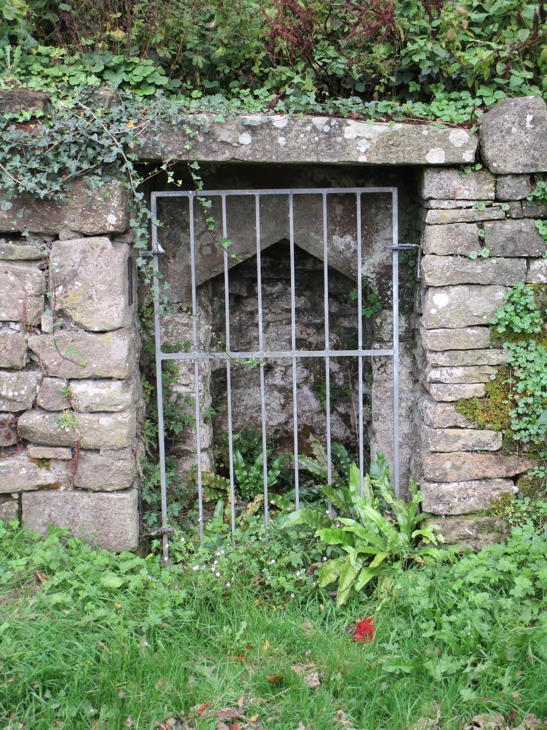
My last calling-point was Staunton, a village back over the Gloucestershire border. My aim there was seeing two more wells. St John the Baptist's Well is the better-known, though it still isn't one of the more celebrated sacred sites in this part of the country. The church is dedicated to All Saints, and the Baptist being the Well's patron suggests it might have been used for baptismal water, though no legend says so explicitly. Instead a little plaque by the well, very quietly sitting at the bottom of a track, informs us that it appears in a 14th-century document and was one of the village's main water-sources until 1931 when a piped supply arrived. 'Restored', says the sign, and looking at the overlooked and overgrown little Well now I doubt any of it is all that old. However, St John's Well looks positively cheerful compared to the other old village well, Brindsey's Well. This is buried in the bank along a lane on the other side of the main road. I had to pull away all the nettles and plants before I could see enough to take a photo, and it's the driest dry well I think I've ever seen. 


Saturday, 7 October 2023

Marcher Land Adventures 1

My Autumn holiday this year took me to Herefordshire - but only a mile from the border of Wales on the one hand and Gloucestershire on the other. My location was here, Rose Cottage, along the kind of lane which has grass growing along the middle.


What I think I may do, rather than breaking the holiday down by topics, is just to describe where my travels took me each day. So we begin by entering the Principality by the Severn Bridge (just as well I wasn't planning to return that way, because you can't presently). I realised I was just yards from St Twrog's Chapel at Beachley Head, whose ruins sit on a tiny seaweed-covered rock just ten metres above the tide, for now at least. I slipped and slid across the rocks to have a look, not entirely sure I was meant to be there as most of the headland is military-owned. There's no sign of St Twrog's Well, which used to be there.


That was the first half-day - Sunday evening. On Monday I went to Monmouth, a pleasant town which seems to be fairly prosperous. There's a long, wide main street which leads up to the Shire Hall and main square with the Priory Church (shut) beyond. St Thomas Overmonnow is a charming small church beyond the Monnow Bridge - the only one in Britain which retains its medieval town gate - and as it has no central aisle it must have acquired its Catholic tradition after it was felt necessary to cleanse a church of such outrages. The Museum is in the process of moving to the Shire Hall, and in terms of objects only has a few broken bits of ceramic on display, but in its new site it will benefit from sharing the building with the old Courtroom, a profoundly terrifying space together with the miserable holding cells in the cellar (see St Albans for a parallel example). 


Previous holidays in Wales have demonstrated how there are castles around virtually every corner. My next stop on Monday brought me to the first of the so-called Three Castles, all commanded in the 13th century by the Marcher Lord Hugh de Burgh. This was Skenfrith. I had hoped there might be a cafĂ© there, but sadly not, and after much delay I finally bought a sandwich from a filling station shop. Skenfrith Church is excitingly plain, though it contains the Skenfrith Cope, a medieval vestment in sadly deteriorated condition. I'd wondered if St Catherine might be depicted on it, but she only cropped up later in the itinerary. 


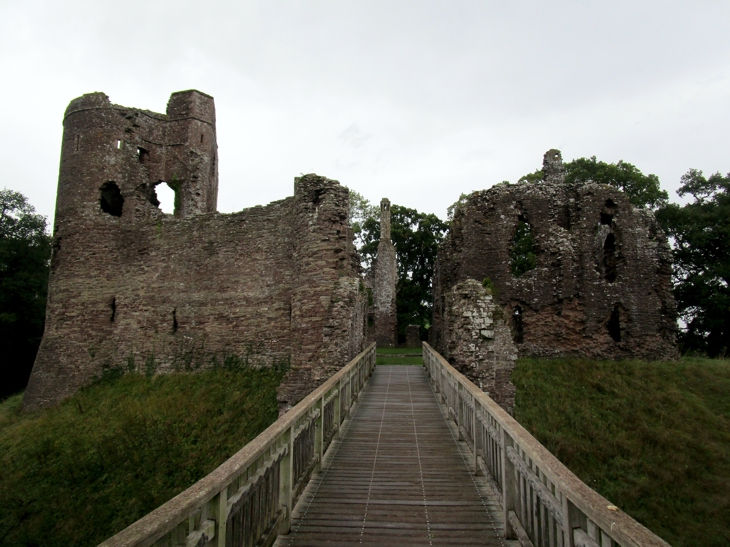
The second of the Three Castles (we have to wait for another day for the third) was at Grosmont: it, too, didn't delay me long and I was grateful that it was free to go in. At Grosmont, again, it was the church that provided the bigger surprise. The congregation has retreated behind a glazed chancel screen to the east end, leaving the nave as a dark, bare, barn-like space with monuments lurking in umbrageous corners: it was utterly unexpected. On the road onwards, I spotted a little folly-lodge, marking the driveway to Kentchurch Court.


By now the rain was falling as I made my way to mighty Llanthony Priory, away up a valley north of Abergavenny. I was grateful for my filling-station sandwich as there were no facilities there, either.


Could I make it, I wondered, to Newport? I zoomed down the rainy road to that coastal city, which, I discovered, is trying its best to look cheerful but really needs bright sunlight to manage even a half-smile. It doesn't help that greeting you along the main road to the car parks is a gigantic Debenhams resplendent in lime green, and empty. The Museum closes one day a week: it was Monday. The Castle by the River Usk is inaccessible. The Cathedral lies a panting walk up a steep hill some distance out of the town centre. The site is very old, but the building only became a Bishop's seat in 1949; entering from the west, you pass through the Romanesque porch through to the east end, which is a 20th-century extension. It's nice, though very obviously an overgrown parish church.


Tomorrow - a walk!

Tuesday, 18 April 2023

Tale of Two Castles

Thankfully Rian-who-was-Cylene and their partner Deri now live in a part of South Wales I can leave my car in and feel reasonably confident it will still be there in the morning - a town a local apparently described as 'tired but functional', which was rather not the case with their previous location - so that's where I was yesterday and today. On the way there, and on the way back, I visited two castles, one offering the real Middle Ages and one a pretend version. The former is Caerphilly, a colossal Marcher fortress with a bloody history of treachery and exploitation; the latter, Castell Coch, which hangs in the woods overlooking faraway Cardiff, built on a medieval site but designed by Victorian Gothic Revival nutcase William Burges for the Marquis of Bute as a fantasy of what might have been there before.


Aesthetically there's little resemblance between craggy Caerphilly and the psychedelic polychromy of Castell Coch, but they both represent engineering triumphs even beyond the usual involved in the construction of castles. Caerphilly is the biggest castle in Wales by area, but what impresses most in building terms is the massive curtain wall that dams the moat-lake, fashioned of huge buttresses flanking concave walls in order to restrain the enormous weight of earth and water behind it. Castell Coch required ridiculous investment in stone-moving and stone-working, artisanship and ingenuity. It used to have a chapel which Burges designed to hang off a series of corbels built into one of the towers and projecting out over the courtyard: it was taken down in the 1890s. Mass there must have demanded faith of a particular kind.