Showing posts with label sermons. Show all posts

Sunday, 17 August 2025

Word from the Pulpit (if there was one)

The readings today were from Jeremiah 23 where God lambasts prophets who prophesy their own fantasies, and Luke 12.49-56, in which Jesus talks about bringing a sword on the earth rather than peace, kindling a fire, and waiting to be baptised with a baptism which is not of water. At the main service I preached a rather rambly sermon which began with God’s rhetorical question through Jeremiah, ‘Am I not a god close at hand, and not only far away?’, and would have ended with the violent imagery drawn from both readings – ‘fire, and a hammer breaking the rock, and a baptism of blood’ – had I not at the last minute veered away to stress how the Cross stands in judgement over us, over the Church and over the world, but the point is that it leads us somewhere better. Somewhere in the middle I touched on the doctrine of the Real Presence – ‘in that cupboard with the gold curtain is the most important thing in your life’ – my own failings (not enumerated in detail), the possibility of some wrong arising in our community which must be named, say a corrupt Council operation, and imagery of angels. There was a lot in it, but I thought it held together, just about.

Over the years I have struggled with understanding the relationship between the pastor and the congregation. What exactly does it mean? Why does the Lord want it to function in this strange way, if indeed he does? I can get my head around the idea that it creates an inescapable relationship (inescapable unless either the minister is driven out or the laypeople leave) and that training in relationship is at the heart of the spiritual life, but why have one person set aside to take this role? You can drag in the traditional Catholic explanation, that ordained people exist to provide the sacraments, but that’s an unsatisfactorily circular argument.

As I was contemplating finishing the sermon with that brutal statement about fire and hammers and blood I imagined myself saying to Giselle the lay reader, ‘Of course you can’t say that’. My feeling would be that it wouldn’t be right for Il Rettore or Marion, when she was with us, or Ted the public school teacher who preaches occasionally, to say it either. I think this is because it is risky. Not only is the expression slightly extreme, but it’s also very directive in a way I rarely am. This is partly what an ordained person sent to a Christian community to speak with the authority of the One Holy Catholic and Apostolic Church is for in a way a layperson (even an authorised one), a retired priest or a curate is not. That status both protects the minister in that they are commissioned to say such things, and also raises the stakes when they do: they’re still going to be there next week (probably), and the congregation’s relationship with them is ongoing and not easy to escape, as we’ve said. The possibility of a strong and directive statement grating like grit in an oyster is part of the point, it seems to me. 

Tuesday, 15 April 2025

Healing Words, Maybe

Past healing masses at Swanvale Halt haven't gone all that well, but eight souls at last night's for Holy Week was all right. The priest rehearses the words and actions of Jesus at every eucharist anyway, and yet it seemed like a special kind of impertinence - a sense of 'privilege', which is what you're supposed to say, was far away - to lay my hand on people's heads and recite 'Receive God's healing touch to make you whole'. 

Only a few minutes before we began I discovered that my homily notes were nowhere to be found, so I had to try and remember what I wanted to say. Il Rettore said it had effectively skated the theological thin ice that holds the healing service up above the abyssal waters of blaming God for our sorrows or blaming ourselves, so I thought I'd put a tidied-up version here. 

When people tell you in response to you sharing some trouble that ‘God has a plan’ they mean it kindly, but it raises questions about the purpose of what happens to us. If we think that our sufferings and sorrows are God’s choice for us, what does ‘healing’ mean?

We can understand healing in different ways – the palpable, natural problems we have that we ask for help with, and the inward shift in our attitudes and understanding that enables us to see things differently. Both make sense: the fact that in the Gospels people come to Jesus and he very much does heal physical issues implies that Christian healing doesn’t only mean passive acceptance of what might come our way, though it might include coming to see our problems in a new light.

Preparing the readings I was reminded of the way the coming of the Christ is prepared for through long ages, foreshadowed in the declarations of the Prophets. God’s saving work unfolds across the centuries, and in so far as we are united with Jesus, we and what befalls us are part of that narrative. We can be confident that, though the fallen world may be arbitrary, and therefore no direct reason lies behind whatever sorrows and sufferings come our way, God is not.

As we follow the way of Christ this Holy Week, we find that he is the site of understanding, the means by which we can place what happens to us in the light of God’s purposes. The events of his passion and resurrection point towards that time when even our sorrows and pains will be made sense of. Christian healing is a declaration of faith in that, here and now.

Sunday, 23 February 2025

D'oh!

What we must now all refer to as Hornington Minster Parish is under-strength at the moment, without an incumbent and short of clergy to look after two of the four churches, so with Il Rettore holding the pass at Swanvale Halt I offered myself to help this Sunday. Given that they do have a reasonable supply of people to preach, I was expecting to be asked to take a communion service somewhere, but no, I was despatched to Hintinghill to do a sermon which anyone, or at least a number of people, might have done. The Minster Parish is one of those kind of outfits that goes in for sermon series based around the enthusiasms of the leadership team rather than the lectionary, so I was given the story of the Feeding of the 5000 from John 6 to speak about to the assembled masses.

This Monday evening I was out at Helgi’s, the rock bar in Hackney, to hear Mr Vadim Kosmos from the Viktor Wyld Museum talk about death-themed cabarets and other morbid entertainments in late 19th-century Paris. The event was originally billed as starting at 8pm; then when I booked a ticket it had moved to 8.45, when I arrived I was told it wouldn’t start until 9, and as is the usual manner of things Mr Kosmos didn’t actually get going until a few minutes after that. 9.05pm is far too late for a midweek lecture to begin if you have a distance to go to get home, and I ended up leaving before even getting to the bit I was actually interested in, as opposed to information about Napoleon III, satirical stereoscopes, and how morgues got their name. Before the talk began I was left with some free time and sat in an alcove opposite a lurid mural of Baphomet and a cascade of skulls to think about what I might say at Hintinghill. I thought of it as claiming the territory (silently). I couldn’t actually remember which of the four versions of the story would be read, and found myself thinking about the differences between them and what conclusions I could draw from that.

At home later in the week, I checked the briefing notes I’d been sent, and these are worth quoting:

The people come in droves to be taught, hanging on Jesus’ every word. It is late and there is no immediately obvious source of food for them all.  … Jesus enacts what will become a familiar pattern, as he takes the bread, gives thanks, breaks it and gives it out. Nothing is wasted and the (twelve) disciples fill twelve baskets with leftovers. The crowds return home satisfied in body, mind and spirit.

Except none of this is actually in John’s account. In that version, there is no preaching, the crowds converge on Jesus as he is with the disciples, and he initiates the events by asking the Twelve to feed them. At the end of the episode, the crowds don’t return home: as a result of the miracle, they identify Jesus as ‘the Prophet’, and he flees out of fear that ‘they were about to come and make him king by force’. The briefing notes aren’t actually based on the reading at all, but on the versions of the story by the other Gospel writers. Curiously this makes John’s point: the crowd is interpreting Jesus according to their own preconceptions of what the Messiah is coming to do, and not paying attention to what he is actually doing. Several of John's stories, I realised, pivot on misunderstandings or deliberate distortions of the significance of Jesus’s acts.

I talked about this, obviously without having a go at the briefing notes. Visiting preachers are always well-regarded unless they’re really awful, and that was the case at Hintinghill this morning. I downed a cup of coffee and a pain-au-chocolat with the good folk there and drove home only to find my William Hartnell fingerless gloves were nowhere to be seen. Back to Hintinghill church – but they’d all left, so I sent the lay reader who was my main contact an email. He later phoned to say he’d been at lunch in the village so popped back into the church but couldn’t find my gloves anywhere. At that very moment I found them in my jacket pocket where for some unaccountable reason my hand had not strayed before that point.

Thursday, 30 January 2025

Steering Clear of the Rocks

The horrid oesophagal spasm which occasionally hits me very rarely starts up in the middle of the day, but that’s what happened as I was setting up for the midweek mass on the feast of blessed St Thomas Aquinas. The only way of stopping it is to swallow something. Water didn’t make any difference, so, avoiding Slimming World who were occupying the church hall, I shot into the kitchen and grabbed a tin of biscuits from the cupboard: eating one breached (my own interpretation of) the eucharistic fast, but the biscuit was horrible, so at least I suffered for it. The spasm was stilled and I was able to carry on.

That was physical pain; I took some emotional turbulence into the service as well. In the midst of my distractions, I reflected how wonderful it is to be carrying out this act that connects us to the eternal worship of the angels, and also that, whoever I may be estranged from in this earthly realm, those broken relationships will (in so far as they can, consonant with the eternal justice of God) be made whole. That’s all very well: it blunts the upset, or puts it into a wider context. At the very least, the words of redemption and praise take you to a different place if only temporarily. But the liturgy and the prayer it is part of doesn’t make the damage go away.

My Spiritual Director was told, as a young priest, ‘You will never get anywhere in the Church if you insist on being so personal in your sermons’. I talk about my own experiences and those of people I know all the time, so I disagree (not that I have ever wanted to ‘get anywhere’ in the Church); but a pastor’s congregation, I think, are caught in contradictory feelings about this. They want their minister to ‘seem human’, to have some sense that they too are subject to frailties and disappointments, but they don’t necessarily want to know in any detail what they are. Equally, the pastor may want to bring personal experience to bear to inject some reality into what they talk about, but it's a tactic fraught with hazard. Oversharing might not only head into areas that most people would rightly be reluctant to talk about, but might also be burdensome. You can think of circumstances (of illness or another misfortune) when a minister might need to be ‘held up’ by their people, but you don’t want them to become reluctant to share difficulties with you themselves out of concern for your own welfare.

The Feast of the Angelic Doctor afforded me limited opportunity to discuss my own difficulties anyway, and in the end I tend to veer away from deep emotional waters unless I have navigated them many times before and know how to talk about them in a way others may find helpful. Because ultimately the pastor's job is to serve, and only relieve your own burdens when it will definitely benefit your listeners to do so.

Monday, 30 September 2024

Angels in Ordinary

Michaelmas Day gives me an opportunity not just to speak about angels but also our former sacristan Sister Mary, the ex-nun who 'always kept her vows' even when the Community of the Sacred Passion told her that because she couldn't put up with the climate in the parts of Africa where they worked, there was no place for her in the Order at all (poverty and chastity weren't a problem, obedience was a bit more difficult). This is because September 29th was the day she took her final vows all those years ago, and I always regard it as a subsidiary, local festival to Swanvale Halt: the Feast of the Solemn Profession of Vows of Blessed Mary Fontingham. We didn't always see things from the same point of view but our disagreements were mostly aesthetic: she felt Roman vestments made priests 'look like beetles scuttling about', and I never got my head around her fondness for gold lamé in the embroidered items she made. Yesterday, though, we did use the burse and veil from the old 'best white' set in Mary's honour.

I talked about Christianity's insistence on a hidden level of reality and the way the religious life is committed to uncovering that reality with an intensity that laypeople don't necessarily have to, even though we're called to acknowledge and proclaim it. We're not alone in doing so - the angels sing with us, but while we sing from a place of hope, they sing from one of certainty.

The congregation wasn't large yesterday; I looked out and realised that probably barely half the people there knew Sister Mary, but have joined the church since she died back in 2013. That caught me by surprise. Even the saints disappear gradually from human recollection, and are left to God's. 

Sunday, 9 June 2024

Clearout

My computer, like most people’s I suspect, is clogged with irrelevant stuff. In the time I’ve been at Swanvale Halt I’ve changed laptop three times and have meekly and unthinkingly copied everything across from one to another. Now I’ve decided to dispose of everything that doesn’t seem useful – all the duplicated photos, the outdated downloaded documents, the superceded liturgies, the items that are far better off on the church office computer than mine – and the sermons.

I preach a great deal, on average three times a week, perhaps (at least that seems like a great deal to me, perhaps it’s not). It’s probably, in fact, my major form of creative output. When I started out at Lambourne I used to write everything out longhand, but when I arrived at Swanvale Halt this seemed too onerous to keep up and for 8am and midweek Masses I got into the habit of scribbling notes and then preaching from them. But when we reopened after the first Covid lockdown I began preaching from a brief outline as part of the attempt to be as brief as possible. I preferred it: it felt more lively, if less polished. It’s not a disaster if I stumble in my search for the right word (as I often do), but I have to steer clear of the hazardous waters of repetitious waffle and be very clear how the sermon is going to end! For one-off occasions – funerals, weddings, and special events – I still write everything out. But there were between four and five hundred written sermon texts remaining on the machine.

I felt a bit of a pang deleting them, as I suppose they represent a significant part of my creative energy, but the fact is that I have never, ever looked back at a single one of them. What would be the point in keeping them? Once upon a time clergy were in the habit of publishing books of sermons, but unless you are John Donne this would seem to be a decidedly otiose activity in this day and age. I remember once picking up a book of ‘Best Sermons of All Time’ and turning to the offering from the mighty Charles Spurgeon: it was turgid and lifeless by our standards. If any of my efforts have ever touched anyone for the good, it will have been for that moment, that time and place, and a sermon lifted into another context from the one in which it’s preached is likely to be baffling and hollow. Getting rid of these files is a small act of liberation. 

Wednesday, 7 February 2024

Is There Anybody There? Yes, There Is, Says The Lord

Once we got beyond the basics, the conversation with the woman who’s joined the team of one of our regular events went in an unexpected direction as she described the comfort she’d derived from visiting spiritualist gatherings, and how Christian friends had reacted (she said) with horror. We discussed why someone might want to engage in spiritualist activity and what the problems might be from a Christian point of view. She agreed that there were possibly malign things lurking in the hidden world, but stressed how her experience had been positive. ‘You’re not going to hear this church announcing “And now we’ll have a séance”’, I said, ‘but I’m not shocked’, which I’m not.

Curiously the readings at mass the day after were the consecration of the Temple from 1Kings, and Christ’s critique of the concepts of clean and unclean practices in Mark 7: these led into a reflection about one of my recurring themes, the contrast between two opposed approaches to religious life. The first is that you ring-fence the sense of the divine with rules and structures to prevent it being contaminated by the profane world and eventually eroding altogether; and the second that you use the sense of the divine to find its presence elsewhere. In my own Bible reading in the morning, too, I found the Lord assuring Moses in Exodus 4 ‘I will be with your mouth and teach you what you are to speak’, encouraging a degree of trust in God which I fall short of all too often. ‘He reigns’, I concluded to our small congregation, and if he reigns there is little to fear in the sometimes wayward spiritual practice we encounter in others. One of the issues, in fact, with seeking solace in talking to spirits is that it’s based in a basic lack of trust in God that we are called to grow away from.

If we are critical of what others do, we must surely know that they aren’t simply going to change as a result of something we say. Nobody is going to blink at us and reply ‘You know, I never thought about it like that. I’m going to stop from this point forward’ – although they might, at some point distant from now, shift their ideas and reflect that perhaps we were right. If we don’t expect change in that way, it raises the question of what we’re doing when we react ‘with horror’ at someone else’s behaviour. I think it may be that we fear that if we don’t rebuke the sin, God will blame us for not distancing ourselves from it. The sin will contaminate us and we need to protect ourselves, to signal to God that we want nothing to do with it, to put up a protective barrier between us and it. It’s not the other person that’s uppermost in our minds.

Now, there might well be particular sins that beset us and from which we do need to flee. When Christ says to St Peter ‘get behind me, Satan’, it’s because the Apostle is raising something that’s a genuine temptation for him: it’s actually important. Knowing this is just proper spiritual self-awareness. But that’s not the other sinner’s fault; most of the time it’s not at issue (I have no desire whatever to contact my long-dead relatives); and our words are seldom as much to the point as the Saviour’s.

Thursday, 21 December 2023

Christmas Revival

As Christmas approaches there is often a spate of journalistic comment about religion that doesn’t necessarily bear on the season, but on the state of Christianity as a whole. Dr Abacus recently called the attention of myself and other clergy he knows to a piece for the FT by Camilla Cavendish, about the benefits of religious observance, while in The Scotsman Tory leader in Scotland Murdo Fraser tilts at the long-toppled windmill of Dr Richard Dawkins to allege ‘early signs of a Christian revival’ in the UK. I thought both were a bit questionable. Baroness Cavendish describes herself as an unbeliever but prescribes religion for personal wellbeing, while Mr Fraser, while also declaring Christianity’s utility in answering what he reports as Nicky Gumbel’s summary of human needs – ‘to be loved, to have a purpose, to belong’ – adds to them its role in underpinning 'Western values', basically roping God into culture-war discourse. His description of Christianity’s ‘inspiring message of hope and light’ rings every bit as hollow and unconvincing as you might predict. I’d never dream of using arguments like this. The first amounts to ‘come to church and you might feel a bit better’, while the second translates as ‘come to church and together we can stop the Muslims’. Never satisfied, me.

Meanwhile over on Radio 4 we have a somewhat more rewarding and intellectually hard-edged diatribe from Will Self:

It’s precisely in order to hear [these ultimate questions] posed that I attend church services of all denominations, and ones in mosques, ashrams, gudwaras, and synagogues as well. Other non-believers may go for aesthetic reasons, and especially at this time of year, for a live enactment of some Christmassy reverie; I go, as I say, to test the mettle of my own understanding of my self, and its relation to others and the world, and for this to work for me, I require a sermon! Often, I’ll find the sermon in the established churches so woefully bad I have to restrain myself from heckling. It’s not just a matter of banal popular cultural references, it’s the reduction of the majesty and awe that should be associated with this extraordinary belief system to a kind of weak humanist jus.

… which all acts as some sort of cautionary warning as I compose the five sermons I will preach across Christmas Eve and Christmas Day, just in case someone like Will Self is there, ‘believing that any sermon I hear could be the one that triggers some profound conversion experience’. At least he was mildly approving, despite one throwaway reference to Nigel Farage, of what he heard ‘on Advent Sunday as I sat with about forty others in the exquisitely beautiful St Jude’s-on-the-Hill’, preached by, as it turns out, Revd Emily Kolltveit, former Mediaeval Baebe and leader of symphonic-metal band Pythia before she caught religion. I wonder what sermon got to her.

Saturday, 11 March 2023

Opening the Word

On Tuesday morning I emerged from the vestry to discover that nobody had braved the chill and damp to join Rick and myself for mass. Like many churches at our end of the spectrum, we gave up a daily eucharist, in the late 1990s in our case, because it had become unsustainable - though my scouring of old service registers is revealing how it was barely sustainable almost everywhere even when it was happening. The Tuesday service is the only survivor of that tradition, and again you can find that pattern in many churches.

We carried on through the service just in case anyone else came along, which has happened in the past, but it meant my meditation on the Feast of SS Perpetua, Felicity, and Companions didn't reach more than a pair of ears, so here it is. I offer it not because it's a masterpiece of the form, but because it's representative of the kind of short homily I usually offer on such occasions. Readings were Revelation 12.10-12 and Matthew 24.9-13 (mercifully brief).

I often say that the early martyrs we commemorate in the calendar are people we know next to nothing about, but that’s not quite the case with Perpetua, Felicity and their companions – though what we know about them is mainly the story of their martyrdom, which we have a detailed account of, some of which could even be in their own words. In fact, through that account they became the model for the early martyrs of the Church, and accounts of what happened to them, as well.

Some of the story might seem a bit morbid and odd, especially perhaps the bit where the gladiator is making a mess of despatching Perpetua and she basically says ‘Oh, give it here’ and grabs his sword-arm to guide the knife to her own throat – but then if you’re on the way out anyway you probably want to expedite matters!

In fact in the story I find myself thinking today less about the saints and more about the crowd in the arena in Carthage at the time. Martyrdom is hard, but cruelty is all too easy. For the crowd watching Perpetua, Felicity and the others, that kind of cruelty was part of public life, the culture they were brought up with. Even if what happened in the arena was often a way of executing people, it was death as a spectacle, an entertainment, whether people were being gored by wild animals, or someone who’d never handled a weapon before was being put up against a professional gladiator – they weren’t going to last very long. The crowds had learned their cruelty.

We must be aware of every step that takes us along that road, whether as individuals or collectively, even if it seems like a small one – because we know where it goes. To argue and act against cruelty in our own time, which may not be popular at all, may just be the martyrdom we are called to. 

Sunday, 19 February 2023

Talking Catholic

Back in November I began my series of talks about elements of what (in my opinion) it means to be a Christian and specifically an Anglican who includes the word catholic in their sense of identity and purpose, inspired by the story of the empty aumbry discovered in a nearby church by a former Area Dean: I've just completed it, in a rather hurried fashion as I wanted to get it all done before Lent begins. My aim was to escape from any impression that Catholic Anglicanism is primarily about incense and vestments - despite any appearances to that effect - and instead talked about The Communion of Saints, The Real Presence, Authority, Tradition & Obedience, and The Prayer of the Church, about the Office and how it works. The fifth and final talk, however, did major on worship and its features, thinking about how what churches like ours (and further up the candle) do is a way of helping embodied, fleshly beings meditate on the saving mystery of Christ, and reflects the fruit of long spiritual experience in the past. As well as The Beauty of Holiness, I also touched on Spiritual Disciplines and how they help anchor our worship in reality and stop it all wafting away into self-indulgence. 

Has it made an impression? People have certainly been interested, but if they also show an increased knowledge of these themes and self-awareness of our particular charism within the Church of England, I will be pleased. I started today's talk with this image: I can always rely on Fr Thesis's west-end church if I need a nice splurge of high-churchery to share.

Sunday, 14 August 2022

Payback

While we were keeping today as the Ninth Sunday after Trinity, the Roman Catholic parish were observing the Assumption of the BVM. But, disaster! Deacon Justin had turned up in a white-and-blue dalmatic, while Fr Jeffrey had left the parish’s Marian kit in Hornington. ‘We have a white-and-blue set’, I offered, showing Fr Jeffrey the vestments in question. ‘And it’s a nice lightweight one, too’, he said enthusiastically. Indeed it is, and in my view the very best of the church’s own kit, a beautiful ivory damask from the late 1940s. The Assumption is, in the immortal words of Bishop Mervyn Stockwood, ‘not an assumption we share’, but I was delighted to see the vestments used.

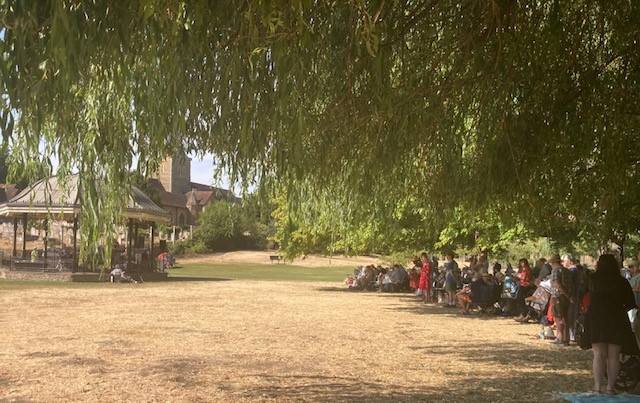
In fact we had no main service at all, observing whichever observance, being invited instead to Hornington Bandstand for the Churches Together summer service. It was the usual hymn-sandwich which I see, in the terms of traditional moral theology, as materia exercitandi virtutis: it had the benefit of being short. We did consider whether to move the service into the parish church because of the heat, but decided to stick it out – we’d had to shift the Jubilee one in June indoors, and it would have been a shame to have to do so again. If some worshippers succumbed, well, there are others. I was given Psalm 8 and preached on drought, the fragility of civilisation, and apocalyptic. My punishment was to be collared afterwards by a woman who wanted to convince me that the ‘killer injections’ (otherwise known as the covid vaccines) were about to murder hundreds of thousands of people. Served me right for ignoring Our Lady. 

Monday, 10 January 2022

Coming Around Again

One of my current projects is to reunite as many as possible of the Spiritual Instructions of Fr Reginald Somerset Ward, the Anglican spiritual director in whom I’ve had an interest for some while. He issued more or less one a month for years, eventually totalling about 450. Some time ago I was sent printed copies of the majority of them, and I now have copies of his books in which many more were published in extracted form. Some are lost, but it should be able to compile three-quarters or more of them.

Fr Ward eventually gave up issuing his Instructions in 1957 on doctor’s advice (he was already 76 by then) and was evidently flagging a bit in the years before that, sometimes only managing one missive to his directees every two months. I wonder whether the slowdown was caused not only by health but by the lack of much new to say after forty years or so. I am only scanning the documents rapidly at the moment rather than reading them, but even so I can detect pet themes and writers being repeatedly mentioned. In contrast, I’ve only been ordained 17 years but there are already many times when I finish composing a little homily for a quiet said mass that I am pretty sure I’ve said essentially the same thing, on maybe more than one occasion!

Nevertheless the round of preaching, driven as it is by the lectionary cycle, does mean you try to come up with new thoughts. At least they may be new to you: it seems to me vanishingly unlikely, even when I produce something I’ve never considered before, that nobody else in the past two thousand years of Christian history has ever stumbled across the same motif.

Now and again you draw something from the texts you are given which seems to offer you some help as much as your audience, but it turns out to be a variation on a theme. Last Sunday was the Baptism of Christ and I spoke, naturally enough, about the relationship between Christ’s baptism and our own. Take whatever it is that causes separation between you and God, and drown it in the waters, I said, or something like it. But is that very different from nailing it to the cross – the kind of imagery we might use in Lent?

The supposed spiritual insights we happen across either for ourselves or from others have a resemblance to, say, dieting fads: here is the thing, the new thing, which is going to make the lasting difference. And we fall on it enthusiastically, pursue it for a little while, and then find it not working, and eventually forget about it.

But perhaps such spiritual techniques can only work for a short time, and that’s all we can expect from them. I try to follow the advice of Metropolitan Anthony, and draw a phrase or verse from my morning Bible reading which shapes my thoughts for the day ahead, usually turning to a new one the following day. I find Fr Somerset Ward counselled the same sort of thing: to take something from your morning meditation (he assumed that would be when you’d do it) and use this as the basis for spontaneous prayers through the day. None of these phrases are supposed to be the one thing that can revolutionise your spiritual life, because nothing will. It’s a long-term business, and such is the dullness, perhaps, of the human soul that we constantly need some new direction to approach God – which will do no harm, provided we recall the unchanging nature of the one who draws us near. 

Wednesday, 30 December 2020

A Final Word (for 2020)

At Lamford, they have shut up shop and resorted to online worship only. COVID case rates in that area are nearly twice what they are here, but the hair-raising reports of ambulance queues and escalating infections have made me, and not just me, wobble. Are our churches contributing to national disaster?

Swanvale Halt services are as COVID-compliant as they can be, even if I have to keep reminding people (including myself) not to have social conversations inside the church building, and opening the doors when helpful souls close them 'to keep the warmth in' when of course at the moment that isn't the only thing you keep in. But it's not just the safety of the event: the event is surrounded by ancillary risks, of people moving in and out of a vestry, handling things (not matter how careful they may be), and travelling to and from church. Multiply these risk-events by thousands of churches across the country, and there is almost bound to be some infection arising from them somewhere. If the focus is not on making discrete events tolerably safe, but reducing infection by reducing general interaction, you should shut up everything you can, and in Tier 4 there's precious little left to shut up except worship settings.

The trouble is that this is not a decision about the management of a particular church - as deciding you can't comply with the rules would be - but about public health. It is to say that the Government should be closing churches. If I were them I might well decide to do so, but I'm not. I'm not taking decisions about public health. In this blog I've stressed the vital importance of rule-based orders, societal norms and legal structures over individual preference over and over again: I feel deeply uncomfortable about making my own choices on these matters based on what must surely be arbitrary and very personal factors.

People are different, and we need people to be different for society to change and progress. Human difference is an absolute social necessity. It’s also an uncomfortable necessity because the behaviour that arises from difference is not necessarily morally neutral and often even when it is it can be couched in moral terms. For instance, people are more or less risk-tolerant. Most of the time the effects are marginal, and we can debate whether mountain-climbers are responsible or whether it’s acceptable to drive faster than the speed limit safely, without much at stake.

These decisions can have radical consequences but they affect very few people at any one time. During an outbreak of infection, however, everyone is faced by the same situation, and thus everyone has a stake in each other’s behaviour. But this behaviour is still conditioned by personality more than pure reason. Because those differences remain, what may seem to one person to be a rational response to risk appears reckless to another. This is why relying on ‘common sense’ to guide behaviour is problematic: what appears to be ‘common sense’ differs from one person to another, sometimes quite radically. Ultimately there is little that is ‘common’. We end up justifying our own behaviour and by implication criticising the next person’s when, in rational terms, there’s little to choose between them.

This is why, in the current circumstances, we absolutely must set, and stick by, common rules and standards, which means they are settled by Government. Today the Government kept the Tier 4 rules as they are, and the Bishop told me that he couldn't give any positive direction as that would mean being out of step with other dioceses. So I will keep the church open for those that want to use it.

Although I am sort-of off work, we were open today for a quiet midweek mass. At first the readings (1John 2.12-17 and Luke 2.36-40) befuddled me but then I remembered Fr Montgomery-Wright and his description of how the Prayer at the Foot of the Altar, introibo ad altarem Dei, helped him enter into a place where age seemed immaterial, where youth was eternally renewed by the Spirit. So I found myself saying:

1. Here is this character Quintin Montgomery-Wright and what he said.

2. Here is what St John said. Why is he addressing these three groups within the Christian community ('children', 'fathers', 'young people') and what does it say to those of us who are none of them?

3. In fact seen in the eyes of God we are all of them, spiritually, and at different times. However old we might feel, he renews our youth. That's part of what it means, as John says, not to be attached to the world, but to the Spirit.

4. Anna the prophetess discovers the fulfilment of her life right at the end of it, when the longed-for Messiah comes to the Temple and she greets him. God still has work for us all as he renews us day by day!

So that is my last homily for this year, but not, apparently, my last at Swanvale Halt for a while. And, just to round things off, the mower is now working:


PS. However there is also the possibility that the Government is actually giving no thought to this specific matter at all, and the bishops are not wanting to give any lead because that would be to criticise the Government in turn. In which case, the balance of conflicting considerations becomes different.

Sunday, 24 November 2019

Christ the King 2019

Some clergy post all their sermons online. I don't very often, but this was a tidied-up version of the 8am homily today, and I thought was almost a blog post anyway.

Readings: Jeremiah 23.1-6; Luke 23.33-43


"The feast of Christ the King was only introduced in the Roman Catholic Church in 1925, and found its way into the Anglican calendar from the 1970s. So this year is the very first time in the UK that this feast day, when we celebrate the kingship of Jesus Christ and his sovereignty over all creation, has coincided with a general election campaign.

"Now, far be it from me, brothers and sisters, to influence how you might cast your ballots in any way, even if I could! But that declaration in Jeremiah that God will send his people a shepherd who will rule in righteousness and justice does compel us to think how that’s reflected in the earthly powers who govern us day by day.

"It seems to me that there are at least four kinds of political lies. The first are the kind of lies you tell to get out of trouble, to cover up something you’ve done or not done, and those come to all of us depressingly easily. Secondly, there are the lies you have to tell to avoid bad things happening, what Winston Churchill called not lies but ‘terminological inexactitudes’, like Jim Callaghan as Chancellor in the 1960s saying he had no plans to devalue the pound. Then there are the lies which represent what people want to believe is true, as when political parties say what they intend to do when they know they probably can’t, or when governments say they’ve spent X amount of money on a thing when it takes creative accountancy to arrive at that figure. Often the people who tell that sort of lie actually convince themselves it really is the case. But the fourth kind of lie is the deliberate, conscious attempt to deceive, and that, it strikes me, is uniquely corrupting.

"The whole of human society rests on trust. We have to believe that most of us, most of the time, mean what we say. If we stop believing that, normal human interaction starts to become impossible. It’s all very well to talk about ‘public trust in politicians being at an all-time low’, but I don’t think distrust in politics stays within politics: it bleeds outwards, affecting how we view each other and the kind of society we are part of. I’m not sure our politicians really understand how dangerous it is when they lie, dangerous not just to themselves and their own prospects, but to the whole of society: it corrupts all our relationships by shifting what we think is normal.

"The Crucifixion is a brutal reading to have on this last Sunday of the Church year. But what it holds before us is an unavoidable truth revealing who Jesus is, what God is like, and our own nature too. The Crucifixion shows us that it is the suffering one, the lowly and despised one, who God vindicates and crowns as the king of all creation. There is no dissembling here, no covering up, and no attempt to gloss over the real condition of things. There is instead in the Cross the triumph of something beyond all human control and power, which does not break down the truth, but makes honesty about who we are the basis for trust and hope. And at that all the powers of the earth should tremble. If they were paying attention! Amen."

Sunday, 10 March 2019

Mortal Signs

No matter what the investigators of Vice.com felt, I find it no surprise that Goths show the same sort of variation in their attitudes to the fact of death as everyone else, something that Goths themselves are probably quite surprised by too. Decorating yourself in the signifiers of death doesn’t imply any particular view of it, or even, I fear, any greater-than-average willingness to confront its reality.

I was going to write a blog post about that article some time ago, but realised it was probably going to come close to the anniversary of my operation last year, which in fact falls today. It was, you remember, nothing drastic, but still the first time I’d had a general anaesthetic, and who knows what might have happened. As I’ve aged and drawn almost definitely closer to the end of my life than the beginning, death has become less a philosophical presence in it, and has come more into focus, somewhere towards the bottom of the hill below my house, slowly and unhurriedly making its way in my direction. I’ve thought more about the process of it, the events that will throw me out of this world, whether it will be painful, or whether I will know anything about it at all. It boggles me, even if it shouldn’t, that the two experiences all human beings share, coming into existence and leaving it, are the two we are utterly ignorant about. I know when I am dreaming; will ceasing to dream be something I am aware of? Will I feel the pity of it, that my unique collection of mental nonsense will (so far as this world is concerned) be coming to an end? Will I panic? How will I react? Or will it be like the utter blank of the anaesthetic sleep? Nobody can give anyone clues.

I told the congregation today this. I have lived a mainly happy life, and I have very little to complain about. Untold myriads of human beings have not been so fortunate, and should I ever be tempted to despair it does me good to think about them, and to ask myself why I imagine I deserve anything different. The vast and uncountable mass of human souls have lived and died and left not a trace behind them, many of them not even in their descendants because they died before having a chance to produce any. The ways in which human beings can be suddenly and with barely a moment’s warning thrown out of this life are so many and various they boggle the mind. Three people died in an accident today on the M4, the news might say, four were shot dead during protests in the Palestinian territories, seventeen died in a fire in a nightclub in Rio de Janeiro, the death toll in the outbreak of ebola in West Africa reaches 11,000. In 2004 my predecessor in Swanvale Halt organised the church in helping the relief effort after the Boxing Day tsunami in the Indian Ocean, a single event which killed 228,000 people in a few hours. So many souls, wiped away so fast. Why should I expect any greater fairness than they got? And in that I find some strange comfort, and even courage.

Thursday, 4 October 2018

Mortified

'Sermonettes make Christianettes' a former vicar of mine commented when members of the congregation complained that his orations were creeping beyond the twenty-minute mark. I've never believed that sermons contribute that much towards the spiritual growth of a congregation, or at least that their effect is most unpredictable.

On Sunday at 10am I mentioned some of the themes I described in my last-but-one blog post. I was in a good mood, even a spiritual mood when I wrote it, full of thoughts of Blessed Mary Fearon and the Little Flower of Lisieux. On Monday at Morning Prayer Hannah who organises one of the house groups where they discuss the preceding Sunday's sermon said, 'I just want to check - your sermon was about the importance of worship?' I was taken aback as I hadn't any thought in that direction at all: unfortunately Hannah is extremely sensitive and any suggestion that she might have 'got it wrong' would propel her into worry. Lillian the lay reader at first said she couldn't recall what the sermon was 'about' as such, but then said that if pushed she would summarise it as being concerned with the power, and also the ambiguity of prayer. I said both of those had come into it, but I thought it was important not to tell people 'what it was about' but to let them take away what they needed.

In fact I thought I was preaching about the vocation of all God's people. Perhaps I was; perhaps I wasn't. Perhaps, indeed, I should take a poll, and then I'd know.

Saturday, 4 November 2017

Lowering the Bar

The great journalist HL Mencken was once asked how he managed to produce so much and where he got the ideas for his perpetual newspaper articles. 'I sit and squeeze my brain until something comes out', he answered.

This workmanlike approach to creativity has always greatly inspired me ever since I heard it, and hardly a sermon-writing session befalls me than I find the words running through my mind. Sometimes what comes out of my brain is nothing very impressive and I have the distinct feeling that I've said it all better, and many times, before. But words still need to be produced. Sometimes the business of a priest is silence. I like those times. But, at least just as often, it is words. 

This week has required quite a number of them. The specific occasions were:

Sunday: a funeral homily and notes for my ministerial review the following day.
Monday: a homily for the All Saints' mass on Tuesday; notes for a staff meeting that we decided to do via email as there was no time actually to meet.
Tuesday: polishing up a plan for a session with the ATC that evening, and suddenly realising I was down to do two sessions, necessitating writing something completely new with the aid (arguably) of Powerpoint; a public statement about 'an extreme pastoral event' in the parish; a homily for the All Souls' Day mass on Thursday.
Wednesday: a story and surrounding discussion for Church Club that afternoon; a set of articles for the public newspaper we send around the parish; writing the liturgy for the Family Service on Sunday.

(Thursday was a day of talking to people rather than planning or writing, and Friday I was off).

Saturday: a homily for the evening service on Sunday.

Now, I am not describing any of this to elicit sympathy: although this week demanded an unusual quantity of creativity, there was just about enough time to get it all done (especially as a couple of time-consuming appointments ended up dropping out of the schedule) and despite it being on the hectic side it's better to be occupied than kicking your heels and castigating yourself for it. What it illustrates is the sort of low-level creativity that clergy are so often involved in. Nothing is very high-powered and had I spent ages polishing my work I would never have got it all done. Not for the first time, I find that the creative side of parish life is on a par with hack journalism: we sometimes have to produce stuff which is good enough and be content with it, squeezing our brains and not being too precious about what comes out. All my stuff this week was good enough. At least I hope it was.

Monday, 25 September 2017

Jigsaws

There is a school of thought among clergy, and those who train them, that you should never allude to personal circumstances in sermons for various reasons: maintaining the distance appropriate to authority, not giving the ill-disposed ammunition against you, or exercising a proper reticence over things that may pertain to other people. I don’t follow this line: you, as pastor, are a human being struggling with the business of trying to live the spiritual life just like the people listening to you, and it helps for them to know that.

On Sunday I was talking broadly about occasions when we’re compelled to reassess our relationships with others and our view of ourselves, and described, very broadly, my dealings with someone formerly very close to me, and now less so, and how my conflicted emotions had made me realise that what I thought was me responding to their need actually included a neediness of my own - the need to be useful and to imagine myself as self-sacrificing and generous.

Amanda, a member of the congregation who often gets into arguments with other worshippers about the way the church works and who can seem a bit prickly wanted to talk to me about it. ‘I think there are times when our needs meet the needs of others and something good comes out of it,’ she said. ‘I think of us being a bit like jigsaw pieces, fitting together in a way we don’t always see at the time.’ Not a surprising thing to say, but you often need someone else to tell you what you know.

Amanda looked at the people milling around and drinking tea in the church hall. ‘I know I can be argumentative, it’s the way my family was,’ she went on, ‘but I look around at the church and I see people helping each other and I think, They’re not a bad bunch.’ No, I agreed, they’re not. They can help me along in ways I don't expect.

Sunday, 13 August 2017

Seeing the Wind

Usually when I sit down and write a sermon it ends up largely how I planned it when I started. Not the other day.

The readings set for this Sunday were from 1Kings, where Elijah encounters God in the 'still small voice' on Mount Horeb after the wind, earthquake and fire; Romans 10, in which St Paul discusses faith and righteousness; and Matthew 14, the story of Jesus walking on the water and calling Peter to come to him. I had thought of the wind - which is very present in both the Kings and Matthew readings - as a metaphor for all the things that hold us back and discourage us, which was all very well.

But like many people I'd always been befuddled by that detail in the Gospel story that Peter walks towards Jesus on the water but then 'saw the wind and began to sink'. Why is it seeing the wind that makes him realise what he's doing is impossible?

I found myself thinking this way. It seems fairly clear that, in the mists of unrecorded history, Yahweh God of the Hebrews was a storm deity: that was how they originally conceived of him. Some of the Psalms, possibly the oldest stratum of Biblical text, refer to him in this way; he makes the clouds his chariot and rides on the winds, they say. Gradually the Israelites come to read the calamitous power of the storm not as a direct sign of the presence of God but as an image for his righteous wrath, provoked by injustice and oppression. So when Peter sees the wind churning up the surface of the lake, that's what he thinks of. He remembers his own unworthiness and the awesome righteousness of God; his fears and doubts about his own acceptability are re-awakened ('go away from me, Lord, for I am a sinful man') - and he sinks. 'Why did you doubt?' Jesus asks him, and his doubts are not about whether Jesus has the ability to enable him to do this impossible thing, but whether he, Peter, is worthy of it. Which of course isn't the point.

I sat and looked at what I'd just written a little surprised. I can't quite bring myself to believe that nobody has stumbled across this gloss on the text before, but I've never heard it.

Monday, 26 June 2017

Black Clouds and their Dispersal

That promised upbeat post isn't coming quite yet, I fear. S.D. likes the idea of there being clouds of melancholy which sort of hang around waiting for someone to encounter them, and that you can blunder into them unawares and take some time to re-emerge. 

As sometimes happens, I was in one of these over the weekend, and arrived in church on Sunday with my mind primed for misery. There weren’t very many people around and some of the most active people in the church are away for all sorts of different reasons. Anyone under 70 was in short supply. Debbie our ordinand (‘our ordinand’ no longer, but ordained) will now be reeling around the southern suburbs of Ipswich as she gets used to her training parish, removing another enthusiastic presence from Swanvale Halt. As I was on my way down the hill I was accosted from a car by another couple: ‘we won’t be in church this morning, our grandsons are with us’. Family as rival to faith rather than partner with it. Never have I got so close as I did yesterday just to walking out in despair at our ability to have any impact even on the lives of those who are the most faithful. ‘It’s hardly uplifting to suspect that you’re merely in the business of spiritual terminal care,’ S.D. had reflected when I saw him. Of course those people matter as much as anyone does, and our hearts should be set in heaven and not on earth and its vicissitudes. We know that; ‘It doesn’t really help, though, does it?’ S.D. concluded.

I was deacon at the 10am mass, so not presiding, and as it happened not preaching either. I sat and listened to Marion our curate talking about Jeremiah 20 and how in church life we tend to cover up what we really feel, worried that it’s not appropriate. I wondered how far I could share what I felt, how far it was real, how far it was merely neurotic, and how far it would be helpful or harmful for my grimmer emotions to be let free to lash around the church. Gradually it became easier to ignore my sloshing inward negativity. The adrenalin of doing a big christening service with lots of children kicked in: at one point I was leading some prayers and opened my eyes to see a little girl in the process of knocking over the Paschal Candle, just in time for me to reach out and catch it.

This morning I sat with Zechariah the prophet and read what he had to say. ‘When you fasted and lamented in the fifth month and the seventh month for these seventy years, was it for me you fasted?’ the Lord asks the people. The answer is clearly no, which is why they end up driven out of their city and scattered abroad. But that’s not the end of the story: ‘old men and women shall again sit in the streets of Jerusalem, and the streets shall be full of boys and girls playing. Even though it seems impossible to the remnant of my people, shall it seem impossible to me?’

Caught up in our own particular circumstances, it’s hard to see beyond them. This time of the purging of the Church, which still has to give up its desire for power and success, means it’s a surprise anyone still wants to come to church at all. We have fasted for entirely the wrong things. But this is the long story of God’s people, and this oscillation, this wave, moves through the narrative again and again. The remnant turns again to God, and things change. Our call is, as it always is, to persist.