Showing posts with label holidays. Show all posts

Thursday, 16 October 2025

Lincolnshire (and Bucks): Big Churches and Things In Them

Of course one of my stopping-points in Lincolnshire was the Cathedral, gigantic and splendid. I was glad the presence of the Imp was pointed out, so I could avoid photographing it by accident and taking its baleful influence with me ("that which holds the image of an Angel becomes itself an Angel ..."). I paid my respects to Bd Edward King, whose statue presumably depicts him raising a hand in blessing, but it always looks as though he's just saying hello. And then there was this wonderfully pompous 18th-century clergyman who is surely thinking, 'God thinks I am a thoroughly fine fellow, and who am I to dissent from the Lord's opinion'.

But there was also a range of huge churches in modest places. St James's Louth was first, with its scary paper angels:

Followed by St Botolph's, Boston, and its carved knight who is surely Death:

And then St Wulfram's, Grantham, where the scary artefact is the shrine of St Wulfram itself:

(And then there was St James's Grimsby, 'Grimsby Minster' as it is now known, which I couldn't get into).

All these buildings are almost shockingly big for churches which have no history of belonging to religious communities - contrast Lincs with my native Dorset, where all the big churches - Christchurch Priory, Wimborne Minster, Sherborne Abbey, and Milton Abbey - were all monastic at one point. That partly reflects the medieval wealth of this part of the country, but also some other historical factor that led to these towns maintaining one major parish church rather than a collection of them. Stamford, which I visited on the way home, is different, though just as prosperous once: there are five surviving medieval churches there, out of at least as many again. 

But visiting High Wycombe, where I used to live, this week, I was reminded that the situation was the same there. All Saints' is the only old parish church, and, like the Lincolnshire examples, is bigger than it needs to be. I was pleased this time to find it open, which it hasn't been for some time. 

Was St Catherine present? She was, though all in relatively modern images; from the left, a window at Louth, carved above the choir stalls of the Cathedral, a window in the crypt at Boston which has a good stab at looking medieval, and a statue at High Wycombe, very unusually holding what I suppose is intended as a small globe. How can I not have noticed it in the seven years I lived in the town?

Sunday, 12 October 2025

Lincolnshire: Museums

It's time for an annual slew of posts about thing seen on my holiday, this time in Lincolnshire, an area I only knew from a very brief visit many years ago when applying for a job in Barton-on-Humber, the end of the line in ways literal and metaphorical. My museum-visiting didn't go as expected. Lincoln City Museum was closed for refurbishment; Grantham Museum in the process of being reorganised though the general public could still come in and wander about while the staff tripped over each other moving display cases and the only objects were some old bottle fragments, a mocked-up apothecary shop, and Mrs Thatcher's coat; and Stamford Museum, while still shown on my map, closed permanently in 2011. That left Louth, Grimsby, and Boston.

Louth Museum rams a lot into a very small space thanks to some creative layout decisions which lead the visitor up and down a mezzanine which allow you to view properly some of the exhibits mounted on the walls. You have to do some work as you occasionally come across artefacts whose significance is only explained later on, such as the amazing products of a Louth woodcarver which you meet before you discover who he was and what these things are. But it's good fun.

In Grimsby I eschewed the well-known Fishing Heritage Museum in favour of the Time Trap Museum. This is a decidedly odd experience. The Time Trap is underneath the old Town Hall, and you have to ring the bell and be buzzed in by a member of staff who points you down a corridor lined with portraits of mayors and cabinets of municipal regalia and to a staircase which leads into the Stygian depths. 'Creative layout decisions' is barely an adequate description as the visitor ascends and descends stair after stair through a variety of sections illustrating the history of the town - or, as so often happens in these cases, the history of the town between about 1860 and 1950. And a riotous, weird, disreputable history it is, almost as though the designers are making the point that this is the dark reflection of the respectable municipal world of the Town Hall above. There aren't many objects, and what you will remember is the bizarre dioramas of raucous Edwardian theatre audiences, rioting pubgoers, and drunken policemen accosted by ladies of the night, like cartoons rendered 3D, as well as the overall effect. Part of the building was the old police cells, and one of the artefacts is a wall of bricks from the prison exercise yard, scratched with inmates' graffiti.

The closest Boston has to a museum is the Old Guildhall, the home of the medieval Guild Merchant of St Mary, and after the Reformation to the Corporation and magistrates' court. This makes for a rich history, but whereas I normally lament the lack of attention museums play to the buildings that house them, Boston's focuses on it to such an extent that you get little sense of the development of the town beyond, and certainly nothing of its contemporary identity. It's also quite fragmentary, and really needs a guiding hand to bring it all together. 

But the trip renewed my sense of how important museums are, or at least should be. It was striking that when I visited friends on the way home who are liberals, Liberal Democrats, and liberal Christians, on being told I'd been to Boston they volunteered that the town 'gets a very bad press' which didn't surprise me. I expected a nice little market town which it sort of is, but when, amongst the sadly boarded-up shops every town centre is defaced by, you come across a 'Bulgarian Shop' that, a sign tells you, has been closed by the police due to 'criminal activity' being carried out on the premises; and yards away there's a 'Bulgarian Food Store' which seems to have no more than three loaves of bread and half a shelf of canned soup in it; and there's a surprising number of young men standing next to shiny black cars talking into phones in Eastern European-sounding languages; then it isn't really shocking that my friends called it 'the most Brexity town in Britain'. Something has happened here that hasn't happened elsewhere and you wonder what it is. This is not a place at ease with itself. A bold museum with a commitment to interpreting a community to itself might be able to tell something of that story - of how so many Poles and Lithuanians came to be here - without expressing an opinion about it. There are, funnily enough, not that many Bulgarians in Boston, so the story behind the Bulgarian Stores might be one to treat with great care.

Monday, 29 July 2024

St Catherine in Maidstone

My holiday last week took me to Wells Cathedral, a likely place to find images of my patron saint, and yet there were none I could see. My archive already contains this stained glass window I have labelled 'Wells', yet I couldn't see anything like it, and Googling doesn't help either:


Instead it was Thursday's visit to Maidstone that brought images to light that were new to me. First, in the Museum, a tiny gold ring, way down in a display case and not at all easy to photograph, and next to it a pilgrim badge. The image on the ring is quite sweet, as much as you can make it out.


The vast edifice of All Saints' Church needs a bit of care and attention: there are parts of the building where the floor is too unsafe for you to tread on, while it took a little while for me to realise that the tapping noise I could hear wasn't a person moving around but rain dripping onto the plastic sheeting covering a group of pews. St Catherine was there on the high altar reredos - looking a little masculine, but surely it's her?

But round the corner was a complete surprise. The tomb of Master John Wootton, first Master of the College of All Saints, is surmounted by a 15th-century wall-painting slightly later than the tomb itself, showing the Annunciation, the Virgin and Gabriel flanked by saints. One of these is St Catherine. In common with the others, she was attacked during the Reformation, her face scratched out and her body scored with sword-cuts. I was feeling a little vulnerable myself at the time, and I think St Catherine Slighted of Maidstone will be my preferred image of her for some while. 

Friday, 12 April 2024

Leave Miscellanea

Although I'm not really posting about things that don't relate to the church, my post-Easter leave this week did take me to Dorset and St Catherine's Chapel at Abbotsbury, which I found still a bit forlorn as its west window remains boarded up awaiting repair by English Heritage. For the first time in about twenty years there was no votive deposit at all apart from a few candle stubs and a bundle of dry flowers and the prayer I left on a scrap of paper was the sole offering. 

On Tuesday I had a trip to Rochester having not seen the Cathedral since I left the area in 1997. Not a single image of St Catherine there: in fact there are very few female saints represented at all, and most of the holy figures are military, fitting in with the martial tone of much of the cathedral. I walked along the road to Chatham, checking the house where I used to live (which looks exactly the same) and St John's Church where I once worshipped. When I left the town the congregation was on the brink of decamping to Emmaus, the United Reform Church on the right side of the ring road which had left the poor Anglican church isolated from the town centre, and St John's spent a while derelict before the Diocese of Rochester decided they wanted to reopen it. Now apparently the congregation is moving out to Emmaus yet again - but only temporarily, while the church is refurbished.

Yesterday I was in London and found another tiny St Catherine hiding on some Netherlandish stained glass in Sir John Soane's Museum. I doubt anyone else has ever noticed her!

I was in town to see the Cult of Beauty exhibition at the Wellcome with Lady Wildwood before we both went to hear Bettany Hughes speak about the Seven Wonders of the World, but strangely what caught my interest most was her incidental remark about Karahan Tepe in Turkey, 'a city in a time and place where there shouldn't be one'. She's overstating slightly it being a 'city', but it certainly does seem to be a permanent settlement with sophisticated monuments (including a ritual chamber of gigantic penis pillars) dating back over 11,000 years and possibly more. The carvings show lots of people with six fingers on their hands, and the whole site was deliberately buried after a couple of millennia. I'm mortified I had never heard of this! 

More about Karahan Tepe here.

Sunday, 15 October 2023

Dover - a Long View

The last holiday post this time comes from a trip to Dover with Lady Wildwood, MaisyMaid, Ms DarkSeville and Madam GreenWitch. The town did not delay us long and instead we spent the entire day in the castle. I'd been there 35 years ago or more but had forgotten the sheer size of the place - the keep, or Great Tower as they call it there, is a match for several of the castles I visited in Wales on its own. I wasn't sold on the gaudy pseudo-medieval decor in the castle, but conceded that without them it would be a succession of big bare rooms. The thing that struck us all was how close France seemed to be: on this beautifully clear day the Port of Calais and the features of the cliffs were easy to see. I would have guessed they were ten miles away at best, rather than the twenty-odd they are. On the tour of the World War Two command centre tunnels we'd seen a blown-up photo of Goering and a row of Nazi colleagues gazing across the Channel in 1941, and it was easy enough to imagine them regarding us from the other side right now. A kestrel hovered over the ramparts to welcome us, while back at Waterloo waiting for my train I watched a pigeon savage a couple of chips, chopping them into bits and improbably gobbling the lot before trotting off with what can only be described as self-satisfaction.


Friday, 13 October 2023

Hastings - Wells and Others

Until yesterday I'd never been to Hastings, but decided to go at least partly because of the number of interesting wells of different kinds the town has, and have therefore jokingly referred to it as 'the Other Glastonbury'. Not that it shares the Somerset town's hippie/New Age side: its alternative scene is more punk if anything, a bit like Brighton just along the way. The town centre falls into two parts - the 19th-century resort to the west of the Castle, and the old town to its east, which is surprisingly old and picturesque.


My first stop wasn't a well but the Town Museum, on top of the hill in a castellated folly-house. It's free to go in, imaginatively laid-out and full of surprising things. I hadn't expected the ethnology displays, derived from various collectors not all of whom were Victorian adventurers, but whose bits and pieces, the museum is keen to stress, were acquired by means as ethical as they could be given the time. Mods and Rockers appear in the history galleries as do bathing costumes, fishing gear, and scary puppets, culminating in artefacts from the Green Man Festival which friends of mine attend.


Down in the old town, based in the former church of St Nicholas (patron saint of fishermen) is the Fishermen's Museum, mainly one big room with a little annexe, housing a boat, fishing paraphernalia, a wartime Doodlebug dredged from the bay, stuffed animals, and some fantastic photographs from the amazing 1890s archive of George Wood. Although the church no longer functions as such, children can still be baptised in the font (there were three last year). The Winkle Club is a Hastings charitable institution, providing the context for the suit of silver-painted winkle shells worn by 'Slugger Hoad the Winkle King'. I'm not making this up, I promise. 

I found the wells generally quite hard to find: all the online descriptions are a bit unhelpful. The Roman Bath lies in Summerfield Woods (cross the grass next to the Leisure Centre, into the woods, go left down a flight of log steps and then left again past the pools and you should find it). It's a folly that seems to have been the work of Wastel Brisco of Bohemia House nearby: there were several Wastel Briscos, surprising though that may seem, and the family derived at least part of its money from Jamaican slave plantations. The Roman Bath was once a much more extensive structure, as this full account shows, and is a bit run-down at the moment with its nasty municipal gratings. I gave it a bit of a tidy up. 

In Alexandra Park there are two mineral springs. They lie right in the north-western half of the park: follow the path past the miniature railway, keep the stream on your right and you will find them, but I wouldn't have without directions from one of the Rangers. Dr McCabe's Well is the earlier - Peter McCabe, so a plaque tells us, was an Irish doctor who became Mayor of Hastings in the 1830s and was 'a committed campaigner for clean water' - and the other Chalybeate Spring was incorporated into the park in 1880 though it was presumably identified earlier. These are both separate from St Andrew's Spa, which lay in the corner between St Helen's Road and St Helen's Park Road to the north. 


Along Rock-a-Nore in the old town lies East Well. This impressive temple-like building was also built by Dr McCabe: the museum has a painting of people drawing water from it and George Wood took a photo of children around it in the 1890s though I suspect it's a bit posed! You can still take perfectly safe water from it and I presume there is a spring that feeds the well structure. Along the seafront is a modern Wishing Well - the Rotarians manage these things in several places. Finally, next to Holy Trinity Church is the very grand if disintegrating Waldegrave Fountain, a big Gothic structure opened as a memorial to the philanthropist Countess Sarah Waldegrave in 1861, and designed by SS Teulon. 


The hardest well to find was what may be the area's original holy well, St Helen's Well about a mile and a half north of the town centre at Ore. I spent an hour wandering the roads and woods west of the ruins of the old St Helen's Church being misdirected by well-meaning locals and misinterpreting three maps before I got accurate directions. What I should have done was walk down the misleadingly-named St Helen's Park Road (it's a track) south off The Ridge, branch off left into Dunclatha Road (another dirt track at this point), and after a few yards look out for little paths leading to the left over a stream and uphill, and that's where the Well is. It's a pair of stone-lined basins, one small, one large, emptying into a pool. It's a nice spot, and its restoration in 2011 was a journey of self-discovery for one soul, though there's a slight question mark over it as it only seems to be named in Graham Jones's 1986 Landscape History paper, 'Holy Wells and the Cult of St Helen'. I also missed by yards what some local people call 'the Monk's Well', which is probably what's marked on the 1878 OS map as a 'drinking fountain', fed by the same spring. 


Finally I drove out east to the Hastings Country Park to find the Dripping Well. This turned out to be comparatively straightforward! You simply follow a marked footpath running south opposite the car park, turn right and then left, and in the little wooded glen at the bottom you'll find it, a rock in a dell with water, as the name suggests, dripping down into a shallow pool from above. It was a popular 19th-century tourist spot and there are lots of photos and prints to see online: when I worked at the Priest's House in Wimborne there was one from 1889 in a random box of stereoscope slides, and on my wall I have a much earlier print. 

But what is perhaps, just for historical reasons, the most interesting holy well in Hastings lies at the moment inaccessible in the crypt of the former church of St Mary-in-the-Castle, whose temple-like portico looms incongruously above the seafront. This is one of those bizarre Georgian churches built in the round rather than with a traditional east-west orientation, and it had a font which tapped spring water coming out of the cliff face. Even more anomalously in terms of Anglican Church history, in 1929 St Mary's created a tiled baptismal pool utilising the same spring water, and at some point the rock basin of the spring itself became a holy well complete with Biblical verses, a cup for drinking the water, and a box for donations. The church became an arts centre, but Hastings Council pulled the funding last year, and until that gets sorted, the spring will remain unseen. 

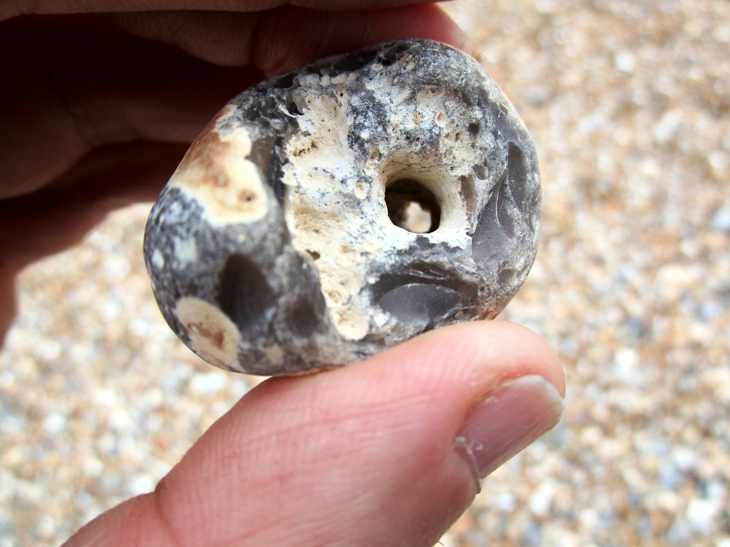
Until visiting the Museum I'd forgotten that Aleister Crowley used to live in Hastings. He allegedly said that you had to carry a hagstone if you wanted to leave the town safely, so it was just as well I found one on the beach. 

Wednesday, 11 October 2023

Aquae Avaloniae

Among those of us who discuss these things, Glastonbury's wells have been a topic of conversation over recent months. The Slipper Well and the Blue Spring have been mentioned, apparently new names for sites we knew about, while St Edmund's Well has been revealed to anyone who doesn't live locally as a really rather important site. But while the esoteric history of Glastonbury has been written about ad infinitum nobody has put all the details of the wells in one place. I thought this might be another little project to work on, so yesterday on my way back from Dorset I diverted north to what turned out to be a misty marshland town, the weather only turning sunny several hours after it had been supposed to.

The journey had been wearying enough to make me fall desperately into the cafĂ© at the Rural Life Museum as soon as I arrived and only walk around afterwards. The Museum occupies the site of Abbey Farm and provides as much of a prosaic contrast as you could imagine with the alternative life of modern Glastonbury. I say 'prosaic', but that's hardly an appropriate word for the mighty medieval Tithe Barn which the farm inherited from the dissolved Abbey. I found the great 18th-century cider press the most charismatic object in the collection. 

In the wall around the Museum site is the first well. This tiny alcove was, as a newspaper sketch from 1888 reveals, once much taller and was probably lowered when the farm closed and the wall was rebuilt. I remember seeing it years ago - in fact, I remember running across the road from my parents' car in the pouring rain to look at it, but paying it little attention because it didn't seem to have a name or any traditions associated with it. In fact that 1888 newspaper article calls it 'The Holy Well' - but not the Slipper Well, the name it seems to have now. It's said to be where pilgrims washed their feet before entering the Abbey precincts. That sounds to me like an idea borrowed from Walsingham, where pilgrims take off their shoes at the Slipper Chapel to walk the last mile to the shrine. 

What of the Blue Spring? That's another relatively recent way of describing Bride's or St Brigid's Well at Beckery to the west of the town, a very important site which may very well represent the oldest Christian monastic settlement in Britain. There's nothing there now, and even the little stone marking the 'traditional site' of the well is hard to find, as my visit demonstrated, and may have been moved from where it used to stand which means we ought perhaps to have another stone marking the traditional location of the marker stone ... The 'Blue Spring' name comes from the complicated story about a blue medieval glass bowl which I'm not going to go into here. I imagine the whole area looks a bit more welcoming in the sunshine!

Back in the town, I called in at the Magdalene Almshouses, a place I'd never visited before, because of a reference someone made to another sacred spring there that pours out of a spout onto the road - indeed it does, though I'm not sure anyone identified it as a holy well until very recently. But the Almshouses are a deeply moving site, a row of tiny one-room 15th-century cells whose last resident died in 1958, and a quiet chapel. I spotted the icons of SS Margaret and Mary Magdalene and recognised the work of John Coleman from his images of the Dorset well-saints Whyte and Edwold. 'Ikon John' was the name the Almshouse volunteers recalled: he had a workshop in one of the cells and talked to visitors about icon-painting and the spirituality behind it.

From there I toiled up the hill, over a stile, and along an overgrown path to St Edmund's Well. This is a site I've known about for years, and in fact have argued that it was the original holy well of Glastonbury, but until about six months ago assumed was lost - until people began to post about it on LiberFaciorum, revealing a well which can hold its own with the best of Cornwall or Ireland, a well-house of some antiquity which is only now coming to anything more than strictly local attention. Additionally, I'd presumed a group of 'Holywell' names north of the Tor referred to St Edmund's Well, but that's not what they say at Holywell Farm, pointing to a spring down the hill as the eponymous Holy Well; I'm not convinced I found the right site, but I'm glad to know it's there.

After that it was a relief to be going downhill to the more famous Glastonbury springs. I've been to Chalice Well plenty of times but it's always pleasing to see people using the site as a tool for their own spiritual lives, drinking the water, wading in it, leaving offerings at the well-head, or sitting in meditative silence ...

... though silence, as such, was a rare commodity across the road at the White Spring, which I'd never visited before. Chalice Well was founded by a group of souls, including Dion Fortune, for instance, who held Christianity and paganism in balance: it's reticent and well-mannered. At White Spring the alternative is much more up-front: people mill about outside playing drums and parting to let vehicles up the road when they need to pass. In the 1870s the town authorities built a waterworks to tap the calcium-rich springs here, but the minerals clogged up the pipes and eventually forced a rethink, leaving behind a building which over the last 20 years has been turned into what anyone can recognise is a deeply powerful water-shrine with an eclectic spirituality. I found entering its dark vaulted space, lit with candles, a bit challenging at first as waves of discordant sound washed over me, and I had to avert my eyes from the people stripping to bathe in the chilly waters of the rear plunge pool! (This is partly why photographs are ruled out at the White Spring). I had a good conversation with Annwyn Avalon who was welcoming visitors to the Spring and who has relocated from the USA, summoned by the call of the Glastonbury springs. This is, of course, not a path I follow, but I know many friends who do, so I lit a candle for them at the Peace Shrine which seemed from its icons of angels to be the most Christian bit, and quietly recited the Magnificat. 

(What was I doing by that? I don't see it as 'reclaiming the space', any more than a pagan coming into my church and offering a prayer to the Goddess alters the nature of that location. Some Christians might argue it did, that some act of counter-reclamation or cleansing might be in order; but the God I believe in doesn't need my defence or anyone else's. He's already in control and there is no power in earth or heaven that can depose him. We can relax). 

Ms Avalon pointed me back into the town for one last visit - the fountain outside the Methodist Church which, so it's said, was built to tap three springs which rise beneath the church itself. Its neo-Norman arch recalls the one well I didn't visit yesterday, St Joseph's Well in the Abbey (I wasn't going to pay another entrance fee just to photograph something I took a snap of 3 years ago). Look at that carved hand pointing towards the Tor! I didn't climb up there, either, and I was very glad to make it back to the car after a long day chasing wells.