Showing posts with label follies. Show all posts

Friday, 28 August 2026

Arundel Surprises

It must have been forty years since I went to Arundel Castle. The town, a port once but whose economy is now based around antique shops, cafés, and the Castle, I've been to reasonably recently, but the Castle requires a deliberate visit, not least because you have to gather yourself to pay the entrance fee. It was, as one might expect as the seat of one of the country's premier noble families, overwhelmingly grand, though I was struck that there was no section looking at the below-stairs life of the Castle, how it functioned as an economic and social machine, such as you now get at virtually every National Trust or English Heritage site now. At one stage the visitor route (which you need as the place is bewilderingly enormous) does take you along a service passage, identified by its featureless walls and green paint, but the servants are notable by their absence. 


Equally striking is the Walled Garden. I couldn't have seen this on my last trip as it was only designed in 2008. It won an award last year and I can understand why: organised around a series of pastiche Jacobean garden buildings, in timber rather than stone, it's a delightful arrangement of capriccione that amuses and impresses though I'm not sure why the designers picked the Shakespearean theme: the Palace of Oberon houses a water-jet emerging from a rockpile and supporting a golden crown, the water toppling over a grotto beneath.

I could well have seen the Fitzalan Chapel when I was last at the Castle (I viewed it from St Nicholas's Church in 2016, but that doesn't count), but wouldn't have remembered any of it. As well as being present in the east window of the Chapel, as I posted here in 2016, St Catherine also appears in the stained glass of the Castle Chapel too (as below), but round the corner in the mausoleum-chapel of the 14th Duke and his wife is an entirely unexpected image - a statue, showing the saint with sword and book, standing on her wheel. It seems that the Duke may have had a particular devotion to her as the inscription on his tomb certainly includes the words Sanctae Catharina Virginis et Martyris, but in the semi-dark I couldn't make out all of the cramped and abbreviated Gothic script. I cannot find anything written to explain this. I left the saint a note: it is, after all, nearly a shrine.


Wednesday, 29 July 2026

Gronthill Fottoes, I mean Fonthill Grottoes

Everyone knows how William Beckford built with slave-plantation cash the mighty, impossible Fonthill Abbey, whose central tower collapsed, before decamping to Bath and constructing the more feasible Beckford’s Tower where friends of mine have stayed, courtesy of the Landmark Trust. But the Fonthill Estate also contains follies, in addition to the insane folly of the Abbey itself. You know when you’re entering what was the Fonthill Estate – the modern version comprises only the eastern half of the land Beckford would have been familiar with – because of the monumental gateway with its hideous faces which was built not by Beckford, but his father (also, helpfully, William Beckford). Beckford pere also created the lake which his son enlarged, and it was around the lake that the follies were grouped. The most accessible now is a ruinous cromlech-like structure on a steep slope, quite rightly fenced off as it looks as though a good gust of wind would bring it down: this is sometimes described as ‘The Hermitage’, but I think that’s more likely to be the towering stone structure in the wood just below the cromlech, with a little arched doorway and two small windows. That building is separate from the Tunnel, which runs beneath the road that follows the west side of the lake: that you can only glimpse through two roughly circular apertures and a largely filled-in doorway, though according to Historic England it has ‘three arched openings leading to a domed chamber and then to a curving tunnel’. Probably the best site, the main grotto on the east side of the lake, is on private estate land and inaccessible, though a LiberFaciorum page has some photos of a structure with fake stalactites which may be it, unless that’s yet another unmarked folly on the public side which I missed. Headley & Meulenkamp don’t cover the Fonthill Lake follies at all, only mentioning a grotto in passing when they discuss Old Wardour and the grotto there; I got the reference from Dave Hamilton’s recent Weird Guide and he rather implies he followed the private path on the east of the lake to find the big grotto, which I balked at doing having seen two vans resplendent with the Fonthill Estate logo either driving about or parked up. An angler I asked insisted you could see the private grotto from the western side just by the boathouse, but that’s the Landing Stage constructed by William Beckford Senior, complete with four huge stone ‘urns’ (except that they don’t contain anything).

Does Fonthill count as a Gothic Garden? I’m inclined to say No. It has some of the elements we see in places that do, especially the arrangement of features around a lake or river, and Beckford was familiar with such sites – Hackfall drove him almost to distraction with imaginative excitement – but there’s nothing here that tends to the sublime, nothing intended to excite terror or induce gloom. Maybe if we had a clearer idea of how the structures we can see now were intended to work as an ensemble we might take a different view.

Thursday, 11 June 2026

Back to Painshill


It is fully twenty-one years since I was last at Painshill Park, with Dr Bones on that occasion. That was blazing summer, but a rainy weekday ('holy well weather') works just as well to follow the walks, wonder at the follies, and muse around the lake. Here and there I could glimpse other visitors, but no more than a dozen of them.

On our last visit the Grotto - the largest in the country - was still being restored and on walking through it it's boggling to remember that it had been entirely ruined, the roof falling in during the 1940s. In fact many of Painshill's features were even more ruinous than they were intended to be, as the garden's designer Charles Hamilton did things as cheaply as he could, often using timber painted to look like stone - and even then he couldn't repay the colossal sums he'd borrowed (from the bank run by his fellow gardener Henry Hoare of Stourhead) without selling the estate and having to leave the very landscape he'd created. The Painshill Trust has in many cases not just restored the follies and features, but actually reconstructed them. 

I'd not really noticed what a superb composition Painshill is - how carefully the views are arranged, how skilfully the experiences are built on until you reach the fairytale Gothic Tower right at the far end of the estate, how the lake is constructed to look like a huge expanse of water here, a tranquil pool there, or a river in a third place, because you never see it in its entirety. It doesn't count as a 'Gothic Garden', but it's a huge delight.

As you approach the Gothic Tower you can hear the A3 thundering just beyond the trees, which explains part of Nia Broomhall's strangely moving poem displayed outside:

Thursday, 2 January 2025

New Year Follies - Ingress Abbey, Greenhithe

This year I will carry on the approach of only posting here when there is something definitely worth posting about rather than as a discipline every other day, but although this isn't a church-related subject I nevertheless think it's a useful topic. It was only by accident that I very recently became aware of the follies of Ingress Abbey at Greenhithe in Kent, when someone on the Holy Wells LiberFaciorum page posted a picture of the Monk's Well. This was already mentioned in Ross Parish's book on Kentish wells, but I'd paid no attention to it and certainly not twigged that it formed part of a larger landscape of follies and garden design. So today I took the North Kent line out of London Bridge station and then the short walk to the park.

Ingress Abbey is an old estate going back to the 14th century, the current Tudor-Gothic house dating to 1833; between 1922 and the 19970s it was a nautical training college, but then fell into ruin. When the folly writers Headley & Meulenkamp came to the site, they found the park overgrown and the follies all but invisible, and worried about the whole place falling victim to redevelopment. This it did, but Crest Nicholson, who bought Ingress in 1998, restored the mansion and cleared out the grounds as well as building a sprawling new estate which strikes me as a sort of cut-price version of Poundbury in Dorset with its emphasis on the picturesque and individual. The current residents of the Abbey itself are British-Canadian oil and gas tycoon Sam Malin and his Cameroonian model and singer wife Irene Major: Mr Malin happens to be an Honorary Consul for Lithuania which is why the country's arms appear on the Abbey gates.

Following the Fastway road from the railway station, the first folly I came across was the Grotto, a set of shallow flint niches to the right of what was once the Abbey drive:


But this is just a very modest taster. Round the corner to the left in a close of modern dwellings, and down a flight of steps, is the very weird Cave of the Seven Heads. There are now only six of the eponymous Heads left, but very baleful they are indeed. The Cave itself has niches set into the flint interior. 


We then follow the road round to the east, and take a flight of steps, which brings us to the gate of the Abbey and the way into the Park. Here we find the glorious ruined arch known as the Grange and its associated tunnel and ancillary chambers; the Monk's Well, which does actually have a well in it; and a decorated flint seat, the Lover's Arch, looking out over the lawn of the Park. 


There are other structures around the Park which may have a more utilitarian origin - the blocked-up Georgian Tunnel, and what it variously called the Model Farm or the Limekiln:


Finally, to the east of the Park, in the middle of Palladian Circus, is a grass-covered mound topped by a flint needle capped with steel: you follow a spiral path to the top. This modern folly courtesy of the estate developers supposedly commemorates a Hermit's Cave which some say occupied the site (the mound was once taken to be Tudor, but it is not). 


Along what remains of Greenhithe High Street is what seems to be a former chapel flanked by single-bay cottages, all in Gothic style and faced in flints. It might have nothing at all to do with the Abbey estate, but it seems worth mentioning too. 


This is a very incongruous set of structures to find surrounded by modern housing on the south side of the Thames Estuary. The redevelopment of the estate makes it hard to envisage how all the follies related to one another, especially the Cave of the Seven Heads which is separated from the others by a busy road and faces west rather than inwards towards the rest of the composition: perhaps it dates to a different phase. The Heads have a distinctly Mannerist flavour to them and I wonder whether they were imported from elsewhere, rather than made especially for the purpose. The truth is that we don't know who was responsible for the follies: Historic England and most sources simply assume they date to 1833 and the rebuilding of the house, but Headley & Meulenkamp hedge their bets and I suspect they are right to do so. The structures look older to me. 

Is Ingress a Gothic Garden? I was reluctant to award this status to Deepdene, the last designed landscape which I thought might qualify for the title. I'm more inclined to look favourably on Ingress. There seems to be a genuine response here to the melancholy potential of topography which binds the follies together, rather than scattering them at random around a site. The Park originates in a quarry whose use goes back to Roman times, and the towering chalk cliffs still loom picturesquely through the trees, so whoever was responsible looked at the landscape they had inherited and saw the capacity for developing it in a Gothic direction. The Grange forms an entrance to the wild area to the rear of the house (I suspect the tidy lawn is a bit more tame than it once was), while the broad green to the front forms a contrast. 

Now, one folly I am kicking myself for missing is the Prioress's Tomb which apparently lies near the Grange. The story goes that this is the burial place of the heart of Jane Fane, last Abbess of Dartford who owned Ingress when Dartford Priory was dissolved in 1539, and that she cursed bad King Henry and all the subsequent owners of Ingress to come to ruin. This is quite something to decide to call attention to when you are building follies on your estate. One local resident even photographed a supposed White Lady weeping at the Lovers Arch seat: could she be Dame Jane herself? If Ingress was not designed as a Gothic Garden, I think it probably is now.                                                         

Friday, 13 October 2023

Hastings - Wells and Others

Until yesterday I'd never been to Hastings, but decided to go at least partly because of the number of interesting wells of different kinds the town has, and have therefore jokingly referred to it as 'the Other Glastonbury'. Not that it shares the Somerset town's hippie/New Age side: its alternative scene is more punk if anything, a bit like Brighton just along the way. The town centre falls into two parts - the 19th-century resort to the west of the Castle, and the old town to its east, which is surprisingly old and picturesque.


My first stop wasn't a well but the Town Museum, on top of the hill in a castellated folly-house. It's free to go in, imaginatively laid-out and full of surprising things. I hadn't expected the ethnology displays, derived from various collectors not all of whom were Victorian adventurers, but whose bits and pieces, the museum is keen to stress, were acquired by means as ethical as they could be given the time. Mods and Rockers appear in the history galleries as do bathing costumes, fishing gear, and scary puppets, culminating in artefacts from the Green Man Festival which friends of mine attend.


Down in the old town, based in the former church of St Nicholas (patron saint of fishermen) is the Fishermen's Museum, mainly one big room with a little annexe, housing a boat, fishing paraphernalia, a wartime Doodlebug dredged from the bay, stuffed animals, and some fantastic photographs from the amazing 1890s archive of George Wood. Although the church no longer functions as such, children can still be baptised in the font (there were three last year). The Winkle Club is a Hastings charitable institution, providing the context for the suit of silver-painted winkle shells worn by 'Slugger Hoad the Winkle King'. I'm not making this up, I promise. 

I found the wells generally quite hard to find: all the online descriptions are a bit unhelpful. The Roman Bath lies in Summerfield Woods (cross the grass next to the Leisure Centre, into the woods, go left down a flight of log steps and then left again past the pools and you should find it). It's a folly that seems to have been the work of Wastel Brisco of Bohemia House nearby: there were several Wastel Briscos, surprising though that may seem, and the family derived at least part of its money from Jamaican slave plantations. The Roman Bath was once a much more extensive structure, as this full account shows, and is a bit run-down at the moment with its nasty municipal gratings. I gave it a bit of a tidy up. 

In Alexandra Park there are two mineral springs. They lie right in the north-western half of the park: follow the path past the miniature railway, keep the stream on your right and you will find them, but I wouldn't have without directions from one of the Rangers. Dr McCabe's Well is the earlier - Peter McCabe, so a plaque tells us, was an Irish doctor who became Mayor of Hastings in the 1830s and was 'a committed campaigner for clean water' - and the other Chalybeate Spring was incorporated into the park in 1880 though it was presumably identified earlier. These are both separate from St Andrew's Spa, which lay in the corner between St Helen's Road and St Helen's Park Road to the north. 


Along Rock-a-Nore in the old town lies East Well. This impressive temple-like building was also built by Dr McCabe: the museum has a painting of people drawing water from it and George Wood took a photo of children around it in the 1890s though I suspect it's a bit posed! You can still take perfectly safe water from it and I presume there is a spring that feeds the well structure. Along the seafront is a modern Wishing Well - the Rotarians manage these things in several places. Finally, next to Holy Trinity Church is the very grand if disintegrating Waldegrave Fountain, a big Gothic structure opened as a memorial to the philanthropist Countess Sarah Waldegrave in 1861, and designed by SS Teulon. 


The hardest well to find was what may be the area's original holy well, St Helen's Well about a mile and a half north of the town centre at Ore. I spent an hour wandering the roads and woods west of the ruins of the old St Helen's Church being misdirected by well-meaning locals and misinterpreting three maps before I got accurate directions. What I should have done was walk down the misleadingly-named St Helen's Park Road (it's a track) south off The Ridge, branch off left into Dunclatha Road (another dirt track at this point), and after a few yards look out for little paths leading to the left over a stream and uphill, and that's where the Well is. It's a pair of stone-lined basins, one small, one large, emptying into a pool. It's a nice spot, and its restoration in 2011 was a journey of self-discovery for one soul, though there's a slight question mark over it as it only seems to be named in Graham Jones's 1986 Landscape History paper, 'Holy Wells and the Cult of St Helen'. I also missed by yards what some local people call 'the Monk's Well', which is probably what's marked on the 1878 OS map as a 'drinking fountain', fed by the same spring. 


Finally I drove out east to the Hastings Country Park to find the Dripping Well. This turned out to be comparatively straightforward! You simply follow a marked footpath running south opposite the car park, turn right and then left, and in the little wooded glen at the bottom you'll find it, a rock in a dell with water, as the name suggests, dripping down into a shallow pool from above. It was a popular 19th-century tourist spot and there are lots of photos and prints to see online: when I worked at the Priest's House in Wimborne there was one from 1889 in a random box of stereoscope slides, and on my wall I have a much earlier print. 

But what is perhaps, just for historical reasons, the most interesting holy well in Hastings lies at the moment inaccessible in the crypt of the former church of St Mary-in-the-Castle, whose temple-like portico looms incongruously above the seafront. This is one of those bizarre Georgian churches built in the round rather than with a traditional east-west orientation, and it had a font which tapped spring water coming out of the cliff face. Even more anomalously in terms of Anglican Church history, in 1929 St Mary's created a tiled baptismal pool utilising the same spring water, and at some point the rock basin of the spring itself became a holy well complete with Biblical verses, a cup for drinking the water, and a box for donations. The church became an arts centre, but Hastings Council pulled the funding last year, and until that gets sorted, the spring will remain unseen. 

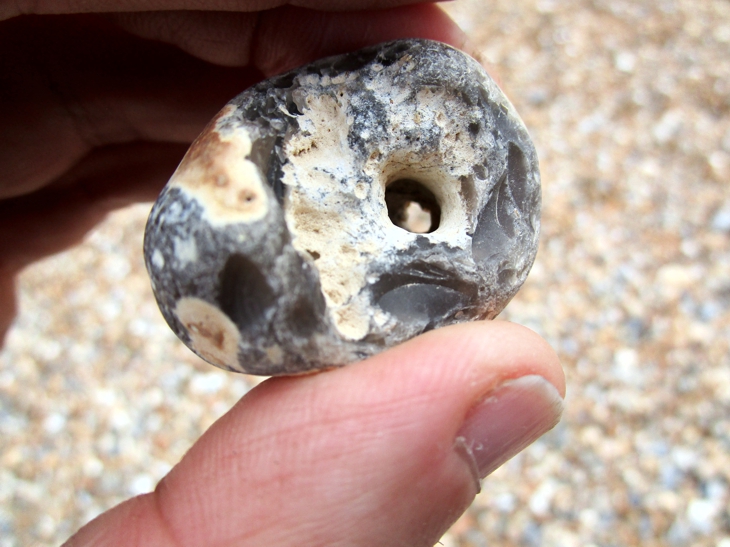
Until visiting the Museum I'd forgotten that Aleister Crowley used to live in Hastings. He allegedly said that you had to carry a hagstone if you wanted to leave the town safely, so it was just as well I found one on the beach. 

Sunday, 8 October 2023

Marcher Land Adventures 3

Back to the road for Wednesday's expedition, and it was another day of castles. My first stop, in fact, was just up the road from the cottage at Pembridge Castle, low, small, and still a private residence. My first thought was that it was a 19th-century folly, but no, though the building was extended and remodelled then a lot of it is genuinely medieval. 

I intended to call in at Goodrich Castle, but I thought that I could squeeze in a short trip north to Ross-on-Wye, as it turned out a busy small town clambering around a rocky outcrop. The big parish church has a fantastic range of memorials including one from 1530 - about as late for these things as you can get - that incorporates a parade of stone saints including St Catherine herself. The castellations around the 'town walls' only date to a road-reconstruction scheme in the 1800s, but there is a genuine ruin, Wilton Castle, on the outskirts of the town - privately owned, but you can just glimpse it from the riverbank.


Goodrich Castle is a massive structure of red Herefordshire sandstone, except the keep, built before the rest in grey stone from Gloucestershire. It was rendered uninhabitable during the Civil War: in the courtyard you can marvel at Roaring Meg, the massive mortar devised by the Parliamentary forces to destroy one of the towers and bring the siege of the castle to an end. 


Zooming through the Forest of Dean, I tried and failed to find Loquiers Well near Mitcheldean, marked on the map right by the main road but with nothing surviving visible at the site. So I went on to the very well-known St Anthony's Well in the woods above Mitcheldean. My friends Madame Morbidfrog and Mr Romeburns had been in the area a couple of weeks ahead of me, and - as wild-swimming enthusiasts - had been bold enough to go in it. I was definitely not, but although the photo below isn't all that impressive St Anthony's Well is in fact a very impressive place, the sound of gushing water mingling with the wind among the trees in the loneliness of the woods. Actually it's not that lonely at all, but it feels it.


I followed in my friends' footsteps again at my next stop, Puzzlewood in Coleford; in fact had they not posted photos from their visit on LiberFaciorum I would never have known about it. This strange woodland landscape is a former ironworking site: after the mines closed in the later 1800s its owner refashioned Puzzlewood as a kind of fantasy garden to amuse his children, and some decades later it was opened to the public. Now you traverse the damp woods along walkways and little bridges between rocks green with thick moss, looking at the weird shapes which look like the kind of towering monoliths you associate with parts of China on a miniature scale. I'm reminded a bit of the Cleft at Hawkstone Park, but Puzzlewood is a fairy landscape rather than a Gothic one. How Madame Morbidfrog managed to negotiate her way even a few yards in with her massive skirts and pixy boots I can't imagine.

St Briavels came next - a closed castle and St Bride's Well -


- and the next stop was Chepstow. Monday is the day the Museum is closed at Newport; Chepstow's has Wednesday off, so that was another I missed. I didn't have the energy to tackle the Castle, and was quite content to take a couple of photos from the outside. Chepstow Priory is grand and full of interesting features.


My last calling-point was Staunton, a village back over the Gloucestershire border. My aim there was seeing two more wells. St John the Baptist's Well is the better-known, though it still isn't one of the more celebrated sacred sites in this part of the country. The church is dedicated to All Saints, and the Baptist being the Well's patron suggests it might have been used for baptismal water, though no legend says so explicitly. Instead a little plaque by the well, very quietly sitting at the bottom of a track, informs us that it appears in a 14th-century document and was one of the village's main water-sources until 1931 when a piped supply arrived. 'Restored', says the sign, and looking at the overlooked and overgrown little Well now I doubt any of it is all that old. However, St John's Well looks positively cheerful compared to the other old village well, Brindsey's Well. This is buried in the bank along a lane on the other side of the main road. I had to pull away all the nettles and plants before I could see enough to take a photo, and it's the driest dry well I think I've ever seen.