Showing posts with label London Goth Meetup. Show all posts

Tuesday, 21 May 2019

Nunhead Cemetery Open Day 2019

Can it really be twelve years since I first went to the Open Day at Nunhead Cemetery? It was my first outing with London Gothic, the occasion I met Lady Minster and the Young Lord Declan, Ms Kittywitch and Lady Wildwood, who have become such good friends. It poured with rain that day back in 2007, while Saturday's weather was rather better than the forecast. Still, I've been often enough to make taking new views of the monuments difficult, and I find myself wandering off the main paths and picking my way through the undergrowth, which you shouldn't really do. I discovered, among other things, a faceless stone dog poking its tongue out, and a weird drum-like tomb with six diminutive memorial stones round its base, part-swallowed in ivy and very hard to photograph. I'd never come across anything quite like it. 


The moods of the main avenues do change, of course, and there are always the other visitors to the cemetery to add some interest. The Goth lady out with her son in the snap below was actually finding it very hard to detach the yappy little dog from her skirt, while its owner, sat on a bench out of sight in this image, made unhelpful comments. 


I gatecrashed a tour of the chapel undercroft, a dank, dripping space full of disappointingly modern coffins ('Even the marine ply finds it tough standing up to the damp' commented the guide).


I think Nunhead remains my favourite of the circuit of cemetery open days around London, and not just for reasons of nostalgia. It has a more community feel than a couple of the others, for instance, and the cemetery itself combines picturesque wilderness with a degree of accessibility. I'm always surprised that so many people come. Mind you, that nice samosa stand whose produce I enjoyed in about 2012 has never come back ...


Friday, 24 March 2017

Support Network

Fortified by theme parks and new friendships, Cylene the Goth has been doing better of late than for a long while, but she still has her moments. At one of them, recently, music came to her aid - or Spotify's algorithms did, pointing her towards 'Bravery' by Assemblage23. 'I'm really, really pleased that there are as many songs like this as there are in the Goth/industrial scene,' she wrote in Another Place. 'I always do love proudly boasting how for a bunch of "scary satanic rejects" we've got good manners and are very good at supporting each other without judgement'. 

The song itself isn't to my taste, but for anyone with mental health issues simply having those issues acknowledged without criticism by someone else, whether you know them or whether they're at a distance, is a step towards change. Of course the mental health 'system' is naturally dedicated to healing, but too often the sense its users get is that they are being judged and criticised by people whose insights into their condition are clinical and analytic rather than sympathetic, and that there's an unspoken verdict that they're not trying hard enough to be normal. Acceptance by one's peers is very different. 

As if it needed stating again, Cylene's experience suggests how the Goth world can function as a place of healing and support rather than exacerbating and exploiting people's negative tendencies as those outside it often assume. Back in the days when our friend Karla was the organiser of the London Goth Meetup, the introductory blurb on the group's webpage warned that new members would not find misery and introspection there and if that was what they were looking for, they might try elsewhere. I know what she was getting at, trying to combat the image of Goths that too many outsiders have; but a place of sanctuary, and growth, is exactly what many damaged souls find in it. 

Friday, 19 February 2016

Capital Flight

It’s been a long, long time since I was last out in London in the evening. Ms Formerly Aldgate didn’t want to go to Silvia from the LGMG’s birthday party at Aces & Eights in Tufnell Park last Saturday, but I thought as I sat on the Tube of the times a couple of years ago when I was fighting my way through the crowds on weekday evenings a couple of nights a week to see her, as well as doing other things. The weekend travellers are very different from the commuters; and I felt a strange air of unreality. Perhaps young people now seem faintly unreal to me anyway, but I suspect it’s down to being surrounded by anonymous people in anonymous surroundings, as compared to the familiarity of Swanvale Halt whose streets and buildings I know well and where it’s unusual not to meet half a dozen people I know on my journey down the hill to the church (at least in term-time: this week it’s half-term and the streets are almost deserted at 8.45am).

It was worth the trip, however, as I had some pleasurable conversations with people I hadn’t seen for ages. The nub of these revolved around the following topics: 1. How old we all are; 2. How many people have moved out of London; 3. How with the removal of various clubs and events there’s increasingly little worth going to anymore; and 4. How we don’t have the energy to go to it even if there was. Ms MetalPole explained how her work at a dental surgery takes her out of the house at 7am and doesn’t allow her back home until 7.30pm. Silvia herself has decamped to Hertfordshire. Even my accountant Ms Death&Taxes, inveterate veteran of every Goth club you can think of, admitted that the delights of night life are less and less able to counteract inertia and the temptations of the sofa. I asked her whether she saw younger people coming into the Goth world. ‘I see some at Slimelight, and they’re often quite beautiful, very dressed up and creative, but they’re mainly coming from miles away’, she said. Of course people moving out of London because they reach the point where they want a different sort of life is nothing new, and that accounts for some of my friends’ moves, but there are newer factors creeping in. Later in the week I heard of another couple who are leaving London because they simply can’t afford to live there anymore, and relocating to Birmingham.

Wednesday, 12 November 2014

Goth Walk XXXIII: A Very Victorian Scandal

On a moderately sunny Sunday afternoon in mid-October, a crowd of people on the steps beneath a railway arch not far from Embankment station listen in (fairly) rapt attention to a man recounting the legal battle between Lady Colin Campbell and her husband a century and a quarter ago which rocked polite society at the time. That man wasn't me, but the Young Lord Declan who I know when he began the Goth Walks tradition in 2007 had no inkling that we would get as far as this. I marvelled at his ability to keep track of all the characters involved in this particular convoluted tale - I certainly got confused at a couple of points.

Tuesday, 10 December 2013

Goth Walk 31: Tell Me Strange Things, the enigma of Fr Montague Summers

We went walking again on Saturday, about 25 or so of us, starting at the Chequers in Duke Street, St James's, and concluding a couple of hours later at the British Museum, to chase down the life of that strange, perplexing and contradictory character Montague Summers, writer on the theatre, the Gothic novel, and most notoriously aspects of the occult. It was fun despite the stress of being somehow separated into two groups by the near-impenetrable crowds of shoppers around Regent Street and having to spend ten minutes or so getting back together again! I was I must confess on the brink of throwing down my book and giving up, and have never been so relieved to see any group of people as when I glimpsed my missing colleagues halfway down Argyle Street. Will I do it again? Well, every time I tell myself No, and am persuaded otherwise by the exhilaration of entertaining people - provided they are entertained. I have an idea for a walk about the Gordon Riots, but it will take a long time to summon up the energy to do it.

Photo by Mr Marcus Tylor.

Monday, 20 May 2013

Goth Walk XXX: The Devil's Architect

On Sunday 12th we went walking around central London again, this time tracing the history and pseudo-history of that mysterious and intriguing architect Nicholas Hawksmoor. Our journey took us from his Spitalfields masterpiece, Christ Church, through a near-impenetrably busy Brick Lane, into the eerie weekend desertion of the City, and back out again to St Luke's Old Street. I found it quite a challenging talk to put together because there's so little known about the man himself: he wrote very little, apart from letters complaining about how badly he'd been treated in the latter part of his working life, and, as Iain Sinclair so vividly put it in Lud Heat in 1975 - the prose-poem that sparked off Hawksmoor's transformation from fairly obscure 17th and 18th-century architect to secret Satanist - 'his motives remain obscure. His churches are his medium, full of the dust of wooden voices'. So I ended up stringing together the weird appearance of the buildings, the fact that so many of his grandiose projects came to nothing, and the fiction that's built his modern and dubious reputation.

Of course all the stuff about Hawksmoor being a devil-worshipper is nonsense, but there remains the oddness of the churches. If you only had St Luke's to go on, rather than the Stepney gems, you'd think the architect was an idiot rather than a genius, sticking a fluted obelisk on top of a tower; what was he playing at? And then, at St George's Bloomsbury, the tower consists of a Greek temple portico beneath a pyramid based on the Mausoleum of Halicarnassus, topped with a statue of George I; is this a celebration of authority, religion and power, or a statement so ludicrous and over-the-top it amounts to a subversion of it, a joke? Why are there no Christian motifs anywhere in Hawksmoor's churches? Was he trying, as his latest examiner Vaughan Hart suggests, trying to construct a new visual vocabulary for Anglicanism by making use of ancient pagan imagery, or was he just an ancient pagan? He remains an enigma.

Photo, taken in St Michael's Alley, by Mr McHenry.

Wednesday, 17 October 2012

Goth Walk 28: Dickens's Dark London

It's a long time ago now, but back in September I did another Walk for the London Goths. Mr Bishop suggested that, it being Charles Dickens's bicentenary, someone should mark that occasion, and as I can't stand Dickens I was clearly the ideal person to do so.

In fact doing the research was very enlightening. I decided early on that the best way of tackling it was to take some of Dickens's most gloomily eloquent descriptions of places in London and themes in its history, and tie them together with a very loose narrative. It brought home to me how so much of his work was driven by a sense of social conscience arising from that traumatic early experience of his father ending up in the Marshalsea debtor's prison, and Dickens himself having to work in a blacking factory. So my view of him rather shifted and that was what I wanted to put across.

In the end the date selected was Sunday September 23rd. This was so that Ms Vale could run the social side of the Meetup, and that particular day was the only one in the course of three months she and I could both make. That Sunday saw easily the worst weather in London so far this year. I got to the starting point, the George Inn in Southwark, to find a handful of people huddling away from the torrential rain and violent wind outside. I wondered whether, if the handful remained a handful, we could justify simply staying in the pub and doing all the readings there. Dr Bones even made it from Oxford and brought Boots the dog with her, introducing him to the underground as well as to some of the worst weather he can have experienced. 'We don't normally allow dogs indoors,' said the young man on the bar, 'But considering ...' Eventually the group reached the amazing total of about twenty attenders so we did indeed set out, blown and battered down through Southwark, past the Cross Bones Graveyard and along the Thames to Blackfriars, across to St Andrew-by-the-Wardrobe and Newgate, and finally along Fleet Street to finish up at Gladstone's statue just opposite the site of Dickens's publishers. People were kind enough to say that the meteorological conditions added to the atmosphere.
Photograph by Mrs Alyson Pacanowski.

Thursday, 28 June 2012

Mummers, Maypoles & Milkmaids

Last Sunday the LGMG went to the Horniman Museum to see the Body Adorned exhibition, ostensibly about styles of dress and adornment in the capital. That was fun, although there was little attempt to marry up the range of ethnographic paraphernalia the Museum had brought out of its stores with the more modern videos, photographs and outfits which were indeed interesting and sometimes thought-provoking. However round the corner (and up the stairs) was 'Mummers, Maypoles and Milkmaids', a photographic display examining English calendar customs and rituals and devised by photographer Sara Hannant. I thought that was so enjoyable I bought the accompanying book:
The photos are lovely, colourful, full of interest and very human. You might think all these calendar customs date back centuries to the times when either bored or desperate peasants cooked up all sorts of excuses to dress up in ridiculous garb, bang sticks together and get slarmied on mead. Well, some are - the Abbots Bromley Horn Dance dates at least to the 13th century, as do some of the horns still used in it - but others are more modern, such as the London Apple Fair, or the Pagan March which takes place in Bloomsbury. Ms Soomarah looked at the photograph of the latter and asked 'Does that woman have her corset on upside down?'

Sunday, 3 June 2012

Coffee House Conversations

We so enjoyed our trip to the Bridge Coffee House inShoreditch back in January that we went again yesterday, or at least a smaller and different selection of us did. We talked mainly about soft furnishings, but also about the state of the Goth world.

Janet is one of the dressier members of the LGMG and can change outfits several times a day depending on what she’s doing. But as she moves elegantly through her forties some things become less of a priority. ‘I’ll still wear a corset to go to a club’, she said, ‘But that’s only for an evening. I just can’t put up with that sort of thing all day now. Corsets and bustles stop you doing so much, and as you get older getting strapped and laced into your clothes doesn’t do you any good. I used to dress up in the whole gear to walk around a stately home and I'd feel completely exhausted and ill by the end of the day. I just can’t be bothered now. I’d sooner wear something looser and less elaborate and be comfortable.’

‘Well, there’s a younger generation to do all of that’, I said. ‘Yeah’, she replied with some ruefulness, ‘unfortunately. Actually’, she added after some thought, ‘I’m not sure that the youngsters in their 20s are going in for all that either.’ I don’t know, and will have to take more notice when I’m next at Reptile or Tanz Macabre. There is an economic factor at work, in that proper vintage clothing, or modern interpretations of it, is now so expensive that younger Goths may not actually be able to afford it.

We also had a conversation about the state of clubs and the music played in them. You might expect that the more mature of us would be miffed about the way things change but in fact the main complaint was just the opposite, that so little new music tends to get played in the London Goth clubs. ‘You’d go to a particular night’, said Mark, ‘and you’d know that when a certain Depeche Mode track was played that was the end of anything interesting. From then on the DJs were catering for nostalgiagoths who expected the same limited playlist.’ This is odd because there are plenty of newer Goth bands in other parts of the country, and the experience of people who head into Europe for the big festivals is that it isn’t the same there. The main purpose of the DJ is of course to get people dancing, but they do have a secondary one of introducing their audience to new music they may like; it may not help that the London DJs and promoters are a remarkably small circle and tend to be, let’s say, no younger than in their mid-30s. Salena (25), who adores Kylie and Nine Inch Nails more or less equally, and Sarah (24) who finds herself drawn more and more to dark-cabaret, electroswing and classical music, didn’t really feel able to contradict any of this. ‘I’m too anachronistic to be used as an example of anything’, stated Salena.
Of course I don’t necessarily expect to hear much that I like being played at a Goth club: I’m there mainly for company and ambience. But the evening before going to Shoreditch, I’d been to Inferno at the Electric Ballroom in Camden with Cylene and a couple of friends, and in the car on the way she’d insisted on playing all of her favourite stuff because she was sure she wouldn’t hear any of it when we got there. It was no more obscure than IAMX, either.

Wednesday, 25 April 2012

In Other News

In amongst all that nonsense, I was out on Monday visiting Highgate Cemetery with Ms Philligrew from the LGMG. I'd been to the eastern half before, but not the West, which is closed to all but visitors on guided tours because of the fragility of the monuments. It was an atrociously damp and disagreeable afternoon, and it would have been good to wander, but even so this was a visit to a strange and unique landscape, as Highgate is not laid out on flat ground in wide, generous avenues of tombs, but narrow, clambering paths and terraces with some features, including of course the Egyptian Avenue and Circle of Lebanon, which are absolutely unique in British cemetery architecture. Much has been cleared since the cemetery's utter dereliction in the 1970s, but the Friends of Highgate Cemetery are sensitive to the need to maintain the lovely gloomth which pervades the place as well as to make it accessible.

After that (and recovering with tea) I scooted to the West End to meet up with some of the other LGMG folk to visit an exhibition, 'Broken Stones' at the James Hyman Gallery in Savile Row. This was a tiny tiny display of photographs of ruinous landscapes by great photographers of the 19th century (Roger Fenton, Eugene Atget etc.). It was very small indeed, and I would have been severely disappointed had I not been forewarned by another LGMG member that there weren't any captions. No captions! Such a thing is virtually unthinkable to a former museum curator, so I'd printed off all the details from the gallery website so we had a catalogue. Still, it was one of those Meetups where the apres-meetup (spent at the Yumchaa tea rooms in Soho) was longer than the event itself. It's a useful insight into the way commercial galleries tend to puff themselves. 

Wednesday, 14 March 2012

Talking Gothic

Last Thursday I and a group from the LGMG went to the Kitschies event at Blackwells Bookshop in Charing Cross. The Kitschies are an annual award in the field of genre fiction which appear to be the marketing brainchild of the producers of a brand of rum, and this year focused on Gothic, aiming to stimulate discussion about the nature of Gothic fiction. We were a very small proportion of the audience of 60 or 70 gathered to listen to John Courtenay Grimwood giving a reading, Marcus Hearn and Christopher Fowler talking very entertainingly about Hammer films, line up for a tot of rum (which I couldn't partake of it being a breach of my Lenten discipline), and walk about talking to a variety of people. Tanith Lee was there - I remember reading all of her books in the school library when I was about 15, but decided not to tell her this. Instead I spoke to Jonathan Rigby, the author of English Gothic and American Gothic; he complimented my on my new tie pin, which bears, I had to admit, the Seal of Rassilon. I'm not sure he was very impressed by that. We thought on balance that the event was a bit oversold (not many 'labyrinthine halls' or indeed 'shadowy figures' in evidence, unless you counted ours) but it was rather amusing. I caused great consternation by actually trying to buy a book which turned out not to be 'on the system'.

Tuesday, 31 January 2012

Turkish Coffee

This is something nice. On Saturday I hosted a small get-together of the London Goths at the Bridge Coffee House in Shoreditch. It was visited by a friend of ours not so long ago, and the pictures on her blog were so enticing I decided to organise a little soirée on an official basis. There were ten of us in the end, and it was a lovely couple of hours spent talking, sipping coffee and nibbling on cake.

The Bridge has been open for a couple of years and the decor is quite astonishing, a mixture of vintage paraphernalia and Turkish harem chic - drapes at the windows, faux-Deco statues holding up faux-Tiffany lamps, gigantic vases, tables smothered in heavy brocade, gilded sofas and glittering mirrors. It was no great surprise to find there, as well as ourselves and the sort of good-looking if ill-dressed young people who tend to inhabit the area (if you're over 30 in Shoreditch you really stick out), a bewhiskered young gentleman in tweed and a victory-rolled forties girl in a dinnerplate hat, yet more proof if proof were needed that Goths and vintage-freaks are often strangely drawn to the same sort of things. 'Just a shame it's in Shoreditch', commented Ms Soomarah.

Tuesday, 25 October 2011

Goth Walk XXV: The Cock Lane Ghost

Last Saturday, to mark the conclusion of my holiday, I took the LGMG on a history walk looking at the story of that 18th-century fraudulent haunting, the Cock Lane Ghost, for which I donned my Georgian clergyman's gear (although the gown isn't exactly authentic, being a rather basic modern academic gown rather than ankle-length and gathered at the cuffs as a proper 18th-century one would have been). The sun shone as we made our way from the Slaughtered Lamb in Clerkenwell and meandered through Smithfield, Newgate and the City, concluding down by Southwark Bridge as we recalled other made-up spectres and wondered whether poor Scratching Fanny had indeed died the natural death she was supposed to have done. Dr Johnson, Hogarth and Horace Walpole all cropped up in the story, and when we visited Bartletts Court where Fanny and William Kent had lodged and I described the seances where the supposed ghost was contacted by what is now the standard method of communicating with spirits by raps and knocks, even though nothing survives there from 1762, a metal pillar presented itself as an ideal source for sound effects - 'Knock once for yes, twice for no!'
Photograph by Mr Christian Zaire.

Wednesday, 28 September 2011

Afternoon Tea at the Soho Secret Tea Rooms

The Soho Secret Tea Rooms, above the Coach & Horses in Greek Street, aren't terribly secret, although access is via a steep staircase behind the downstairs bar, which does make you feel as though you're going to do something rather disreputable instead of just having tea. The Goths liked the idea of going there and so with a lot of faffing about involving dates and deposits to book the private room, I organised it. In the end only half the attenders actually turned up, which, given that I'd sent out several messages warning people to update their response on the Meetup site if they couldn't come because numbers were limited, did not please me at all. Anyway, those of us who were left enjoyed ourselves being stuffed with sandwiches, cake, scones, and of course tea, in lovely vintage surroundings with sofas and doilie-draped tables and being serenaded by Ella Fitzgerald. Mr Valentine even treated himself to champagne to celebrate his new job.


We are actually enjoying ourselves in the last photo, honest we are.

Late Bank Holiday

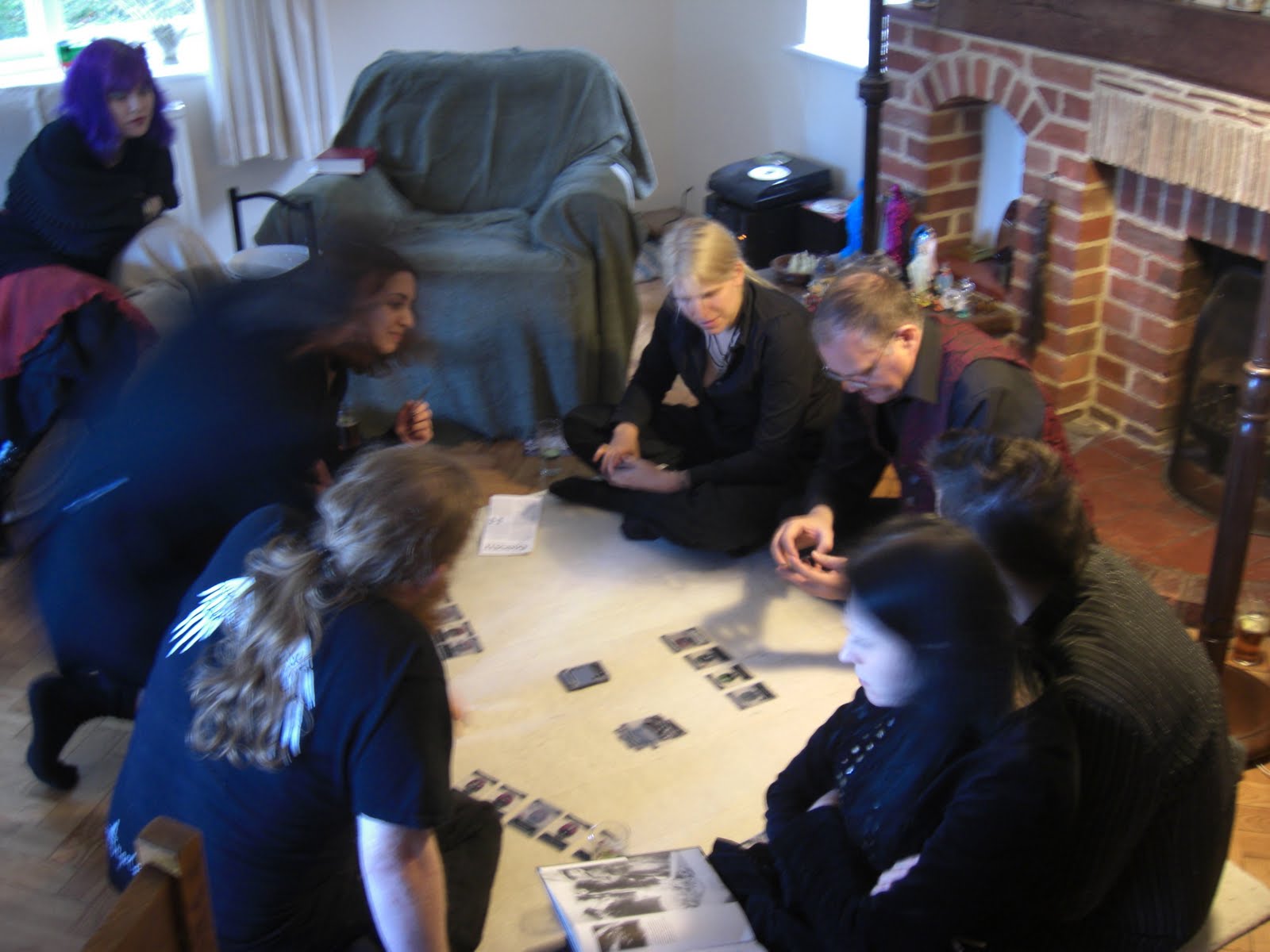
In keeping with what is now an ancient tradition, I invited a selection of LGMG friends over to consume the produce of my garden and what turned out to be a quite heroic quantity of gin over the weekend of the August bank holiday, and of course it was lovely. It's comforting that drink will enable a disparate group of people to get on with each other. I had to go to a station (not Swanvale Halt station) to rescue Cylene, whose inability to negotiate the British rail system is unparalleled, and came back to find Mr Valentine, Ms Narain, Ms Orphanides, Mr Boulton, Mr Garnett, Ms Luczak and Mr Webb being disgraceful Goth stereotypes and playing a card game called Gloom.

Thursday, 7 July 2011

Damnation!

Miss Vale of the LGMG organised a trip to the Globe on Saturday to see the production of Christopher Marlowe's play Doctor Faustus. It was an energetic production, done with great inventiveness and enthusiasm, but as some of the critics have said, strangely unaffecting. Perhaps the problem is with the play itself, some suggest: it's just not really that good. There certainly does seem to be something hollow at the heart of it, and you wonder how far Marlowe, the great sceptic, took it seriously at all. Then again, perhaps the problem is with us. 'You can imagine how terrifying that must have been to people at the time', Miss Vale commented afterwards - not that Marlowe seems to have been very terrified - but that is perhaps the difficulty. What terrors do ideas like 'damnation', 'selling your soul to the devil' and so on actually have for modern human beings? It isn't clear from the play what Faustus does that is actually so very bad, apart from denying God; this is so vastly remote from modern experience that it needs detailed unpacking before you even begin to appreciate what it might be about, and the play doesn't give you that: it assumes you already know. It's a piece from a lost world, and performing it straight leaves it lying on the floor.

Thursday, 19 May 2011

Goth Walk XXIII: Down the Well

On Saturday I had the privilege of taking the London Goth Meetup Group on another history walk around the capital, this time looking at wells and spas. I shall be in a quandary about the next one; I've exhausted all the subjects I can do without looking it all up first ... We were able to visit the well at Sadlers Wells theatre (much to the bemusement of the staff) and at least squint through a window at the Clerk's Well in Farringdon Lane, but understandably all the rest are gone with the exception of the rather splendid Gothic drinking fountain in Lincoln's Inn Fields which finished the walk off. Despite the forecast of 'heavy showers with the possibilty of hail', the weather was perfect. Thanks to Costume Queen for the photo.

Sunday, 3 October 2010

Horace Would Have Been So Proud

Horace Walpole's 'little Gothic castle' in Twickenham, Strawberry Hill, has recently re-opened to the public after a huge restoration which has seen the exterior whitewashed and the rooms stripped of Victorian and later accretions to return to their state when Walpole, the First of the Goths, died in 1797. It's been open for guided tours for a couple of weeks, but Saturday was the first day the public could go round under their own steam. So the LGMG decided to go and look round: never a better occasion for doing so.

If you spurn the audio guide you have instead a little booklet with Walpole's own description of the house leading you round the rooms. The whole place is obviously very, very much a work in progress and while there are spots of magnificence you need a lot of imagination in the more bare and echoey parts. The gardens are full of mud and mire. One of us remembered visiting about a dozen years ago when Walpole's house was being used by St Mary's College and still had its Victorian (and later) furniture, wallpaper and decoration, and was a bit disappointed. The full restoration, including gathering together some of Walpole's collection, is still to come. Having taken that brave decision to take the whole house back to 1797 rather than leave it where it was, I hope the Strawberry Hill Trust can actually follow through. It will, assuming they can, eventually be marvellous rather than just intriguing as it is at the moment.

We were all issued with charming polythene overshoes which fitted better over some Gothic foot attire than others. Still, the staff were delighted we were there. 'Horace would have been so proud', said the lady on the desk.

Saturday, 25 September 2010

Goth Walk XXI

The LGMG went walking last week through the dark heart of London - and, as he freely admitted, that of our guide the young Lord Declan - examining the origins of Goth in the capital in a grand peregrination that took us from Kensington through Brompton and Westminster and up into Soho, narrowly avoiding both the Bishop of Rome who happened to be around at the same time and a gaggle of figures carrying black flags. Anarchists, was my first thought. Then I saw the beards; Pirates was the second. Pirates have black flags. Then I saw the placards reading 'Jesus hates the Pope' and 'Jesus loves Islam' and realised they were Muslim Fundamentalists. One of my colleagues misheard the latter slogan as 'Jesus Loves His Mum', which we much preferred though didn't think it really needed saying.

These are my two favourite pictures of the day, arches in a church doorway on Milner Street, and massed black-clad folk descending the steps of the Albert Hall. I tried to think of a joke involving Hitler, and failed.

Monday, 13 September 2010

Down in the Depths

Last Thursday took some of the London Goths to Shoreditch to view the exhibition 'Subterranean London', which was kicking off the annual Illumini Event, in the basement of Shoreditch Town Hall.
I saw some interesting items on the way along Old Street; an excitingly derelict building, a Gothic triple doorway, a backbone on a building, and a beguiling rogue sculpture which I now know to be the Credit Crunch Monster created by a guerilla sculptor naming himself Ronzo.


However, little did we know that we were not the only people there, but that several hundred (and for all I know several thousand) others had had the same idea. It took me, at any rate, an hour and a quarter to make it along the queue. We were, to be fair, plied with sweetmeats by costumed attendants and juggled at by entertainers during the long, long wait.

Once inside, a labyrinth of tunnels, chambers and stairways was revealed, decorated by a variety of artworks mostly of the sculptural variety inspired by the strange world of underground London - crypts, forgotten railways, cellars, air raid shelters, and the like. It was very intriguing, if cramped, and I thought the quirky and slightly unsettling humour was worth the wait.

Of course I can't help viewing these types of things as a former museum curator, and my only gripe was with the tiny size of the labels - rather than squint through the semi-darkness I photographed the most interesting for future reference!