Showing posts with label weather. Show all posts

Tuesday, 11 August 2026

Caniculares Dies

 ... only with fewer actual dogs. In Swanvale Halt this sharp summer, the canines keep inside for most of the day the same way the humans do. These are quiet times at the church, punctuated only by the roster of events that happen every year - the Feast of the Transfiguration which we try to observe with an outdoor mass in the churchyard (and easily succeeded this year), the ecumenical open-air service in Hornington, and, yet to come, the Village Show. That's likely to be the least successful of the three, given current conditions which have shrivelled the dahlias and reduced the allotment tomatoes to the size of, well, currants. 

 When I can come up with literally nothing I can bear to do at home at the moment, I have a wander about, pray for the people I know or indeed don't know in the streets I go along, and challenge the Lord to bring me into contact with someone who might appreciate talking to me. Sometimes he does, but I'm realising this venture is not very effective if I follow my usual inclination and try to polish off whatever tasks I might need to do before heading out, maybe in the middle of the afternoon; in the middle of the afternoon, everyone who can is hiding out of the sun. The cafĂ© opposite the church is deserted; the roads are silent. 

I take with me my little directory that lists not just members of the congregation but also baptism families, funeral next of kin, wedding couples, and other contacts. I tell myself I might even knock on a door or two. And at that point I realise how neglectful I have been. Not only have the numbers of all these pastoral contacts declined over the years - which I can't do much about - I have been very shy about keeping in touch with people, and now it's a bit late to go calling on someone whose child I baptised a few years ago and haven't seen since. Despite having a set of very good excuses to knock on a door, I think 'shy' is probably the right description. At the back of my mind I have a conviction that they will have no interest in hearing from the priest, and at the front of it a set of rationalisations for holding back - it's raining, it's the weekend, it's the holidays, it's not the holidays. I have been very foolish, and changing my outlook would do everyone good, not least me.

Thursday, 21 July 2022

The Church amid the Heat

At the very moment at tea-time on Tuesday that I was listening to a BBC reporter talking about the fire at Wennington in Essex, and mentioning the parish church there, I was watching this aerial footage on Sky, showing that very building. The church was safe in the end, though as you can see the flames came very close, the scorched grassland just a yard or two from the foot of the tower. The image reminded me of the famous photo of St Paul's Cathedral emerging from the smoke of the Blitz, although SS Peter & Paul's, Wennington, is not the grand cathedral of the diocese of London: this doesn't look like an image of defiance, but of vulnerability. The photos of burning houses from Wennington that appeared in the newspapers were more terrible and violent than this, and people live in houses and not in churches, but for me this picture is about the fragility, not merely of the Church, but of the whole of human society in the face of the chaos our hydrocarbon-based economies are unleashing. Of course there are always wildfires in heatwaves. Accounts of holy wells and other folkloric springs often refer to water-sources which 'kept running even in 1921', a once-proverbial time of drought when, again, crops spontaneously caught light in the fields; but as we know the temperatures are significantly higher now.

Here in Swanvale Halt I had a number of tasks on Tuesday which took me out into the heat. There was a mass in the morning (attendance: 4), and then, just after lunch, the Infants School Leavers' Service. The church felt relatively cool when we started and less so after 150 people had been in it for an hour. I stood outside to say goodbye to everyone as they left; there was quite a breeze, but it just felt like being in a fan oven rather than a conventional one. Finally I was at the Air Cadets in the evening. Turnout was unsurprisingly low but the remaining youngsters sat dutiful and even engaged through my presentation on Change. They had the option of leaving the hut if it became unbearable but none of them did. I did cut it a bit out of compassion, though. I'm coming up to a week's leave which means I am psychologically winding down somewhat, but even putting that to one side the heat hardly encouraged me to do anything more than I absolutely had to!

Saturday, 19 February 2022

Storm and Tempest

The wind battered Swanvale Halt yesterday as it did most other parts of the country. At the Rectory I eyed the trees, but got away with nothing worse than a tile fallen from the garage roof. Meanwhile, down at the Steeple House, we escaped the fate of St Thomas's, Wells, and suffered only a couple of branches shed from the cedar tree at the back of the church. Rick the verger and Jack who heads the gardening team were able to deal with them pretty readily.


A poster blew off the noticeboard and I found it in a far corner of the churchyard. This afternoon it had disappeared again, and this time was nowhere to be found. Well, if that's the worst we get ...

Tuesday, 13 July 2021

View from the Hill

The hill in question being Chapel Hill at Abbotsbury. I am on leave this week and St Catherine's Chapel is now open again so I made my way there, as always wondering whether I will be back again one day. The lowering clouds over Portland and the Fleet avoided the hill itself and while the long closure will have emptied the niche where the votive deposit gets left there are candle stubs and prayer notes again, and some hopeful evangelist has donated some more substantial devotional literature. 


Wednesday, 31 March 2021

Dramatic Chromatic

There is no reason to share this photograph of our amazing and towering rhododendron bush in the church grounds other than its beauty, dramatically placed against a perfect blue sky yesterday. Of course the splendid weather comes with a slight tremor of worry at yet another near record-breaking temperature (though not quite), but put that to one side and enjoy the stunning sight.

Sunday, 24 January 2021

Weather Change

Who can resist snow photos? I can't.


A friend of mine confesses to not usually liking snow but being quite excited to see it this morning: I think it's because anything breaks the monotony at the moment. Snow is irresistible but I am also quite happy to see the back of it as its appeal quickly wears thin once a chilly night coats the pavements in a crackly carapace of ice.

Sunday, 11 October 2020

The Dorset Landscape, October 2020

When my intended Autumn trip to a folly in South Wales fell through thanks to epidemic restrictions I was extremely lucky to find an alternative in Dorset - a flat in the centre of Swanage, not my usual holiday fare but a strange pleasure to sit in the bay window and watch the good citizens of that seaside town go about their business, and then emerge from my secret doorway into the street. Access to the Isle of Purbeck can either be gained by going through Wareham to the west, or via the old chain ferry between Sandbanks and Shell Bay on the east. I chose the latter, for time's sake.

There are several Purbecks. Heathlands of sand and gravel slope towards Poole Harbour to the north of a narrow band of chalk hill - almost a single one, in fact - and then a small strip of fertile farmland separates that from the limestone plateau on the south which finally collapses into the sea. I spent a bit of time walking all of them!


Shipstal Point at Arne felt a bit like Barbados-in-Dorset.


Before the tourists arrived to paddle at Swanage or goggle at the ruins of Corfe Castle, the economy of the limestone area in south Purbeck rested on stoneworking. The landscape is still pitted with the remains of tiny shallow mines, like this one. Men and boys sweated and sometimes died in them. Loads of stone were piled on carts below ground and then winched to the surface by donkeys walking around great wooden windlasses. Heaven help anyone below if the chain broke.

Of course the economy is different now. There are great cruisers moored in Bournemouth Bay at the moment, surreal and slightly terrifying. They have nowhere to go.


This unexpected trip re-acquainted me with places I hadn't seen for decades: some were the same as ever, and others deeply altered, and I'll post about more of them later. Even the same place, of course, can alter significantly depending on the weather, as Ballard Down did on Thursday; on the way out, windblown and rain-shrouded, and on the return journey, bathed in sun (still windy, though). 


Sunday, 16 August 2020

Sussex Scenes

And Friday's trip out took me on a shorter but slower journey southeastwards. My intended first stop was the National Trust-owned Bodiam Castle. Thanks to my birthday-gift membership card I wasn't paying for what amounted to a short walk around an attractive ruin ('It's like a child's idea of a castle', as I heard someone say), and that was just as well.


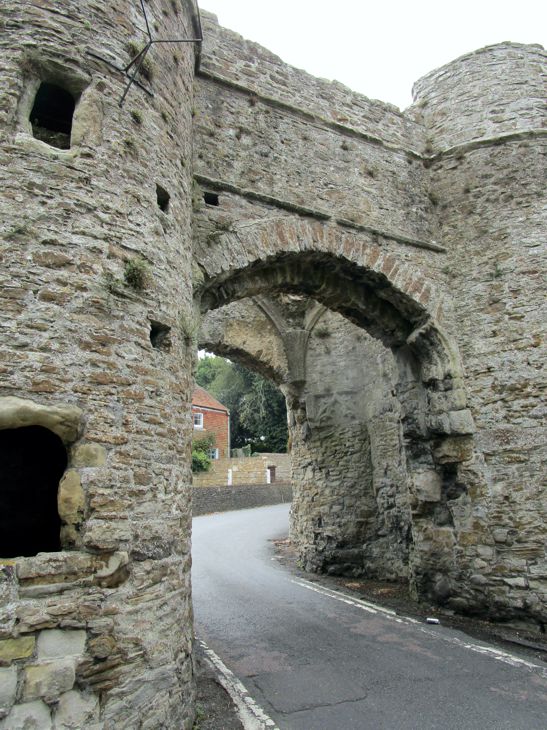
It was quite sunny at Bodiam: less so at Winchelsea, a place I'd wanted to visit for some time. Built in the 13th century to replace a small port washed away by a succession of storms, Winchelsea's prosperity was already in decline by the 1500s, and the 'town' today - if you can so term a settlement that houses about 600 souls - has the strange feeling of inhabiting the ruins of something else, a bit like the way Avebury sits in the middle of its stone circle. It's laid out on a grid pattern but most of the grid is empty, and many of the buildings incorporate medieval bits and pieces left over from the time when Winchelsea was a much more considerable place. It has three mighty gates on the steep main roads, and a church which was once twice the size. The great treasures of the church of St Thomas the Martyr are its mid-twentieth-century windows, burning with colour.


Winchelsea had an impressive variety of holy wells including one of St Catherine. This one has been identified rather dubiously with it: its other name of Queen Elizabeth's Well also seems to be a mistake, borrowed from one in Rye. The genuine title seems to be Strand or Grindpepper Well, and you can find it by going down the steep stone steps off Barrack Square - 'Spring Steps' - and then (as I discovered) before you get to the very busy road at the bottom striking off to the left along the overgrown slope. At first I found my way to the road and couldn't work out how I'd missed the well.

Following a suggestion made on these pages I headed next for Cuckmere Haven on the coast, a long, slow journey that took me through Hastings and Bexhill and then striking southwards across the South Downs which were shrouded in a strange warm mist which made the landscape most odd. There was a type of pillbox I'd never seen before, resembling a sort of corrugated biscuit tin. Cuckmere Haven was busy with cyclists, punters and photographers as well as souls paddling - which turned out to be a bold choice, not because the sea was cold (it wasn't) but due to the pebbles, most uncomfortable underfoot.


Meanwhile, along the A264 some laudable lunatic is building a castellated folly to live in. It's very easily visible from the road and very hard to photograph!

Friday, 14 August 2020

Somerset Scenes

I never, ever take a break in August but this year as in so much else normal practice has been put to one side, and this week I've have had my first bit of leave since January. Not long ago my sister and her family had a trip to Glastonbury and that reminded me that I haven't been there for years, even since Archangel Janet and Mal Friday from London Gothic moved there a little while ago, so I went on Wednesday. But not just to Glastonbury: there were a couple of stops first.

These included the Nine Springs at Yeovil, now a Country Park but once part of the Aldon estate centred on the big house on top of the hill, Aldon, or Aewelldune originally, the 'hill of the great spring'. The ornamental walk centred on the stream flowing around the base of the hill was laid out in the early 19th century and was regularly opened up to the public throughout its history until it was - in a curious phrase which leaves the nature of the transaction open to question - 'secured from the Batten family' by the Borough of Yeovil in 1928. I found it busy with families and dogwalkers, making their way to and fro around the walkways, arches, stepping stones, grottoes and cascades. It is not quite a Gothic Garden, but more a fairy dell, I suppose, and that seems to be how children view it.


My sister was kind enough to buy me a year's membership of the National Trust for my birthday and so far I hadn't used it at all, so although you can't go in it at present, lunch at Montacute House was an ideal opportunity to do so.


On the other side of Montacute village is the early 19th-century St Michael's Tower on a small, steep wooded hill, the site of a medieval castle. Headley & Meulenkamp in Follies say you shouldn't take the steep path up the hill unless you have crampons: it was all right going up, but coming down I had to grab a stick to help me and proceed very gingerly indeed. Of course the tower does not really lean at the angle my camera suggests, or at any angle in fact.


In Glastonbury I hurried round the sites I hadn't seen in 25 years at least. The Abbey is better organised now, with a smart visitor centre and museum, the most moving item being the funeral pall made out of a cope which once belonged to Richard Whiting, the last Abbot of Glastonbury, hanged on the Tor for refusing to accept the Royal Supremacy over the Church.


The Chalice Well hasn't changed much at all, although I remember a time when hardly anyone seemed to go there. People still seem to manage to meditate among the laughing children jumping in and out of the streams - and people taking photographs.


How I made it up and down the Tor in heat that was into the mid-30s I'm not sure. I had a full bottle of water from the Chalice Well, that must have been it. An hour with Janet and Mal and two hours' drive home and I could barely think!

Thursday, 6 August 2020

Box Hill

It was with some effort that I compelled myself to make up a flask and some sandwiches and head out for a walk this glorious afternoon, but it was worth while. I still find it hard to shake the habit of only walking with something to go and look at, and new examples in my vicinity are reducing in number, but Box Hill furnishes a few. 

The first of these is Broadwood's Folly, a little circular flint tower (one of quite a number in Surrey) dating from the early 19th century. Once upon a time you could get in through a now-blocked doorway, and you can see the marks of the internal stairs to access the long-vanished roof for a view over to London to the north. 
This area of the Hill was completely deserted, and I suppose it's no surprise as the long wooded northern slopes of Box Hill are accessed by tracks which are a long way from civilisation and were baking hot this afternoon. The areas around the National Trust car parks on the south, on the other hand, were busy. Everyone kept their distance sensibly and it was delightful to see people enjoying themselves in beautiful countryside, especially as I reckon about half the visitors were black or Asian, which was a surprise to me. We always get told that people from ethnic minorities don't go walking in the countryside: in Surrey they seem to. 
Financier and big-house owner Leopold Salomons bought Box Hill and gave it to the National Trust to preserve it for the nation, and has a memorial at the viewpoint on the southern flank. Everyone takes photos here. 
Box Hill Fort is one of a string of late Victorian defences ringing London to the south and east, just in case the country was invaded from the Continent. It really seemed a sufficiently likely scenario for the Government to invest in a set of these small fortifications designed for the storage and distribution of munitions.
WW2 anti-tank defences, on the other hand, you find all over the place. The old stepping stones at the ford across the River Mole to the south of Box Hill were destroyed as an anti-invasion precaution (just imagine a group of Nazis goose-stepping from one to another), and then replaced in 1946 using re-purposed dragon's teeth. The spot was very popular this afternoon.
I walked back from the Stepping Stones to the Burford Bridge car park and celebrated with an ice lolly, the first I've had in some years.