Showing posts with label fashion. Show all posts

Saturday, 30 December 2023

Far East Gothic

Radio 4 is redoing The Wombles at the moment, though I can’t see (or rather hear) Richard E Grant narrating as any kind of credible replacement for Bernard Cribbins. Still, rather like the Wombles ‘making good use of the things that they find’ as the song goes, Goth fashion was originally a matter of salvaging bits and pieces other people discarded or used differently – lace, and velvet, and torn fishnet-stocking sleeves, that sort of thing. By the late 1990s and early 2000s some Goth scene participants had realised they could make some money (and maybe even a modest living) out of the things they enjoyed wearing, by making them for other people to buy: every Goth girl (and a lot of the boys) knows how to sew, though actually making stuff anyone might want to wear required a bit more application. There were of course the one-stop-Goth-shops in Camden where you could pick up desperately cheap corsets, skirts and coats that were only one step up from Halloween fancy dress and would fall apart after a couple of evenings out; but there were the serious makers like Darkangel too. Based in Tavistock, Darkangel* was the brainchild of Carri who began as a photographer and has cycled round in that direction again now that, she says, it’s ‘very difficult for small independent labels such as ours to survive when competing with low cost overseas manufacturers’. In fact, my only item of clothing from any Goth retailer is a Darkangel brocade frock coat – it has a suitably clerical collar, not that I’ve had a chance to wear it for a long time, since S.D. gave me a vintage frock coat from the 1930s. Good, heavy wool, that, keep you warm if nothing else.

I hadn’t noticed Darkangel’s claims to be an ethical manufacturer, specifically ‘avoiding using any fabrics, trimmings or other components that are made in China’. I wonder what Carri makes of one of the makers whose wares were flashed across my LiberFaciorum feed the other day, the Guangzhou-based fashion house Punk Rave. They’ve been going since 2006, though I’d never heard of them (in contrast to Poland’s well-known Restyle brand, with its big round hats, huge hoods, and astronomical imagery). Punk Rave’s founder and head designer, Zhi Yi Kim (or sometimes Kin) comes from Chinese/Korean ancestry; she started out (she says on the company website) from a poor background and was always interested in clothes. An early clothing store business didn’t work out, but after a stint slaving in a Beijing restaurant Ms Kim went back home to Guangzhou to try again, having discovered punk and Goth culture through a friend and realising that the styles she kept being instinctively drawn to had a name and a meaning. Dissatisfied with the clothes she was selling – mainly, then, for export – Ms Kim took a design course at Baewha Women’s University and set up Punk Rave. In 2010 a sub-brand, PyonPyon, was started to market clothes specifically in the Japanese-oriented Gothic Lolita style. Further lines ‘Fashion Series’ and ‘J&Punk Rave’ now cater for a Chinese home market as, Ms Kim says, ‘domestic young people acceptance of punk Gothic culture is far greater than when she first started designing’. Punk Rave came to pre-lockdown London Fashion Week in 2020 (you can even see a catwalk video here) and now sends its wares to online Goth influencers to try out, and the founder has a go at describing Gothic fashion for anyone in doubt on the matter. So this is not a local cottage industry outfit, nor a mainstream fashion house which occasionally uses Goth ideas, but a basically Goth retailer becoming part of the international mainstream.

But what are the clothes like? Unlike Restyle, Punk Rave does try bravely to cater for chaps, but although there’s a range of dramatic cloaks, coats and shirts, such as the Halifax jacket below – with integral weskit, as far as I can make out – on offer, what I really want is an interpretation of the traditional gent’s suit. Ah, if only I had the talent to do it myself, or believed enough people would buy such an artefact.

Predictably it’s in the women’s range that Punk Rave is most interesting. We might legitimately claim that ‘all Gothic life is here’ (it's not even all black), but in amongst the more familiar Victorian and punky-influenced stuff we find some really beautiful items such as the Cheongsam jacquard dress (trad Chinese style, Gothically reinterpreted with buckles and lacing), the Amaterasu kimono dress in cotton and leather, named after the Japanese sun goddess and which you can easily imagine Yuuko-san from xxxHolic wearing, and this lovely asymmetric velvet coat the company just calls ‘Avant’. I don’t know what conditions this schmutter is made under, but it’s no cheaper than Darkangel was.


There’s another political aspect to think about, too. Ms Kim seems to envisage fashion as having something to say about ‘promoting a future-oriented consumption model that achieves a cultural, environmental, scientific and technological balance’, and sums up the punk ethos as ‘never depressed, never slavish’. Such comments are two-edged in modern China. She’s probably safe as long as she carries on making money and doesn’t comment too much.

-    -    -    -    -    -    -

*[I notice an increased emphasis in parts of the Goth world on ‘fairy’ motifs. You find this in Carri of Darkangel's current photography, in events including the annual Fairy Ball in Glastonbury, and the styles occasionally adopted by my friends such as Madame Morbidfrog and Lady Wildwood. There’s some crossover with pagan and medieval themes, and enough material for a short thesis].

Monday, 22 June 2020

'Phantoms: the rise of Deathrock from the LA punk scene' by Mikey Bean (2019)

At long last, I’ve finally made my way through this monumental volume. My friend Ms GothPotter put me on to it and knowing remarkably little about the development of Goth anywhere outside the UK I had to send off for a copy.

I’ll get into some of the meat of the text soon, but knowing where to begin with that is a struggle – there is such a huge amount to grapple with. Many books are labours of love, but author Mikey Bean has redefined the term. Over a decade or so he conducted more than 200 interviews with people who’d been around in the Los Angeles punk and post-punk scene of the late 1970s and early ‘80s, and then, rather than present each interview sequentially, he cut them up into sentences and built the bits into histories of bands, clubs, and individuals, decorated with the odd photograph from someone’s shoebox collection and masses of reproduced flyers, gradually growing more sophisticated from their cut-and-paste punk origins. How he managed to keep track of all this is beyond me, speaking as someone who enjoys writing but loathes research. Some of his interviewees were no longer living when the book finally came out.

I confess that for a little while I was almost distressingly bewildered, until I worked out what the format was, and that the sections didn’t represent group interviews as I originally thought, but assembled fragments of individual encounters. Sometimes they do read like actual conversations as Bean makes his interlocutors comment on each other from a distance, as it were. Once you discover what’s going on, it becomes more relaxing to read! You begin by admiring the sheer industry, the overwhelming work, involved in Phantoms, but then realise how much Bean has rescued from the oblivion of memory. There is so very, very much in the book’s six hundred close-printed A4 pages (what a lot of text that is!) that I had to have a pencil at hand to mark the passages I most wanted to remember, and even extracting a summary is a challenge. But, well, how could we not try?

The thing that strikes me most, and which I didn’t know clearly before, is that what becomes Goth in the US – or least in California – was a parallel but independent movement from what happened in Britain. It quickly made connections, but had a different flavour from the start because of the materials it was working with (Natasha Scharf’s Worldwide Gothic gives a summary of what was happening but necessarily only in a couple of pages). Deathrock grew from the alienation some felt as a result of what was happening to punk – as Mikey Bean puts it in an interview from a few years ago, ‘the jocks who used to beat up the punks becoming punks themselves’. LA punk wasn’t exactly a tolerant landscape: punks referred to Christian Death as ‘fag music’ and Michael Ely of Red Wedding described the whole scene as ‘very very anti-gay’. Thrown out of seminal LA punk band Germs by its lead Darby Crash, Don Bolles joined girlfriend Mary Sims (who’d been in a radical all-female horror-punk group called Castration Squad and whose inspired stage name was, and is, Dinah Cancer) to form a band called 45 Grave; they, and other outfits, drew on horror-movie imagery (‘more Plan 9 from Outer Space than Hammer’, said Sims, though she also modelled herself on Ingrid Pitt and Barbara Steele) and became more obviously what could be recognised as ‘deathrock’. The more arty and less campy the music and the fashion grew, the more it could be thought of as ‘goth’, even though the term didn’t arise until at least 1983 or so.

In theory all these genres were separate and people on the ground could tell the difference. Bruce Duff of 45 Grave described how Mary Sims and Paul Cutler ‘went to the Roxy to see Bauhaus, which would have been the descent of straight-up Goth on LA as opposed to the harder-driving deathrock we were playing’. They were impressed by ‘how they looked all regal in tuxedos and whatnot’ while Don Bolles was scathing in terms I’m not going to repeat. When Bolles went to a club called Séance a couple of years later, ‘I felt really old [in his late twenties!] coz these were the younger kids who were more like modern Goths than deathrockers proper’. Goth – once people recognised what it was – was felt to be something foreign. One of the best lines in the book is Scott Maxson’s reaction on meeting Patrik Mata: ‘his face was white and he had lipstick on and this long jacket. He looked like he was British or something’! Steve Darrow succinctly defined the difference by stating that Siouxsie & the Banshees' music went better with acid than punk did.

In practice, though, the individuals involved moved around fairly freely from one band and genre to another. Mary Sims says ‘most of my friends kind of ricocheted between five scenes’ and there was even a significant overlap with metal – Steve Darrow states ‘we were all really into Alice Cooper and Sabbath’ (he left Eva O’s band Super Heroines to join Guns ‘n’ Roses so there you go) while Michael Ely remembers that Red Wedding ‘associated deathrock with lame heavy metal music masquerading as punk’. Mary Sims described 45 Grave’s outlook as not really deathrock at all but ‘existential nihilism with a comedic edge’, but look at images of her from the mid-1980s and you won’t see any difference from self-identified Goths. Pompeii 99, who joined Rozz Williams in 1983 to make up the second version of Christian Death, look in a photo more like Bow Wow Wow rather than anything identifiably ‘dark’.

Phantoms makes very clear a point I’ve always stressed, that Gothic is an extensive cultural tradition and once you make contact with it, it will start to draw you into its pre-existing world of references and identifications. In LA, there were local and universal aspects to this. You can see individuals responding to the same set of influences that European proto-Goths were discovering: Shannon Wilhelm of Castration Squad and Cloudia Wintermute of Die Schlaflosen both modelled their look on Theda Bara (‘I was a sort of Cleopatra vampire’, said Wintermute) while Margaret Arana of Kommunity FK ‘just loved Louise Brooks and the 1920s’ and in 1978 was the only person in the area with her hair bobbed. Red Wedding ‘often dressed up in vintage wedding attire … inspired by the Victorian-like vampires in The Fearless Vampire Killers’. The flyers and posters included in the book often ‘quote’ imagery from artists such as Harry Clarke and Aubrey Beardsley, from Weird Tales and religious tracts (as well as S&M pornography, which is another matter). All this is ‘universal’ Gothic, if you like, but living in California added other elements: the decaying glamour of Hollywood, memories of the Universal horror films of the 1930s, the great cemeteries, even locations such as the old Bela Lugosi estate with Lugosi’s spider-shaped swimming pool where scene photographer Edward Colver took 45 Grave for a photoshoot. This meant that the LA scene could develop its own distinctive flavour quite apart from anything that might have been happening in the UK: there was a history here which Europe didn’t have.

One of the very pleasing elements of the book is the way it draws attention not just to bands and their kaleidoscopic interactions but also to the clubs where people saw them and the shops where their stuff was sold. In Pomona, where Rozz Williams came from, there was an influential store called Toxic Records, run by Bill Sassenberger whose acidic commentary Bean very sensibly tends to let luxuriate down the page rather than chop it up. The store found ‘a niche catering to the local malcontents’, says Sassenberger. Williams and Ron Athey lived in one of his back rooms for a while but he tired of their challenging behaviour and ended up organising his own band in a parody of Christian Death, Moslem Birth. Along Melrose in Hollywood there were a number of businesses which catered to the scene such as the clothing store Poseur. Jwlhyfer de Winter summarised the problems for anyone trying to look good: ‘if you thrift-stored for black clothes you were as likely to find some horrific polyester night-gown as anything else and a lot of people ended up taking that kind of stuff and fiddling around with it, because … you couldn’t go to Hot Topic and buy a Goth dress’. Clare Glidden set up a club called Brave Dog ‘to make a safe place for some of the people to perform and hang out … It was a pivotal time in my life and it changed my whole life’. Other clubs included Fetish whose owners eventually tired of the scene, held a ‘Death of Deathrock’ funeral event and turned it into a glam-rock club. Lhasa had an angular, Cabinet of Dr Caligari aesthetic and a black and white epoxy floor, and projected silent movies on the walls (and sometimes the bands). This all makes the important point that creativity isn’t only found in musical form.

I learned less salubrious stories: about Radio Werewolf’s totalitarian-themed Satanism which may or may not have been that tongue-in-cheek after all, or Mephisto Walz’s awful experience in Europe in the early 1990s which led to two band members being unable to get home and subsisting on bread and alcohol for weeks; about Rozz Williams and Ron Athey crucifying a cat at one of their art performances, which they always claimed was dead when they found it, though not everyone believed them. ‘I, for one, failed to see what the artistic statement was in this exhibition of depravity’ remarked Bill Sassenberger icily. I was glad to discover ‘lesbian Jewish deathrock artist’ Phranc writing a song called ‘Take off your Swastika’ after she got fed up with every second punk in town wearing one (Siouxsie did that, remember). I marvelled at the description of the mid-teenage Rozz Williams: ‘there was this guy with peg safety-pinned pants, a clear Mickey Mouse children’s raincoat, and thrift store men’s pointed slip-on shoes, one painted pink and the other black’. And I noted, sadly, the pervasive influence of hard drugs on the scene and the shocking number of times Bean notes in the text that somebody referred to has died.

And most of all I was glad to meet the late Jwlhyfer de Winter, arguably the most creative individual in the whole book. De Winter’s mother was, Gothically enough, a medical illustrator who was often mistaken for Carolyn Jones, the actor who played Morticia in The Addams Family, but that didn’t necessarily make for a comfortable home life and as soon as she could de Winter ran away to live with her grandmother. Influenced by Caroline Coon’s 1977 book 1988: the New Wave Punk Rock Explosion which covered UK punk (including Siouxsie & the Banshees), she began absorbing elements of universal Gothic culture – art, movies, poetry and literature, Salome, Beardsley, Bara, Nosferatu. She began showing silent movies at home with partner Vaughn Thorpe, and wearing veils, antique gear, crucifixes: friends accused her of emulating Rozz Williams but she’d reached her Gothic identity independently. She became a regular performer at club nights, not in a band, but reading poetry and dramatic monologues, and devising a vampire character who had been a Sibyl in ancient Rome, presenting her experiences in a theatrical piece called ‘Theosomorphia’. The band Die Schlaflosen, who had a similar range of interests, provided the musical accompaniment for that, and for ‘Masque of the Sirens’, a tribute to Theda Bara. Jwlhyfer de Winter’s Gothic creative work never stopped, though the rest of it falls outside the scope of this particular book.

In years to come – should life ever resume! – Phantoms will provide enough jumping-off points to keep writers in this area busy for ages. And they will need to keep returning to what is an unchallengeable sourcebook for a dramatic, creative, and not always comfortable moment in subcultural history. Now it can go back on my bookshelf and add to the weight considerably!

One final fun quote, from Magie Song about Eva O of Super Heroines and other projects: ‘Eva became a Goth for Christ. I reckon the only adjustment to the costume was to turn the crucifix the right way up’.

You can buy the book via Lulu.com, here.

Saturday, 16 March 2019

Goth Past and Future

I was excited to hear about this book on Radio 4’s Thinking Allowed, and having waited until a copy came up for sale whose price didn’t make me wince I was more excited when it arrived through the post. There are things wrong with it, and I will dispose of those first; I am also not convinced about aspects of the authors’ core argument, but that’s not necessarily a problem with the book as such, so I’ll relegate discussion of the actual case until later.

The Evolution of Goth Culture: the Origins and Deeds of the New Goths (Emerald, 2018) is dreadfully proof-read. Everywhere there are missing or superfluous letters, stray apostrophes, signs of sentences having been rewritten halfway through but not made consistent, and on a couple of occasions a missing negative which actually reverses the sense of a statement. Although most of the time the authors refer to themselves in the first person plural in a refreshingly conversational manner, on p.126 they revert to standard academic-speak and Karl Spracklen appears merely under his surname as though he was someone else. Given that the authors are proud sticklers in matters temporal and grammatical (pp.69 n2, 76), I’m sure they’re even more upset about being so badly served than I am on their behalf.

Karl Spracklen is a lecturer in leisure and tourism studies at Leeds Beckett University and his wife Beverley used to work as a bellydance teacher and performer. They’ve written a lot of stuff together and with others, and can’t quite resist inserting wodges of that research into the book. The section on the development of heavy metal substyles in the 1990s (93-97) is dizzying and basically irrelevant, and neither explains what heavy metal is, nor how it differs from or resembles Goth. There is some point to this section as the cross-fertilisation of Goth and metal is important, but the rehearsal of the history of the Internet (122-126) is of no use whatever. Equally, we all have our favourite bands and much as I loathe The Sisters of Mercy I can concede their crucial role in the formation of Goth recte in the early 1980s, but the chapter about the band (71-87) seems to be mainly an exercise in Eldritch-baiting, an amusing and popular sport in the Goth world but of strictly limited interest. It would have been more informative to pick a less well-known group and look at what it was that got them started, and how they developed. The book has an odd habit of quoting sources at length, then rephrasing what they have said. All this adds up to a lot of essentially superfluous wordage.

My last quibble is about how to understand Romanticism. I disagree with the Spracklens over the extent to which Goth can be interpreted as an aspect of Gothic more widely, but that’s a debatable matter. They are keen (nay anxious) to paint Goth as a movement of political radicalism and anti-capitalism; I think they are not quite on the mark there, but that’s by-the-by, too. The problem is that wanting to downplay the role of Gothic in Goth and Goth in Gothic because Gothic isn’t anti-capitalist enough leads you astray. For the Spracklens Romanticism, of which Gothic is part, is nothing but ‘insipid’, passive and unpolitical, a matter of swooning women in long dresses and soppy poetry. They blame Gavin Baddeley’s 2002 book Goth Chic for introducing the connection into Goth’s self-awareness (20-21) – unaware, apparently, of Richard Davenport-Hines’s Gothic (1998) which boldly described anyone ever involved in producing or consuming Gothic culture from the 17th century onwards as a ‘Goth’, or Jenny Grey’s Gothic Society (founded in 1990) which made the same link. I’ve had my arguments with Gavin Baddeley, but he rightly points out in Goth Chic that Romanticism was revolutionary – the insistence that individual experience and sensibility, and not objective authority, was the basis of moral order and artistic value – and you don’t get more Goth than that.

But I come to praise Caesar, basically, an apposite phrase considering the splendidly pompous title of the book, alluding as it does to a history of the original Goths in the ruinous centuries surrounding the collapse of the western Roman Empire. The Spracklens show an aptitude for pinching amusing allusions from other disciplines, referring to the ‘Whig interpretation’ of the history of Goth and the ‘Received Standard Version’ of what happened to Goth in the 1990s.

Now, for some time I have been suggesting that there are features in the development of Goth which someone should write about, and here, at last, someone is doing so! The Spracklens take the narrative from the first stirrings of something dark in the welter of post-punk music and activity that came to be tagged ‘Gothic’, through the formulation of the ‘goth’ template in Leeds around the Sisters of Mercy (I’m not completely convinced that’s the whole story, but we let that pass), what was different about ‘goth rock’ compared to early Goth, and what happened afterwards. Once the mainstream music world had got goth rock out of its system, they suggest, the scene went underground, its radical ‘communicative alternativity’ being maintained by fanzines, clubs, and websites – ‘goth fans found community and identity in the goth spaces that were available to them, especially independent record and clothing shops’ (186). This was the phase Goth was still in when Paul Hodkinson wrote his groundbreaking sociological study of the scene for Berg in 2002. However, at the same time the growth of the Internet allowed a global dispersal of Goth motifs and their increasing commodification; Goth became redefined not in terms of music but a broader ‘dark aesthetic’ which could, eventually, be bought off the shelf by anyone: ‘anyone [can] play at being a goth for one video, or one album, or just for one weekend … Dressing like a Goth is now very easy, unless you live in a place ruled by conservative reactionaries or crazy autocrats’ (170). It is – as already memorably described in one of Karl Spracklen’s earlier articles – ‘the entropic heat death of the goth aesthetic’. When all can be Goth, none truly are.

In the course of this analysis, we are given some real gems. The authors’ exemplar for the commodification of Goth is what has happened to Whitby Goth Weekend over the twenty-odd years of its existence, and they make their case very convincingly (137-153). They are absolutely right to cast doubts (37-38) on the well-known ‘origin myth’ that the word ‘Goth’ came from a joke told by Ian Astbury and others against Andi Sex Gang of the band Sex Gang Children, a yarn which I have doubted for a long while (and which I first read in 2003, long before the 2009 date they quote). There is a fine little section on Goth in Uzbekistan (116-118) and, as well as making it clear that modern Goth differs significantly from what it was in the 1980s, the Spracklens make a stab at explaining why, arguing that the Internet allowed the diversification of Goth substyles and subgenres (129-130). The most interesting claim is that Cybergoth style actually developed out of the experience of using the Internet and associated technology. A lot more work is needed on these statements which at the moment remain just insightful assertions, but at least they are asserted. The methodological approach – a bit of global analysis, a couple of case studies, moving back and forth over the field of study – is entirely appropriate to such a disparate and elusive thing as Goth.

But make no mistake: this book is a polemic. Karl and Beverley Spracklen are very, very annoyed about what they believe has happened to the subculture they love. Their rage at the betrayal of what they want to paint as an anti-capitalist crusade reaches its feather-spitting climax in the chapter ‘Goth as Fashion Choice’ (155-171), especially their attack on a hapless Goth model who calls herself Wednesday Mourning (‘becoming a goth is becoming seen to be just one other way of becoming rich and famous … one way people without power are fooled into accepting the inequality of the world’ (165)), and on Steampunk (‘Steampunks … desire to be elite Victorians fighting for the Empire’ (169)). There’s a deep paradox, they argue, within which Goth is caught at the present time – the desire to signal alternativity versus the need to be acceptable. ‘Goth is not dead, but it has changed so much that it is in danger of losing its meaning and purpose’ (183).

So, The Evolution of Goth Culture is a good book. It tells a coherent story, and examines critically themes which have been becoming apparent for some time, but which nobody has tackled before. Much applause for Karl and Beverley Spracklen is in order.

But are they right?

Three sentences from across the book summarise the argument. ‘Goth in the early 1980s embraced the punk fear of selling out, doing things underground and DIY’; then in the 1990s ‘goth culture started to replicate the instrumentality of the mainstream by constructing its own logic of production and consumption’; and after twenty years of this ‘goth will only survive if it becomes a radical, transgressive and counter-cultural space again … returning fully to its communicative alternativity’ (69, 103, 188). On the one hand, this is a correct account of what happened; on the other, it’s a misreading of that past. I could have called this review Nostalgia for an Age that Never Existed, but thought it would be a bit rude.

It is absolutely correct that first-wave Goths made, adapted, cadged, and probably occasionally stole their clothes and bodged together their music like punks. But they did this more because they had no other option than out of a sense of principle, though they may have made a principle out of necessity. Young people in the late 1970s and early 1980s didn’t have much disposable cash, and so there was no market to supply what they wanted. The Spracklens’ account of how this changed to what we have now is, I believe, spot on, although it still needs fleshing-out with actual data. But although they continually describe first-wave Goth as an anti-capitalist phenomenon (as Charles Mueller does, remember), their key evidential text is an article by a music journalist in 1989 analysing Goth, not anything that comes from Goths themselves (67). Turning to my own pet band, Siouxsie and the Banshees were defiant elitists (Steve Severin once dismissed the democratic ethic of punk with a terse ‘No, everybody can’t do this’) who were certainly interested in artistic integrity but also out to make a successful career for themselves, and did. There is very, very little material to demonstrate that first-wave Goth was anti-capitalist as such, except by accident. What it was was anti-conformist and anti-authoritarian, and it’s a mistake to confuse these with economic radicalism. They can be linked, but they aren’t the same.

The Spracklens themselves quote the German band Pink Turns Blue, formed in 1985: ‘we wanted depth, doubts, darkness, eeriness. We wanted to sulk’ (61). So much for the music: as for the clothes, just a couple of days ago I visited Brighton Museum, whose costume gallery contained a Goth outfit worn by Paula Huntbach in the mid-1980s. It consists of a customised black leather jacket, a long black dress with flounces at the calf – not far from ‘Victorian’, although it’s closer to Morticia Addams – spiky jewellery and winkle-picker boots which Ms Huntbach decorated with Klimt-inspired swirls. In a caption, she describes how she would attach bits of old scarves to her outfit: ‘This was the whole important thing to me for Goth … that your clothes looked slightly shredded and old, as though you’d been maybe hanging round in a castle or somewhere gloomy for a while’. Notice, she doesn’t say ‘my clothes were a statement that I wanted to smash the prevailing economic system’: she says they were an expression of a personal fantasy, framed by Gothic imagery. Goth’s was, is, an individualistic rebellion – a Romantic one, dare I say. Pink Turns Blue also expressed a dislike of ‘consumerism’, but experience has demonstrated that this doesn’t mean Goths reject consuming anything, only what the majority consumes. Capitalism can sell you anti-conformity as it can anything else; and, because Goth never had a critique of capitalism in the same way it did of conformism, when forced to choose it makes its peace with the market. Goth individualism might sometimes be sentimental and unrealistic (I think it often is), but it’s at the core of the whole thing.


It is true that Goths are now socially acceptable in a way they weren’t when I first encountered the subculture about twenty years ago and certainly when the Spracklens got involved a bit earlier. I’ve already said elsewhere that it’s a shame it took a young woman having her head stamped on until she died to achieve that (I believe the murder of Sophie Lancaster in 2007 is the single biggest galvanising event in Goth since it began – strangely the Spracklens’ book only has two passing references to it, and nothing in the index). For most individual Goths, the choice to be acceptable comes in the form of getting a job and discovering that having some money to spend on what makes you happy is preferable to the insecurities of other forms of living. Sorry about that.

But if a critique of capitalism has never really been part of Goth, perhaps the Spracklens are right in this – to preserve what Goths really do value, they might have to discover one. The history of Whitby Goth Weekend suggests that without doing so, space to be themselves will be eroded. ‘To feel human, we need to resist the inequalities and injustices of modernity, even if in resisting all we can do is find a space where we can be alternative among others like us’ (188), and that does mean a neverending tension between genuine community and the marketing of identifiers of community. This story, I suspect, isn’t over yet.

Saturday, 2 February 2019

DIY Darkness

Bernice is married to Mal, long-time Goth DJ whose involvement with that world goes back to the days when Goth didn't even know that's what it was. They both have a personal style which harks back to that time, too, when the Goth scene orbited around the Batcave nightclub in London (and the other cities it visited) - a punkish combination of leather and chains, spiky backcombed hair, and round-toed boots from before New-Rocks got going and began their towering skyward ascent.

In fact I think this jacket which Mal bought Bernice for her recent big birthday from Berlin-based clothing and accessory-maker Kathrin Moravcsics -  YoungBat - has more of the Psychobilly about it than the Deathrocker, with its zebra-stripe lapels, cartoony bats and crossbones, but it does follow that one-time-universal handmade ethos that took everyday garments and customised them to death, or at deathliness at any rate. Bernice hasn't had the easiest of times over the last year or so and deserved a bit of fun.

Thursday, 3 May 2018

Not So Nu Goth

Cylene recently bought a new coat, nice, warm and stylish, but with the one drawback that its massive hood kept flopping over her head. I thought it might be from some avant-garde clothing label: 'it's just some mass-produced Gothy coat', Cylene told me, and in fact it came from Restyle, a not-especially-obscure company based in Poland. Its silhouette (see how I can speak the jargon) and the detailing appealed to me and I intended to look it up, an intention I've only just carried out. Here it is. They call it the Future Goth coat.


It's not their only piece with a massive hood. Look at the size of this, a hoodie called Sigillum Dei:


I'll come back to the Sigillum Dei business in a minute. The look reminded me of the videos Liisa Ladouceur produced last year called '40 Years of Goth Style', one for women and one, generously, for chaps, showing a pair of reluctant-looking models being dolled up in a variety of Goth outfits, although I hope nobody really imagines they'll get a clear idea of the evolution of Goth fashion from these short films. Ms Ladouceur's subcultural credentials are impeccable but none of her outfits very closely resemble the sub-styles they're supposed to epitomise: they seem strangely more like an outsider's view. Goths hate the videos, and if you want you can check out plenty of condemnatory replies on Youtube. The problem is less with the clothes themselves - something like all this schmutter must surely have been worn by Goths at some stage - but with the labels she puts on them. Anyway, the last segment of the distaff-side video is labelled 'Nu Goth' and leaves the young woman model looking like this: 


- tights and a vast hood. Describing anything as 'Nu' Goth when Goth isn't a single coherent style to be renewed seems unhelpful to me, but it turns out the label has been out there for years: Megan Balanck included it in her exhaustive list of Goth stereotypes as long ago as 2014. She links it to the musical subgenre Witch House, which we talked about here a couple of weeks ago, and you may note the vaguely occultic decorative elements. The Sigillum Dei is a medieval magical device made use of by Dr Dee among other experimenters - basically Christian, of course, though everything in the Middle Ages was. Ms Balanck and others link Nu Goth to hipster styles but I can't see this, myself, associating hipsterism as I do with skinny trousers, objectionable facial hair, and tweed jackets with elbow patches, none of which I can see reflected in Nu Goth. This young man, for instance, who seems to come from the US, is hard to define as hipster in any way. What he does have is the big hat that many of the Restyle models wear. Restyle label it the 'WITCH' but it looks more like a 17th-century Puritan's hat to me; some of them were indeed witches, of course. 

What I like about this style, whatever you want to call it, is that it draws into the swirling and ever-deepening maelstrom of Gothic a different range of referents and widens the scope of the community's creative energies. I particularly appreciate astronomical references, as illustrated here on the Restyle phases-of-the-Moon hoodie. 

Sunday, 29 October 2017

Modern Gothic

It's nearly Halloween, after all.

The online news branch of media company Vice is known for many things, and journalistic excellence used not to be one of them. Their London office used to produce, in general, snide, ill-informed, would-be-clever clickbaity nonsense that you learned never to take seriously, or ideally not read at all. It was a great surprise to me to hear Vice News journalists being interviewed on the BBC and brought into discussion programmes as though they actually knew something, and even more to realise that the company had gathered a reputation as a committed and serious news organisation. Even the London office got the message.

More than one person I know called attention to this recent article on the UK Vice website about Goth, as part of a series on subcultures. The writer spoke to ten people who identified as Goths (I use that phrase carefully because of what comes next) aged between 18 and 31. They talked about becoming Gothic (‘I felt the boots were wearing me’), their reactions to feeling accepted or disdained (and occasionally attacked) by the wider community, issues of identity, definition and diversity, bewilderment at being assumed to be Satanists, and the effect of the murder of Sophie Lancaster in 2007. Of course there were occasional infelicities (including on the part of some of the interviewees), but the overall tone was supportive, underlining what Catherine Spooner has said in Postmillennial Gothic about the increasing public approbation of Goths and Gothic. What a long way we’ve come since a Guardian columnist could write in 2002 ‘sullen, suburban and witlessly morbid, Goths have lingered like the living dead while other youth cultures have come and gone’, accusing them of ‘infantile notions’, ‘middle-brow suburban myopia’ and ‘paucity of imagination’. Shame it took a young woman having her head stamped on until she died to change that.

I liked what the young(ish) self-identified Goths had to say. Simone claimed that “The scene is becoming more diverse than ever, people are expressing themselves with more freedom than ever before without fear of judgement”. Klinga said 

It seems like the goth scene is much more open and diverse than in past years, there's still a bit of elitism but it seems to be dying out. There's lots of people in the gothic (and alternative) community that are kind, open minded, willing to talk to you and make you feel very included no matter how much of a goth you are. I feel like the gothic culture is much bigger now days, mostly due to the amount of subcultures that were created to the standard "goth" image, such as pastel Goths, nu-goths, Lolita Goths, health Goths... the list goes on.

The young man whose picture accompanies the article, Arcade, is a friend of my accountant Ms Death-and-Taxes, and illustrates the point; he’s wearing New-Rock boots (obviously), but a black faux-fur-collared coat from Bench, which is not usually considered a Goth retailer. Good.

Not everyone is completely happy with this. One person I know who linked to the article is Mal, a Goth DJ who’s been there right from the very beginning, and regards the  changes in the Goth world with emotions that shift between wry and irritated. I greatly honour the man, and his wife Bernice, but his and others’ statements on the matter do remind me of Mojo Nixon and Jello Biafra’s track ‘Nostalgia for an Age that Never Existed’:

You stay home, mad at the whole scene
For refusing to freeze
In nineteen-eighty-three

Mal is among a class of older Goths who have struggled for years to keep the torch burning, who have battled their way across the country to run and attend club nights playing music that fits that early-80s template. It’s not a surprise that they don’t respond well to these hard-won, scarred badges of identity being taken away from them as Goth transmutes into something less oppositional and marginalised. One person commented rather beautifully:

Goth is goth - pure and simple, the silly prefixes that became are a result of other alternative tribes that may have had the tiniest of dark leanings getting lumped into the ever expanding melting pot. As a result you get so far removed from the initial concept that for many they don't really know what it is anymore or didn't to begin with. I got into Goth in 1991 - I was 13 and really caught the tail end before imo actual goth music went underground. There I think was the changing point. To me first and foremost it's about the music - I wore my clothes, and still do to symbolise who I am, my tastes, the music I love with every fibre of my being - it's what kept me going in my teens when I was chased, spat at, verbally abused etc. It seems now it's all about fashion and no substance and way too much confusion over what actual goth music is.

The tension between ‘concentration’ and ‘extension’ is familiar to any kind of subcultural grouping, including Christianity. When exactly have you strayed so far from what the ‘thing’ originally meant that it’s no longer recognisable for what it was? Where are the boundaries beyond which adherents must not stray?

The trouble with maintaining that to be Goth, Goth must what it was in 1982 is that it never was that even then. I related a couple of years ago about meeting early-80s Goths who described cheerfully going to club nights that played entirely different sorts of music, wearing entirely distinct brands of schmutter, and thinking nothing of it because at that stage they didn’t know that they were supposed to be acting in an exclusive, oppositional way. The very band around whom the Goth world coalesced in many ways – although they were, like true Goths, always horrified by the very idea – was Siouxsie & the Banshees, and their music never stood still. They didn’t have the deliberate, restless need to experiment that PJ Harvey has, true, and their musical referents went no further back than Bowie and Bolan for the most part, but over their 17 years of active music-making they drew in a huge range of influences, chewed them up, and regurgitated them as Gothic. It was dramatically, excitingly creative, and I enjoy discovering bands who, in their own ways, do the same now. What’s the point in sounding exactly like the Sisters of Mercy in 1984?

Admittedly, I’m an entirely fake Goth because I came at it through culture and not through music; although I knew about the Banshees, I’d come across very little by other recognisably Goth bands and tended not to like much of it when I did. And I did it at a time – the mid-1990s – when Goth barely existed. The only Goth I met during the time when I was first identifying myself with Gothic was a young woman who came to the museum in High Wycombe researching local ghosts and who interviewed me on the subject. I started thinking about what Goth and Gothic were, and developed some very definite opinions on the matter, most of which I abandoned when, a few years later, I met some real participants in the subculture, which was just about to swing upwards again, and realised it was far beyond me to control, define, or even comprehend within my knowledge. I abandoned myself to the flow and it was vastly liberating. I was freed to enjoy the welter of incomprehensible and yet mysteriously, miraculously united eclecticism that I found at places like Intrusion, the club in Oxford. In the end, what I found most lovable about that world wasn't the music (most of it didn't resonate with me), or the style (which I never really adopted), but the companionship, a group of people who shared the same referents and language: a sense of home.

When Goth was rescued from oblivion in the late 1990s, it wasn’t early-1980s Goth that did it: it was the pagan movement and the bands associated with it, the internet, and very elaborate neo-Victorian dress styles that only bore a remote relationship with the more punky business of a decade-and-a-half before. The individuals attracted by that then discovered early-80s Goth, but very naturally didn’t see the need to confine their attention to that template. And so we’ve gone on, via Steampunk, Cybergoth, Lolita, CorpGoth, health goth, and all the things that my friend Cylene has tried out that nobody else seems to want to copy. And these subcategories aren’t all a matter of dress: they have ramifications in music, film, literature, art.

The blessing and the curse of Goth is that it isn’t, and never was, an isolated phenomenon: it’s part of a bigger, grander, deeper current in the river of experience and desire called gothic, and will continue to feed into wider culture and be fed by it. It can’t be constrained or controlled by anyone, and I don’t care. I like that about it. 

Wednesday, 8 February 2017

Retail Therapy

My friend Cylene had had a disastrous night out a few days before, so on my day off I took her for a meal at her favourite Ethiopian restaurant (Kokeb in North London, in case you’re interested – and don’t be put off by the astroturf bizarrely covering the front yard), and then for some retail therapy in Camden. It is a truism among alternative people that ‘Camden is not what it was’, but then that opinion has been current since about 1990. In some places, ‘gentrification’ means rising property prices and less prosperous residents being squeezed out; or it can simply mean that there are fewer drug dealers in street corners and fewer pools of body fluids around the pubs. It’s an ill wind that blows nobody any good. I have never seen much that’s genuinely creative and edgy about Camden: it’s always been touristic and self-conscious.

Of course there are differences. The area seems to have decided that the late Amy Winehouse is a bit of a draw, on the slender grounds that she worked on a market stall there for a few months: her statue now stands in the Stable Market and her image graces T-shirts and memorabilia in the outlets. The one-stop Goth-shops continue to retreat and vanish, but one can’t really lament too much the loss of opportunities to buy overpriced synthetic-fabric corsets and coats that will fall apart after you wear them twice. Of the higher-end retailers, Black Rose is still there, Sai Sai is still there, Burleska Corsets are carrying on, and because Cylene wanted something fluorescent we even ventured into the Stygian pit that is Cyberdog, still plying its varicoloured wares despite the near-complete eclipse of the rave culture that it ventured into once it decided cybergoth wasn’t enough to pay the rent.

But then we found Psylo, and I thought that was genuinely interesting. Its tribal/punk fusion aesthetic clearly isn’t marketed exclusively, or even mainly, at Goths, but there was a Goth lady serving when we were there and the schmutter is at least Goth-friendly, provided your taste veers towards the punky or industrial end of the spectrum. Natural fabrics, muted colours, well-made and showing signs here and there of interesting design – although none of it is to my taste as such, I was quite impressed. None of the clothes and accessories are cheap, but there’s no reason why they should be.

I was more impressed still when I found out the background to the company – not so much the hippie-ish story of its origins in the experiences of two Westerners travelling through the developing world together or its hifalutin self-image, but its management and organisation. The design team and production is based in Bali, and the company’s major outlets are – apart from Camden – there, two in Mexico and two in Thailand, which is an unusual profile to say the least. It seems to be a conscientious employer, a developing-economy business based around exporting neither sweated bargain-basement standard Western fare nor faux-ethnic costume, but something genuinely different rather than just posing at being different. As I say, not for me, but interesting nevertheless. Cylene even made a purchase.


Friday, 2 December 2016

Some Different Music

We celebrated St Catherine's Day last week by heading out to see The Men That Will Not Be Blamed For Nothing at the Star in Guildford. Having both seen them before some years ago we knew what we were getting and wondered why they were straying to Guildford to play in the back room of a pub (there couldn't have been more than 60 people there - was it really worth everyone's while?). Still, it had to be done. The said back room, helpfully called 'The Back', is a long, narrow and awkward space for a band, accessed by negotiating the staircases and mezzanines of the Star's appealingly maze-like interior, but it meant we could loiter at the back and still see something. I don't much enjoy stand-up comedy, so I found Andrew O'Neill's warm-up routine only intermittently effective, and neither of us was ever going to respond to all the silly encouragement to the audience to bounce around the limited space, but the set was fun. The Men's lead singer and saw-player Andy Heintz had a tussle with cancer last year and is only just recovered, and has swapped his pith helmet and red military jacket for a bowler and tattered Dickensian urchin coat with a touch of makeup that makes him look rather like the Tiger Lillies' Martyn Jacques after a very late night. The new album, Not Your Typical Victorians, has a more political edge than their previous stuff as well as being more musically interesting, and I rather liked pieces such as 'This House is not Haunted' and 'Third Class Coffin'. I felt like taking Mr O'Neill to task on his lyric insisting 'Jesus was a Cockney (even though he didn't exist)', but I'm glad someone is doing this kind of thing.

PS: I forgot to mention that the audience included remarkably few visibly identifiable Steampunks. 'I thought all that business of sticking goggles on a cheap fancy-dress top hat had finished', opined Ms Formerly Aldgate.  Truth be told, the few folk dressed up looked more like Morris dancers than Steampunks, but it can be a fine line, I suppose.

Friday, 29 April 2016

The Honour of the Drape


My Dad was a Ted, which was why I picked up this slim book from the sales stall at the local library (one of my main sources of books). I have a couple of photos of my Dad from 1956 (when he was 17-18). He didn’t have a great deal of cash and I suspect the longish jacket he’s wearing in the photo with my Mum was his own father’s, or something inherited at any rate. In a little passport-type photo he has a tie and something under his jacket, probably a cardigan rather than a waistcoat – an expedient adopted by less prosperous regional Teds. Incongruously he’s also wearing what seems to be a dufflecoat, which wasn’t part of the style, but there you go. Apparently older chaps would scathingly remark about Teds ‘a spell in the Army’d sort ’em out’ and that seems to be what happened to my Dad as a couple of years later after his National Service his quiff was a bit less obvious and he’d ditched ties for anything but very formal occasions. ‘We were Edwardians, that was where the name came from,’ he told me, so I knew that part of the story.

A couple of things struck me from the book. It’s written in a more committed way than one normally expects, certainly. Mr Ferris, the co-author, is very scathing about anyone who suggests social change in Britain got going in the 1960s rather than during his father’s youth in the ‘50s: ‘listen to their drivel for long enough and you end up believing it’. I recall my boss at the Royal Engineers Museum saying exactly the same thing. He remembered his time at St John’s College Cambridge: ‘some of us had come back from bloody Korea, and we were being told to wear silly little academic gowns and that we had to be back in by 11pm. We weren’t putting up with that.’

Mr Ferris also maintains that being a Ted wasn’t – isn’t, for those who still are Teds - mainly about music or about clothes but about ‘a way of living and thinking’. ‘That’s just the kind of thing a Goth would say’, remarked Ms Formerly Aldgate, echoing my first response exactly. It’s a sentiment that trips easily enough off the tongue or pen, but it strikes me as a fairly empty one. In the Goth context anyone who wanders into a Goth club on more than just a one-off basis – especially if not accompanied by a regular – is expected to join in, and joining in means at least wearing black – and I doubt Teds would be any different; possibly for them it would be all the more true as Goth lacks the aggressive working-class edge that Ted had. Its brand of rebellion is very different. For both, though, insisting outsiders do adopt the style, regardless of any statement that clothes and music aren’t the point, is about maintaining the safe subcultural space where questions don’t need to be asked nor explanations given, and perfectly understandable.

Mr Ferris, son of a Ted, who adopted the style in the mid-1970s, is an adamant champion of latter-day Teds and accordingly contemptuous of anyone who abandoned the style; but if there ever was a subcultural style that had its epochal moment from which the world then moved on, New Edwardianism was surely it. Born out of the marriage of an elitist British reaction against American culture with US zoot fashion, at a moment when media, economics and social change favoured it, the early-to-mid 1950s was its natural soil. Again, Goth differs from other subcultures because of its linkage into an artistic and literary tradition that stretches back centuries (millennia, you could argue), but the way it looks has changed at different moments over the decades: most Goths now, if you can find any at all, don’t look how they did in 1982. They were of their time too, and time moves on because society moves on (one of my favourite books, Robert Elms’s beautiful The Way We Wore, about his own journey through fashion from the 1960s to the 1990s, describes and expresses this truth to perfection). This is what makes essentialist analyses of subculture and narrow defensiveness about what they are and aren’t a bit daft. 

At one point Mr Ferris gives an account of the 1970s Teds who battled Punks on the streets of provincial towns: ‘rightly or wrongly’, he says – and it doesn’t take much insight to guess which side of that dichotomy he falls on – ‘they believed they were fighting for the honour of the drape’, the most ludicrous sentence I’ve read in a good long while. 

Friday, 15 May 2015

Keep Up At The Back

A text conversation.

Cylene: Is Pastel Goth one of our relatives or are they just neighbours who only really do a similar look but have their own scene (like Gothic Lolita)?
Me: I don’t know – I don’t think I've ever met anyone who described themselves as a PastelGoth, or pointed someone out to me who was!
Cylene: I've only seen it online! Hence why I don’t know if they’re ‘us’ or not
Me: Or whether they exist at all?
Cylene: Well, if major newspapers are doing reports on Health Goth I've just come to assume everything exists now
Shoulda gone with Hula Goth while I had the chance
Me: I hadn't heard of Health Goth either. I’d argue it’s not Goth until Goths wear it, regardless of what some idiot fashion journalists with a Tumblr think
Cylene: It’s literally just Goths who go to the gym; and it was covered I think by the Telegraph
Me: As far as my in-depth study of the last 5 minutes suggests, there’s no indication that exists outside the pages of said newspapers
Cylene: Your eagerness to disprove almost sounds like elitism ;p
And actually Irena had Health Goth in her belt, but first and foremost she considered herself Rivet
Me: It’s not elitist really, because I don’t think there’s any such thing as ‘real’ or not real Goth – except I don’t think it could conceivably be ‘real’ unless people beyond the imaginings of fashion journalists or designers were actually wearing anything like that style. There’s a parallel with CorpGoth which has been a definite ‘thing’ for many years but was originally just a matter of Goths trying to dress in a way acceptable to both straight employers and their own tastes. I’ve seen people with pastel hair and clothes but it doesn’t become Pastel Goth until people consciously think ‘I’m going to look like that’. If Irena wore something that said ‘Health Goth’ that she or someone else had made it does suggest it’s more than just a designer’s label of convenience or what Goths wear in the gym …
Cylene: Agreed, actually. I feel mainstream is all too eager to stamp Goth on things just because there’s black in it or a Goth did it once, and it’s always worst in Autumn

Me: Exactly! Goths go to bed and might well have one or even more pairs of black pyjamas but that doesn't mean there’s a sub-style called ‘Bedtime Goth’ you can get in Debenhams

(And then a couple of weeks later when I and Ms Formerly Aldgate went to the V&A for Alexander McQueen I spotted a young couple the chap of whom was a typical off-duty example of one sort of Goth - beard, long hair, long black coat, big boots), but whose companion retained Gothy eye makeup but was wearing a pink wool 1950s-style coat and a maroon beret - the overlap of Goth and (slight shudder) Vintage). 

Friday, 1 May 2015

Two-Exhibition Day

On my own I wouldn't have chosen to go to 'Savage Beauty', the exhibition about fashion designer Alexander McQueen at the V&A: it was Ms Formerly Aldgate's suggestion, and I wasn't sure what to expect, but the spectacle was worth the travel and the ticket. I know very little about the branch of the art industry that is high fashion, though perhaps just enough about clothes to be able to recognise when somebody knows how to stitch, but this was extremely entertaining and engaging, even if the weakest element of the show are the words of Mr McQueen himself, scattered here and there throughout the displays - you should never take seriously what artists say, and arguably if they had anything worthwhile to put into words they wouldn't need to make the art. As a former museum curator I find myself paying almost as much attention to the staging of these big shows as to what's in them, and here the arrangement, set-dressing, lighting and even music renders devastating what could otherwise be an enervating experience, if done in a less imaginative way. Of course fashion designers often have the label 'Gothic' slapped onto their work, but there is more justification than usual for describing some of Mr McQueen's designs in those terms, and there's a whole row of black outfits that wouldn't be at all out of place at Whitby.

From there we found our way to the slightly less spectacular surroundings of the London Metropolitan Archives, wedged into a sidestreet in Clerkenwell and not at all easy to get to, for the very last day of their London Gothic show. This is mainly a display of reproduced images and graphics although there are some documents on show too as well as a very odd mock-up of one of those spatchcock 'mermaids' that used to appear in sideshows. The exhibition is a bit of a rag-bag of Gothic themes and history though none the less amusing for that. I liked particularly the 1980s footage of the Batcave (awful), the 17th- and 18th-century Bills of Mortality (who would have thought so many people would have died of 'evil'), and the sketches of Boris Karloff's feet made by a travelling shoe salesman. I didn't take any photos, so this one is pinched from www.badwitch.co.uk. The show is now closed so if you wanted to see it I hope you already have!

Friday, 18 July 2014

Marginalia

We went to the Chap Olympiad last Saturday, and I’ll write a bit more about the event itself some other time. Ms Formerly Aldgate had been before, but it was my first venture there.

A friend posted a link on Facebook to this very annoyed blogpost by Ms Redlegsinsoho, justifying the event and the antics of the people who attend it against various critics. I think she gets a little intemperate and, as is the manner of these things, edges into the sort of intolerance she herself has a go at, especially as I couldn’t find much online which is particularly hostile towards the Olympiad or Chappism in general. The one exception is this vile, angry article in Vice, but then you don’t go to Vice for anything well-considered or understanding and its contributors toe a dedicated line in mock-fury.

Nevertheless, Goths, Vintagers and Anglo-Catholics all know what it’s like to be insulted for their interest in certain forms of dress. I will leave aside the last case for the time being, as its context is a self-consciously ideological one which separates it from a mere fashion subculture.

Or does it? Those subcultures do each carry a sort of ideological gloss. For Goths, that ideology can be expressed in very succinct terms as ‘Life’s a drama: let’s dress up’. I haven’t done as much thinking about the ideological implications of the Vintage scene, but they are there: you can’t flick through very far the pages of The Chap without becoming aware that there is a definite agenda in favour of tradition, politeness, decorum and formality. I suppose you might sum it up as ‘The past can teach us stuff: let’s dress up’. Both subcultures share an assumption that the way you look encodes and declares these basic ideas. Both are also complicated by a knowing self-awareness that there are ambiguities in their positions, and both use camp and over-the-top humour to defuse the ambiguity: for Goths, the ambiguity is to do with the dangers of melancholy, romanticism, self-involvement and deathliness, and for Vintagers it’s the negative elements of the past whose positive lessons they want to draw on.

In both subcultures, too, there is a privileging of the idea of beauty and a commitment to beautiful things, even if they find beauty in different places. You could argue (as society once assumed) that meticulous care of one’s appearance rubs off in the form of care for other matters – the feelings and needs of other people, a concern to do work well, respect for one’s surroundings; that’s definitely what Chappism argues, and the idea even finds a place in Goth (read Jillian Venters’s writings on the matter). An old-fashioned sort of Christian thinker might argue that beauty elevates the soul and, paradoxical though it may seem in the case of the Goth world, a concern for beauty is connected to a joyousness about life, provided it remains light-hearted and full of gratitude rather than censoriousness.

Non-subcultural people looking at these ludicrously attired individuals can respond negatively to the implied criticism of themselves that they see embodied before them. If these people are so concerned to distinguish themselves from me and others like me, it must be because they think they’re better than me and want me to know about it. And very often there is some justification for this: I have come across (thankfully indirectly) Goths who contemptuously use the horrible words ‘norms’ and ‘mundanes’ for non-Goths, while arch criticism of non-Chappish dress is what keeps The Chap going. But as always happens, these mutual criticisms chase each other round, using each other as the justification for an escalating cycle of contempt and misunderstanding, based on what each party thinks the other thinks.

The truth is that ‘Life’s a drama’, ‘The past can teach us stuff’, and ‘Beauty is good’ are pretty unexceptionable ideas which most people can happily subscribe to: it’s just that not everyone chooses to devote their time and resources to expressing those ideas in what they look like and the things they do. The fact that some people do and some don’t doesn’t give either group any reason casually to despise the other when they meet them. Because a person hasn’t dedicated a good portion of their lives to symbolising and ritualising these basic ideas doesn’t mean that they necessarily have a superficial view of existence, disdain everything about the past, or are indifferent to beauty, although they may exhibit all of those traits. Conversely, subcultural participants may equally pay no more than lip-service, or not even that, to the ideals of beauty, creativity or civility their particular fashion embodies, no matter what they look like, as neither a Darkangel dress nor a tweed three-piece proves that its owner is not an idiot. I can vouch for the truth of both these statements.

A subcultural participant meeting someone who isn’t might despise them for not coming up to their standards, or they might assume that they had chosen to devote their limited resources to something else equally life-enhancing; a ‘normal’ person meeting a subcultural participant might choose to resent their pretentiousness and elitism, or appreciate their attention to the task of increasing the general gaiety of the world. Either way, we ought to presume the best of other people and treat them accordingly, and take an interest in them, until they demonstrate that we are wrong. This utterly banal and obvious advice ought not to need stating, but it
clearly does.

Thursday, 6 February 2014

Gothic Evolution

One of the things that fascinates me is how, why and to what extent people change the style they may have adopted for themselves. Of course some Goths, once they have become such, stay exactly the same as they were at 18. Others move away from the subcultural world completely, once it’s fulfilled whatever need it was that drove them there in the first place. Those who stay, but change, I find most interesting.

Now, many, many years ago I used to contribute to the Goth magazine Meltdown with the odd article or review. The editor had set it up to make her fortune, or at least her reputation, although I don’t think it really managed either in the few years it was going. Meltdown had an in-house illustrator called Dr A who would come up with cartoons to accompany articles for which no sufficiently appealing photograph could be found. Here’s the one he did for my article on Gothic academic studies.

Dr A wasn’t just an illustrator. He also played synths with a band who started out calling themselves Sneaky Bat Machine and then in the very early 2000s morphed into Goteki. Goteki, or Sneaky Bat Machine, were broadly speaking a Cybergoth band. I’m pretty sure I’ve never listened to any of their output, but feel fairly confident that it would have been the kind of thing that makes more traditional Goths quiver with rage. ‘Sounds like an ‘80s computer game soundtrack’, commented IF magazine of their album, apparently. You don’t see many Cybergoths these days – you don’t see many Goths at all, of course, but Cybers are a near-invisible minority even within the subculture now, though once upon a time, in the late 90s and early 2000s, there were loads of them. Cybergoths mingled regulation black with fluorescent tubing hair extensions, enormous furry boots, and, ubiquitously, little black goggles perched high on the arrangement of multicoloured dreadlocks and plastic that served them for a hairstyle. So Dr A was one of these fellows. Here’s a picture of the band from their Goteki phase, from their one-time record label Wasp Factory: he’s the one on the left.
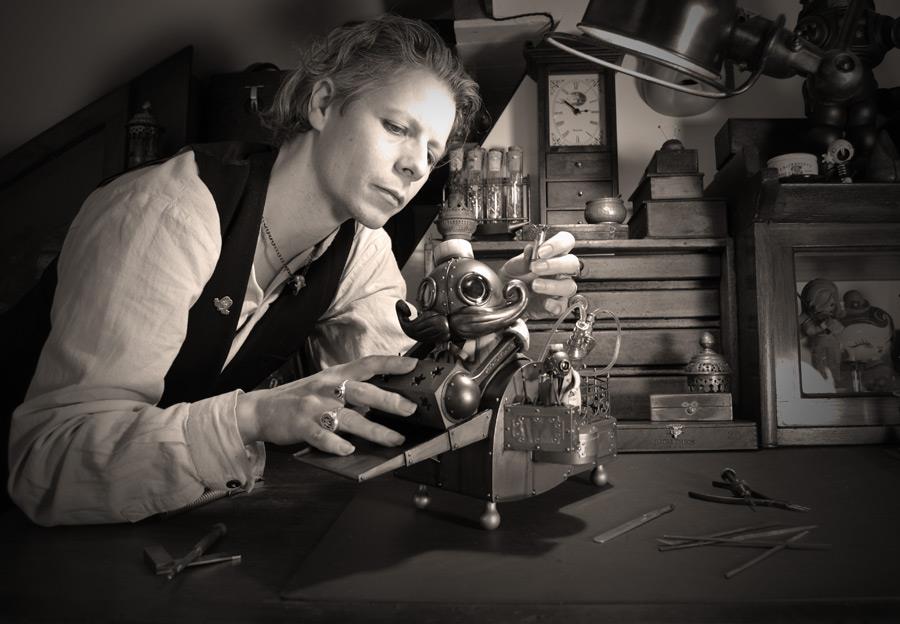
I had not spared any of this a thought for years. Then not long ago while looking for something else entirely I stumbled across an artist and sculptor/toymaker calling himself Doktor A. This Doctor constructs little Steampunkish characters from a strange fantasy world called Mechtorians, all of which have their own identities, histories, and, quite often, riveted brass moustaches. He exhibits them all over the place and sometimes people buy them. It was while looking at some of his drawings that I noticed affinities, little features, that reminded me of the cartoons of the other Dr A all those years ago. There were spirals – and you might say with some justice that attenuated spiral motifs pop up in all sorts of Gothic artistic places thanks to Tim Burton and The Nightmare Before Christmas – but they still leapt to my attention. And, buried away in the depths of Doktor A’s website there are little resin caricatures of the members of Sneaky Bat Machine, which can be yours for a mere £150. The Doctor and the Doktor are one and the same, even if the resemblance may be hard to glimpse in photographs.

But Dr A has eschewed his fluorescent tubes and gigantic boots in favour of a granddad shirt and a waistcoat. This is what he looks like nowadays, as depicted by circusposterus.com. His ‘artist’s biography’ somewhat unhelpfully informs the online enquirer that ‘raised by the military and monitored by men in white coats until he was 16, Doktor A has always scribbled monsters’, giving no clue as to the nature and causes of the artist’s shift over the last dozen years from Cybergoth to Steampunk. It’s a move from a style based on a fantasised vision of the future to one organised around a fantastic vision of the past – in which the only continuity is provided by goggles, except that now they’re brass and leather whereas once they were plastic. But they’re both outsider style, linked by a dissatisfaction with the aesthetics of the present and a determination to dress up. That’s the connection, I suppose.

Mind you, the question arises – now that Steampunk’s dead, where do we go from here?