Wednesday, 11 October 2023

Marcher Land Adventures 5

For this final stage in the journey we stretch the definition of 'Marches' a bit to include the land well into Gloucestershire! But as I made my way home from Rose Cottage I called in at Welsh Newton parish church, to which the term still definitely applies. It has an original stone rood screen dating from about 1320, a most unusual feature for a little village church, and also the grave of St John Kemble, one of the Roman Catholic Forty Martyrs of England & Wales: although he was found to have nothing to do with the Titus Oates conspiracy (not hard to have no connection with something which hadn't happened) he was executed anyway. This is all mentioned in the church. What they don't mention is another grave within a yard or two of St John's which I spotted from a distance. Is that the Jake Thackray, Yorkshire songster and humourist, I thought? He died in Monmouth, and it is. 


I'd visited Gloucester Cathedral, but many years ago, so it was time to return. St Catherine appears in glass twice, once in a medieval treatment, once in a Victorian.


Gloucester's museums carried on the pattern of not being open. The City Museum was - a nice ground floor of palaeontology and archaeology accompanied by medieval music, which becomes a rather fragmented and bitty account of later times on the upper storey - but the Folk Museum, which is the social-history branch, appears to have erratic opening times at the moment and the staff at the City Museum couldn't even confirm when they were despite being part of the same setup.


Two wells to finish with. Nobody seems quite sure how the Crocodile Spring at Compton Abdale came to be, though Historic England says a local builder, 'George Curtis of Hazleton', made it in the mid-1800s. Its crocodile-snout spout was a bit obscured when I saw it, but it was flowing very merrily indeed. I met a woman washing in the water. A little further on is a very important site to the history of well-reverence in the British Isles, the Roman Villa at Chedworth. The octagonal spring-fed pool in its Nymphaeum seems, from nearby finds, to have been converted to Christian use at some point, and then converted back again. Recent excavations have uncovered mosaics that appear to have been laid down in the villa as late as the mid-400s, which rather changes our view of sub-Roman Britain. Unfortunately when the Victorian excavators originally dug the place up they not only stuck a little shooting lodge right in the middle of it, but also preserved the Roman walls with twee little tiled roofs that don't help when you're trying to envisage what the two-storey buildings would have looked like. 


That got me back home, but I still had a week of holiday to go so there are more travels to come!

Tuesday, 10 October 2023

Marcher Land Adventures 4

Thursday's itinerary wasn't that involved as I was heading to the Valleys in the evening to see Cylene and Deri. It was no surprise to begin with a castle, though, on this occasion White Castle, completing my circuit of the Three Castles. There's nothing all that remarkable about White Castle, nor is it noticeably white. It does have a waterfilled moat, though.


Raglan Castle is a different matter. The seat of the Earl of Worcester, this is one of Wales's grandest ruined castles, occupied until the Civil War, knocked about by Oliver Cromwell, and finally abandoned by the Countess of Worcester who inherited it after the Restoration as it would have been far too expensive to make habitable. Its status as a Tudor palace as well as medieval fortress means that it has, first, something of the air of the kind of castles you see in fantasy manuscripts such as the Tres Riches Heures du Duc de Berry, and also the remains of a formal courtyard with a fountain in it.


Abergavenny was the next stop, an agreeable town with lots of small shops and, as far as I could see in the centre, no vacant sites at all. The Priory contains a mass of medieval sculpture, and one incomparable treasure - a mighty 15th-century Jesse, once the base of an entire Jesse Tree and carved from one trunk of oak. There is nothing else like it in Europe. It was completed with a modern Jesse Tree window as late as 2017.


The Museum was - I saw with some sense of inevitability - in the Castle. At first I thought from the scaffolding enclosing the little keep-like building that houses it that the Museum was shut like all the rest I'd tried to visit, but no! There is a mocked-up grocer's shop based on the one round the corner run by Basil Jones until the 1980s, and all the advertising material he left behind. Here he is. It's clear he doesn't actually want you to buy anything. That may explain why the shop isn't there anymore. There's an Anderson shelter retrieved from an Abergavenny back garden and accompanying sound effects - the entire air raid right through to the all-clear, which is a bit of an ordeal.


The road along the head of the valleys between Merthyr and Aberdare is being rebuilt, and will be until 2025. It seems to consist of multiple roundabouts that don't lead anywhere but exist only to make you go on purposeless detours. I got lost going to Aberdare, got lost taking Cylene out for a meal, and lost again twice on the way back.

Sunday, 8 October 2023

Marcher Land Adventures 3

Back to the road for Wednesday's expedition, and it was another day of castles. My first stop, in fact, was just up the road from the cottage at Pembridge Castle, low, small, and still a private residence. My first thought was that it was a 19th-century folly, but no, though the building was extended and remodelled then a lot of it is genuinely medieval. 

I intended to call in at Goodrich Castle, but I thought that I could squeeze in a short trip north to Ross-on-Wye, as it turned out a busy small town clambering around a rocky outcrop. The big parish church has a fantastic range of memorials including one from 1530 - about as late for these things as you can get - that incorporates a parade of stone saints including St Catherine herself. The castellations around the 'town walls' only date to a road-reconstruction scheme in the 1800s, but there is a genuine ruin, Wilton Castle, on the outskirts of the town - privately owned, but you can just glimpse it from the riverbank.


Goodrich Castle is a massive structure of red Herefordshire sandstone, except the keep, built before the rest in grey stone from Gloucestershire. It was rendered uninhabitable during the Civil War: in the courtyard you can marvel at Roaring Meg, the massive mortar devised by the Parliamentary forces to destroy one of the towers and bring the siege of the castle to an end. 


Zooming through the Forest of Dean, I tried and failed to find Loquiers Well near Mitcheldean, marked on the map right by the main road but with nothing surviving visible at the site. So I went on to the very well-known St Anthony's Well in the woods above Mitcheldean. My friends Madame Morbidfrog and Mr Romeburns had been in the area a couple of weeks ahead of me, and - as wild-swimming enthusiasts - had been bold enough to go in it. I was definitely not, but although the photo below isn't all that impressive St Anthony's Well is in fact a very impressive place, the sound of gushing water mingling with the wind among the trees in the loneliness of the woods. Actually it's not that lonely at all, but it feels it.


I followed in my friends' footsteps again at my next stop, Puzzlewood in Coleford; in fact had they not posted photos from their visit on LiberFaciorum I would never have known about it. This strange woodland landscape is a former ironworking site: after the mines closed in the later 1800s its owner refashioned Puzzlewood as a kind of fantasy garden to amuse his children, and some decades later it was opened to the public. Now you traverse the damp woods along walkways and little bridges between rocks green with thick moss, looking at the weird shapes which look like the kind of towering monoliths you associate with parts of China on a miniature scale. I'm reminded a bit of the Cleft at Hawkstone Park, but Puzzlewood is a fairy landscape rather than a Gothic one. How Madame Morbidfrog managed to negotiate her way even a few yards in with her massive skirts and pixy boots I can't imagine.

St Briavels came next - a closed castle and St Bride's Well -


- and the next stop was Chepstow. Monday is the day the Museum is closed at Newport; Chepstow's has Wednesday off, so that was another I missed. I didn't have the energy to tackle the Castle, and was quite content to take a couple of photos from the outside. Chepstow Priory is grand and full of interesting features.


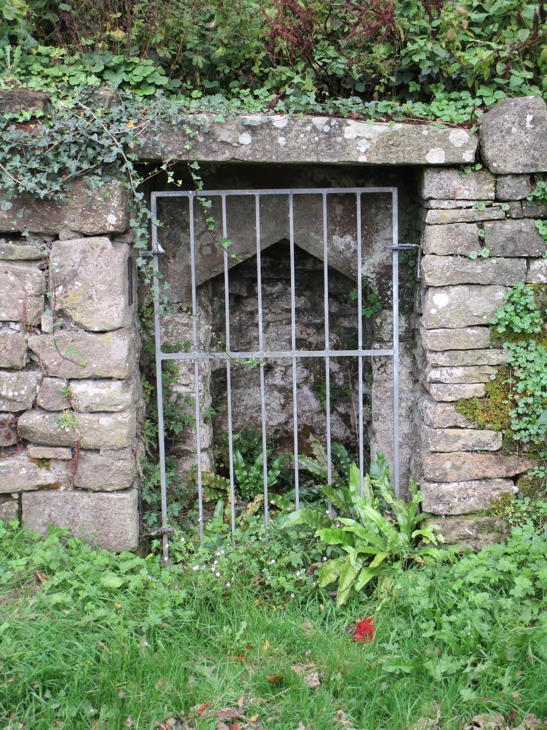
My last calling-point was Staunton, a village back over the Gloucestershire border. My aim there was seeing two more wells. St John the Baptist's Well is the better-known, though it still isn't one of the more celebrated sacred sites in this part of the country. The church is dedicated to All Saints, and the Baptist being the Well's patron suggests it might have been used for baptismal water, though no legend says so explicitly. Instead a little plaque by the well, very quietly sitting at the bottom of a track, informs us that it appears in a 14th-century document and was one of the village's main water-sources until 1931 when a piped supply arrived. 'Restored', says the sign, and looking at the overlooked and overgrown little Well now I doubt any of it is all that old. However, St John's Well looks positively cheerful compared to the other old village well, Brindsey's Well. This is buried in the bank along a lane on the other side of the main road. I had to pull away all the nettles and plants before I could see enough to take a photo, and it's the driest dry well I think I've ever seen. 


Marcher Land Adventures 2

It's my custom, if possible, to spend a day on holiday without using the car, but to go for a long-ish walk instead. The weather was set fairest last Tuesday, so that was walk-day. I was glad I took my stick as the very first stretch required a detour off what seemed to be the path and then beating aside brambles and ferns to find the steep stone steps leading down to the A466 opposite Boundary Cottage. Apart from the rather nice little barn, the first 'sight' was St Swithun's Church, Ganarew. There's not much to Ganarew, but the service register handily left lying on a cupboard in the church showed that there were 39 souls at the last offering of the Holy Eucharist, which is not at all bad and must have made the building pretty crowded. 


From here the way took me to the northern outskirts of the Forest of Dean, a maze of footpaths and roads that presumably once were footpaths, linking cottages that cling to the side of Doward Hill, their associated cars usually kept elsewhere in whatever layby scratched from the hill their owners can find. I scrambled through several hedges and a bit of undergrowth to find the White Well at Symonds Yat; at least, I hope this was it, so nobody else ever has to bother to look. The owner of one garden I passed was getting into the folly spirit with a decorative stone wall.


The farthest point of the journey was Yat Rock, where the River Wye bends back on itself such that it almost meets, and one day, millennia hence, will. There are two hostelries on either side of the river, the Old Ferry Inn on the west bank and the Saracen's Head on the east, and there are very few crossing points: Huntsham Bridge to the north of both, and the Biblins Footbridge to their south; equidistant between the two, a hand-ferry rows you across to the Saracen's Head and back. I arrived at the ferry-quay along with an older couple, and we stood for a couple of minutes gazing across the river at patrons of the pub enjoying drinks and food, and eventually concluded that nobody was coming to row us across, so it was down to the footbridge and then back, adding about three miles to my journey at any rate. It was then my turn to sit by the river and watch people staring from the west bank wondering where the ferry was (it had been cancelled due to high water, it turned out). 


Yat Rock is a steep climb up the hill but the thirty-mile views are worth while. Everyone has said so since the Wye Valley tour got going in the 1750s. The cafĂ© there is equally pleasing, and it would have been much cheaper to eat than the Saracen's Head at the bottom. 


From there I retraced my steps to the footbridge, past the towering Seven Sisters Rocks and sadly ignoring the Dropping Wells which lay in impenetrable undergrowth to the north, and then cut up an exhausting trail to King Arthur's Cave. Stone Age humans definitely spent time here, though it's unfortunate that the 'giant' skeleton found in 1700 was eventually lost at sea; the Cave is just along from a Bronze Age hillfort which was landscaped in the 1800s by Lord Blakemore to include a Hermitage, Grotto and Iron Tower, all of which are long since gone. I did find what the OS describes as a Well, but which English Heritage insists was just a mine shaft. There's a lonely Trig. pillar, sitting on the edge of the trees. 


By now I was pretty footsore, and the last few miles back past Ganarew were merely a preparation for the relief I felt to catch sight of Rose Cottage once again.