Sunday, 13 February 2022

About the Parish

Every month or thereabouts I go out round the parish knocking on people's doors - not randomly, but the doors of houses which have recently changed hands. My life has been made immeasurably better since Dr Abacus suggested I take all the details from Rightmove, rather than trying to spot estate agents' boards going up and down in the village streets.

The property traffic has been quiet lately, but yesterday I had no fewer than twelve stops to make as well as a couple of general pastoral visits to do at the same time. Those were to a recently bereaved gentleman, who wasn't in, and a lately married couple whose banns we read, and they weren't around either. That sped things up a bit. Just as well, since the chill wind and a recent back strain had decided me to walk my route rather than cycle as I normally would. As a result it took ages even if only about half the new residents of Swanvale Halt were in for me to bother them. In fact I very rarely get anything other than a friendly reception once people are past the slight bemusement of having a clergyman knock on their door who wants nothing but to say hello and give them a leaflet.

When I ask whether people have moved in from elsewhere in the area or further afield, a story I often get told is that of young couples moving out from London for more room (often because they're starting a family) or better quality of life. But yesterday there were several young people who were engaging in what you might call 'family consolidation' - deliberately moving closer to parents and siblings so that they could all keep an eye on each other and see each other more often. That may be a result of the pandemic encouraging a bit of reassessment, but we will see whether it becomes a more noticeable trend.

I always ask how newcomers are finding things so far. One young man who'd moved with his partner from South London told me it was 'paradise in comparison', which even as a partisan of my parish seemed a bit over the top. I do hope they carry on feeling that way.

Friday, 11 February 2022

Beautiful Badbury

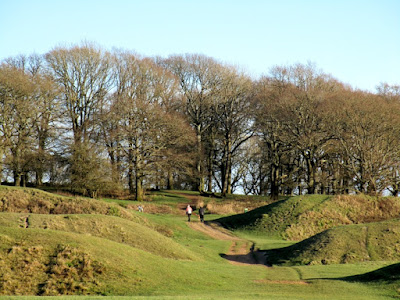
A trip to Dorset to see my family managed to squeeze in a walk round Badbury Rings. I can always rely on the Rings to take me out of myself even if I do nothing more than follow the same route, from the car park and between the ramparts, straight across the interior and past the orientation plaque to curve right around the rampart and back to the car. In a way it's the ritualisation of the walk that helps - plus the history, and the views.


Wednesday, 9 February 2022

Welcome in the Spirit

'To you that hear prayer shall all flesh come', it says in Psalm 65. 'You are the hope of all the ends of the earth, and of the farthest seas'. I am not someone who says there is only one God, and so it doesn't matter what you call him. I am someone who says there is only one God, and so there is nobody else to receive prayers offered in faithfulness and truth. There is only one place where prayers like that can conceivably go, and it is to him.

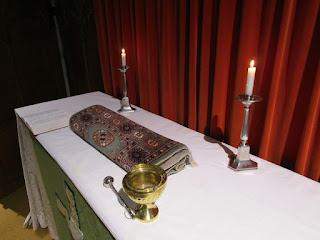
Pam, former Mayor, local councillor and congregation member, was told that one of the refugee families relocated to the UK after the Taliban takeover of Afghanistan was coming nearby. She and Sylv our Pastoral Assistant doubted they would have brought prayer mats and wanted to make a present of a pair of mats as a sign of welcome, and asked if I would bless them. We prayed for the family to find peace, security, and the support they will need in an unfamiliar environment. A Christian prayer, certainly, offered in Christ's name, but in faith in his universal power. Grace is everyhere, and he will do the rest. 

Monday, 7 February 2022

Swanvale Halt Book Club: 'The Waning of the Middle Ages', Johan Huizinga (1919 - the Penguin edition, 1955/2001)

How can it be that, here I am, 52 years of age and with a history degree more than three decades behind me, and yet I had never read Huizinga's great classic until now? Of course I knew about it - and knew, too, the haunting phrase that summarises its case, that 15th-century Europe was redolent with 'the mingled scent of blood and roses' - but hadn't actually read it. At least, The Waning of the Middle Ages was the book I knew: it tends to be known as The Autumntide of the Middle Ages now, a more accurate translation of Huizinga's Dutch original, Herfsttij der Middeleeuwen. And you will note that it's categorised as a Classic in the Penguin library, a sure sign that it's currently regarded more for its literary virtues than its strictly historical ones.

Huizinga's thesis was that late-medieval Europe was a decadent, worn-out culture whose fondness for ceremony, formality and fantastic artistic detail was a way of psychologically managing its tremendous violence and disorder. It was an exhausted age, incapable of originality, whose art was in decline and whose literature was dulled and stifling. Everywhere in the 15th century he looked, Huizinga saw corruption: it only remained for the Renaissance to come sweeping up from Italy to wipe away the Gothic north that had nothing left to offer humanity, and usher in a new and healthier age.

To demonstrate his case Huizinga barely strayed beyond the court of the Counts of Burgundy, which is undermining enough, but more radically his was a kind of history nobody writes any more; and nobody writes it because we don't feel confident enough to write it. Huizinga's sweeping characterisation of the culture even of one bit of medieval Europe, let alone the whole of it, is something nobody would pen now. He feels absolutely qualified to draw dramatic conclusions about society from his responses to this or that artwork, or the output of a handful of Burgundian poets and chroniclers: he looks back five centuries and can trace the outlines of a grand mental narrative from an aesthetic impression. It would be a bold commentator indeed who would dare to state, as Huizinga does, that an emphasis on the visual in culture is itself a marker of intellectual atrophy. Not only does nobody now trust their own responses in that way, but thinking about cultures in terms of 'rise' and 'decline' is alien to us. 

Or at least no historian tries to do so. Thinking about Waning led me to Steven Pinker's The Better Angels of our Nature which came out a few years ago and which had an even grander narrative, the alleged decline of social violence over the course of millennia - an equally contested suggestion. Of course Pinker is even less a historian than Huizinga was, a psychologist as against the Dutchman whose original training was in linguistics. Perhaps it takes non-specialists to be able to tell us fundamental stories about ourselves: I leave for another time the question whether we need them. 

Saturday, 5 February 2022

Have This One On Me

"I expect an answer next time we speak!" Dale told me over Zoom this week. Former member of the Swanvale Halt flock, Dale comes from an American Lutheran background and I have been talking to him regularly since the first lockdown. This time we were discussing the resumption of communion being administered to the laity in both kinds, which we suspended nearly two years ago. Nobody doubts it would be preferable to return to giving the wine to the congregation; many of my (even) more Anglo-Catholic colleagues did so long ago. Others have adopted the use of the president intincting the Host before adminstering it, but I've never been able to see how you safely do that without ending up pressing a mushy disc into the communicant's hand. But how we are to go about it? Dale, you see, would be delighted if I plumped for individual communion cups. 

Evangelical Anglican commentators such as Ian Paul, when he has caught breath between agitating for bishops to give up mitres and Anglican churches to stop putting out crib scenes at Christmas, saw the pandemic as a God-given opportunity to promote the use of individual communion cups. But then he went on from there to suggest that it would better to decamp communion services permanently to domestic settings, so perhaps we should leave him to one side. Anyway, the bishops came out with a statement against this particular form of administering the Sacrament in July 2020, which according to some parties was based on a very inadequate legal opinion on the matter dating from 2011; but in October last year they discussed it again, and agreed that there was nothing to be gained by putting the matter to Synod (something generally best avoided in any circumstance) and that they had no intention of telling individual churches what to do. I don't know of any churches in Guildford diocese that have taken this option, but some evangelical churches elsewhere have.

We rightly associate individual communion cups with Nonconformist churches. Until the late 1800s Dissenters were content with common cups like everyone else, but from the 1890s an increasing awareness of the mechanisms of infection led to a movement among Dissenting churches in the northeastern United States to use separate communion vessels for each communicant, and the habit spread as quickly as the sicknesses everyone was afraid of. Asked about the matter in the early 1900s, Archbishop Randall Davidson decided using individual communion cups, were any church to do so, would indeed be legal, and the 1908 Lambeth Conference stated that bishops could authorise their use, though there was no medical case for abandoning the common cup wholesale (if it was all that risky clergy would be endlessly ill from consuming the dregs of the chalice at the end of communion, whereas they are not obviously sicker than anyone else and it would be presumptuous to ascribe this to divine intervention). 

Still, the standard Catholic objections to using separate cups do ring a bit hollow. We administer the bread in separate wafers happily enough, and any argument in favour of sharing a cup would equally apply to sharing a loaf. Any remains left in the cups could be reverently dealt with by collecting them, rinsing them, and then pouring the water with its diluted wine to earth in the same way we do when laundering purificators. No, the core of the problem is elsewhere.

I'm surprised that nobody ever talks much about the psychology of receiving the sacrament.  During lockdown, Marion our then-curate got into a rough debate in the group of Franciscan Tertiaries she belonged to (imagine that!) about the validity of 'remote consecration', in which clergy who refused to consecrate bread and wine over Zoom were accused of 'denying the sacrament' to the laypeople. This is not the mindset of passive, thankful reception, but of the exercise of rights. We come to the altar, into the real presence of the Lord, as recipients of grace. Think about the difference between coming to an altar, kneeling, and having a chalice put to your lips, and on the other hand approaching, standing, taking a small cup, and knocking it back either off to one side, or, worse, back in your seat. This is not the same as having a Host put into your hand which you then eat; it is like coming forward, breaking off a portion of a loaf of bread yourself, and taking it away. It is, psychologically, administering the Sacrament to yourself, rather than having it administered to you; it is claiming your grace from Jesus, rather than accepting it as his gift. This, I suspect, is why Protestants rather warm to it, because it promotes the sense of freedom, choice and independence which is at the heart of the Protestant mindset, one which - I feel constrained to argue - history suggests leads eventually to effective unbelief. I shouldn't think they themselves know that's what's happening, and would resist the case if it was made. 

I can see a Catholic way of using individual communion cups: they would have to be given to the communicant, ideally kneeling if they are able to do so; the Blood consumed there and then, and returned to the minister. Hard to manage, though. Any harder than a chalice? I'm not sure.

Thursday, 3 February 2022

St Anne's Hill, Chertsey

It's been years since I've been to St Anne's Hill near Chertsey. A few months ago I took part in a National Trust-organised symposium on sacred landscape and memory and decided to talk about St Anne's Well on the hill and the layering of history there - Bronze Age activity, Iron Age hillfort, early medieval vineyard, 14th-century chapel site and fair location, and all sorts of other things, ending in its modern incarnation as a public park, to which families come in search of somewhere for the children to run around, enthusiasts in search of history or pseudo-history, and occult investigators in search of ghosts. 

The Surrey Paranormal Society spent a night scaring themselves next to the Well a few years ago with all their instruments to record bumps and noises, drops in temperature and the like, and I lifted an image from their video which you can find on LiberFaciorum. In correspondence with them they said they'd found what they believed to be the remains of the medieval chapel, which are supposed to be somewhere in the vicinity of Reservoir Cottage on the hilltop, so being in the area today I went back for a look around. I couldn't see anything that suggested ancient remains (I reckon the Ordnance Survey has simply copied that detail, 'Remains of Chapel', onto its maps from edition to edition over the years and it doesn't mean there's much there), but it remains a haunting, haunted landscape. It's has the same isolation, the sense of being a separate world, as other wooded hilltop sites such as St Catherine's Hill in Dorset, or Alderley Edge, though I've never been there. Ringed by paths, you can look out from the beacon site as far as the hills north of London, taking in Heathrow Airport on the way. Southwood House on the southern slope keeps the folly spirit admirably alive with its little brick, flint and tile gazebo, and in The Dingle is a gigantic ball of tree root turned into a work of art.


I've never experienced the eerie sensations some other people have reported at the Well. Whatever sense of melancholy I feel have there arises from the state of the place itself. The old 'Nun's Well' illustrated in a mid-Victorian history of Chertsey was, at some time subsequent to 1853 when that was published, replaced by a domed structure made of brick, flint and tufa which so closely resembles others of its type across the country you might suspect it was ordered from a folly catalogue. The waters were deemed good for the eyes, as so many holy wells were, but I wouldn't allow the rank brown stuff that fills the Well now anywhere near any part of me, least of all my eyes. I think it's little more than a receptacle of stagnant sludge, sad to say.

Tuesday, 1 February 2022

Back Over the Border - to Hawley

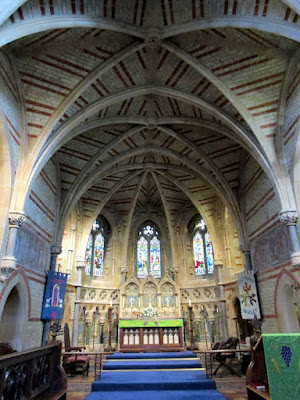
Hawley lies over in the Hampshire chunk of the Diocese of Guildford, and has two churches. The older one, Holy Trinity, seems to have had a Catholic tradition from the beginning, the beginning in its case being 1837 when the first church was built by the Revd John Randell: it’s under the patronage of Keble College, has a statue of Our Lady of Walsingham, and still celebrates the mass eastward-facing, possibly the only church in the diocese where this is the case – at a main Sunday service, anyway. The first building was rebuilt in 1858, and the side chapel (of ‘The Resurrection’) constructed in 1908. Those Stations of the Cross have the definite stamp of Faith Craft about them, and are the right date for that, after 1947.


In the south of the parish is All Saints. This began life in 1882 as a chapel attached to a convalescent home, all founded by Charles Randell, cousin to Revd John, as a memorial to his wife. He invited the Clewer Sisters to run the home, and they remained until 1953 when it was passed to a secular charity. The chapel was always open to the public, but was of course outside the authority of the Bishop of Winchester who wouldn’t have been able to stop the creation of a Chapel of the Blessed Sacrament in 1924. Changes in the population locally led to All Saints being deconsecrated in 1974. Descriptions prove it was quite elaborately decorated, with figures of the BVM and the Four Western Doctors, a rood screen, seven hanging sanctuary lamps, and a plethora of stained glass including an image of St Charles Borromeo. Where all that went is anyone’s guess. The building still stands, forlorn and derelict behind a fence and a patch of waste ground, awaiting – something.

Its modern successor is half a mile to the south. It was locked when I visited but the windows allow a very good view of the interior with its own Stations, large icons, and silvery tabernacle on a table.