Showing posts with label Landmark Trust. Show all posts

Sunday, 16 January 2022

Hackfall Holiday

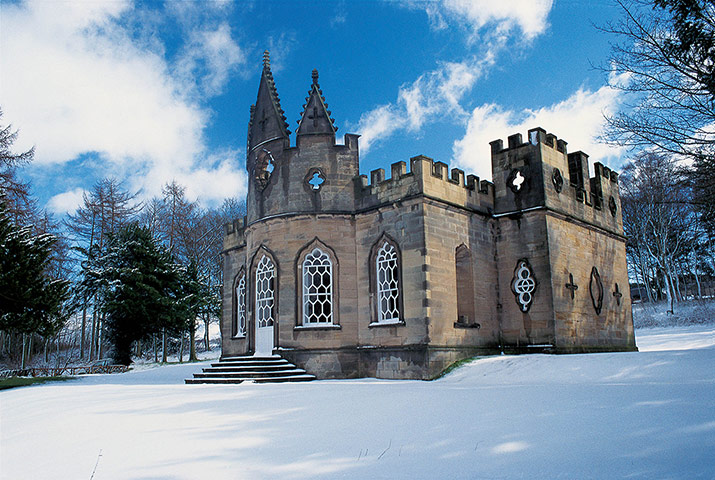
It's rare that I use anyone else's photos here, but my friends Madame Morbidfrog and Mr Romeburns have been celebrating their anniversary by travelling to Hackfall near Ripon and staying in The Ruin. I realise I was there so long ago it was before I even began this blog: Autumn 2008. Hackfall wasn't my first introduction to the concept of the 'Gothic Garden' - that had been Hawkstone in Shropshire the year before - but it crystallised the idea in my mind and confirmed my theory that there was a series of these dramatic landscapes around the country. The Landmark Trust's restoration of The Ruin (or The Banqueting House, to give it its more correct and less interesting name) was the first step in rescuing Hackfall from its decades of obscurity and neglect, work which has carried on under the aegis of the Woodland Trust and Hackfall Trust: the follies that inhabit the woods have been stabilised, the great Fountain restored, and the walks tidied up - so far as they can be. This time of the year they will be an ocean of mud if my experience was anything to go by.

I loved The Ruin: it's one of the Landmarks I might return to, notwithstanding the fact that none of the three rooms communicate with each other, so to have a wee or retire for the night you have to go outside onto the terrace, teetering on its precipitous drop down to the valley of the River Ure far, far below. My first night was marked by howling wind and rain and strange noises: finally I went to the window to investigate and found myself being stared at by the reflecting eyes of a sheep. I think. Realising that Professor Purplepen wasn't far away in Leeds, I invited her to dinner (actually, Leeds turned out to be farther away than we thought, but she came anyway). On the second day I'd come back from a trip and there was a knock on the door. A woman in a wax jacket and wellingtons with a dog asked me whether I was Mr Weepingcross. She handed me a letter: 'This arrived at the farm for you. I think the postman delivered it to me as it's the closest address to The Ruin'. The missive turned out to be from the Professor who couldn't remember whether she'd told me she was a vegetarian, and had lost my phone number. Royal Mail to the rescue.

Madame Morbidfrog and Mr Romeburns look like they are enjoying themselves immensely. Only proper Goths take all their gear (it's nowhere near all their gear, but never mind) to a field in Yorkshire even though nobody else is going to be there. And don't quibble that Madame is barely wearing black at all, it still counts. 


It's very encouraging to see the restoration work elsewhere in Hackfall. This was The Grotto when I visited, a tumble of stones with a bench in the middle:


The Grotto hasn't exactly been restored, because it can't be, but its remains have instead been transmuted into a splendid arch which you'd never believe had only been in place for about ten years.


I can feel a return tempting me even now (though not this year, I am booked elsewhere). 

Saturday, 12 October 2019

The Bath House, Walton

It's been many years since my Autumn holiday has taken me to any of the more off-the-wall properties in the portfolio of the Landmark Trust. I returned to that fold this time, though, in the form of The Bath House near Walton in Warwickshire, a place I wanted to visit some years ago but wasn't able to. The Young Lord Declan & Lady Minerva went there, and in conversation with Caroline, a non-stipendiary priest who sometimes comes to our 8am mass, I learned she and her husband have been there too. I further learned to keep the door that leads to the grotto shut, or bats get into the living room (that happened to them). 

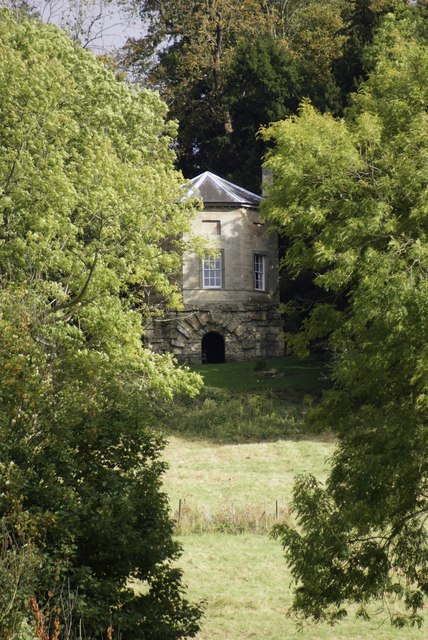
For the Bath House is just that: a very salubrious and shell-festooned octagonal shelter painted the most delicate blue (I know it looks green in the photo) over a 'cave' which shelters a cold bath, made for the benefit of the Mordaunts of Walton Hall. The architect was Sanderson Miller, no less, whose own small estate at Radway scant miles away was the first, as we might call it, 'Gothic Garden', a landscape tweaked to provide reflections on melancholy and mortality. It's another building that Landmark has rescued from ruin, and into which a bed, bathroom and kitchen have been crammed despite it never being intended that anyone should spend a night there. 

You approach half a mile or so through woodland, a journey which at least in the morning I found always fraught with pheasants (I wonder if Landmarkers ever run them over?), and come across the Bath House down a slope once you can drive no further. People very rarely photograph this view, so I did: it has a certain Vanbrughian solemnity. It looks very different from the other side, with a clear distinction between the upper bit and the grotto.


Inside, of course, all is refinement and delicacy. Except when you take the cold, damp staircase down to the pool ... In common with most guests, I did go for the full 18th-century experience and take to the water, gradually making my way down the steps into the pool until the pain receded. My feet even, finally, touched the bottom - though not for very long, and on a less sunny afternoon I chickened out of my intention to take a second dip.


Outside, Gothically, there is a small pets' cemetery at the front of the Bath House, but there are living beasts around too. The bats were not a myth.


Wednesday, 14 May 2014

Whiteford Temple, April-May 2014


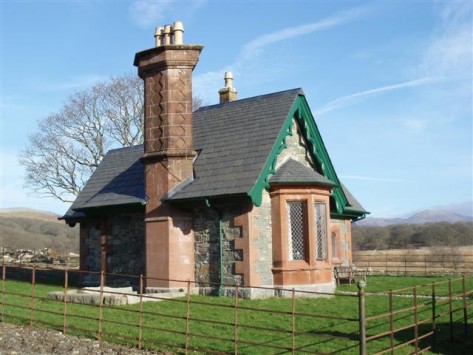
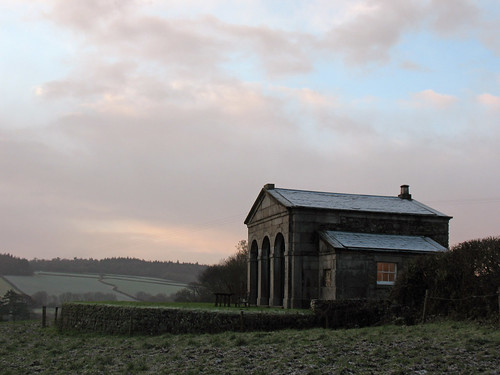
A couple of weeks ago - and how remote it seems now! - we made our way along the southwest peninsula to east Cornwall, and specifically to Whiteford Temple, a little Landmark between Callington and Launceston. Its history is a little obscure but it was related to a now-vanished big house down at the bottom of the hill and probably dates to the very late 1700s or early 1800s. When Landmark took it on in 1997 it had been used as a cattle shed and was ruinous; the way it appears now is, more than usual, a rather imaginative reconstruction of what Landmark's architects think it may have been intended to look like.


The Temple sits at the end of a rough track from the lane negotiating which is a diverting experience, and has its own little turf temenos which had just been strimmed before we arrived meaning that you couldn't venture outside without your shoes being instantly and irretrievably coated in grass clippings. The building occupies the brow of a hill and the wind and rain sweeps across it, given that this is Cornwall, most of the time. It did clear up occasionally, though.


Inside the building has an appropriately Georgian elegance. The logbooks contain regular complaints about the cold, the difficulties lighting the fire, and the blue tinge to the water, none of which we had any problem with at all!

Tuesday, 19 February 2013

Getting Away

I haven't booked my main holiday this year which is a bit late. I would like to spend a week in a Landmark as I have before. I love the Landmark Trust and its policy of buying ruinous but quirky properties and doing them up as holiday lets, but ... well. I've enjoyed them in the past. I've stayed in four:


First was St Winifred's Well in 2007, tiny, quaint and atmospheric with an actual holy well underneath it. I really liked it.


The Ruin near Ripon, where I stayed in 2008, was wonderful, a bizarre and delightful folly perched on an escarpment.


Next was The Abbey Gatehouse in Tewkesbury: that was a bit of a mistake as it seemed secluded but was in fact in the middle of a busyish small town.


Finally there was Ty Capel at Rhiwddolion in 2011, which took a little bit of getting used to but was lovely in the end.


Last year I wanted to stay in Derbyshire, but Swarkestone Pavilion was booked - and I'm not sure about its location anyway as it seems uncomfortably close to a major road. That was what led me to stay for a week in The Fairy Cottage in Edale. It was nice to have a full week there rather than the four nights afforded by Landmarks, and the building was very pleasing, but some of the furnishings would have disgraced a student bedsit. At least with Landmarks you're assured of cleanliness, a high standard of furnishing, and that you will not be assaulted by aesthetic nightmares such as are often perpetrated by owners arranging properties for rental by the General Public.

The trouble is, much as I love Landmark and its ideals, its properties are becoming eye-wateringly expensive. There's no point forking out a lot for something less than ideal, and my general requirements are small size, secluded location, and odd character. That means the following are really the candidates, and here are the costs for a four-night stay in my preferred autumn slot, arranged in ascending level of pain. Prepare yourselves.


The Chapel, Lettaford, Devon: £325. It's the cheapest, but then it's the smallest and least interesting.


Glenmalloch Lodge, Dumfries: £369. Not too pricey, but the real investment is having to get to southwest Scotland to stay there.


Lynch Lodge, Peterborough: £391. Dr Bones has stayed here, and I called by for one night having gone to our former curate's induction as Rector of four parishes in mid-Norfolk. Nice, but it's not really very secluded as it's round the back of a farmyard. And the area is pretty built-up.


Whiteford Temple, Cornwall: £407.


Swarkestone Pavilion, near Derby: £429. Has the issues specified above. One runs the risk of forking out a lot of money and being kept awake by the road noise.


Queen Anne's Summerhouse, near Bedford: £431. This is nice, and I don't know Bedfordshire at all. But we're already more than £100 a night now.


The Chateau, Gate Burton, Lincolnshire: about £450. Very pretty, and again Lincolnshire is an unknown quantity to me. After two holidays in rugged Wales and the Peaks I quite fancy somewhere flatter. But it's not cheap ...


Houghton West Lodge, near Hunstanton: £461. Not the most special of houses; I'd have to be very sure I wanted to spend a week in west Norfolk.


The Bath House, near Stratford upon Avon: £474. I would love to go to the Bath House as the bottom storey is a faux-Roman bathing pool decorated with great blocks of tufa stone and the whole thing is the most insane sort of Georgian folly.


Robin Hood's Hut, Taunton: £521. You will notice how, now that we are reaching the very nicest and weirdest buildings, the pain barrier is becoming insistent. This is a fantastic folly, but even so.


The Prospect Tower, Faversham: £631. It's gorgeous. It's Gothick. It's much too much.


The Banqueting House, near Newcastle: £646. Oh, you can stop now.


And the last insult, from my native Dorset, a building which has haunted my imagination since I was small and we used to go to Kimmeridge Bay and were able, in those far-off days, to go right up to it and peep through the broken windows: the Clavell Tower. It isn't even available until 2014, then only for a sprinkling of extremely unhelpful dates, and when it is it's likely to cost well over £700 for a four-night stay.


I could always go back to St Winifred's.

Saturday, 22 October 2011

Hols

I went on holiday to North Wales the week before last. I'd intended to stay in Ty Capel at Rhiwddolion last year, but that never happened for one reason and another, and I was very happy to make it there for five days this year. This is Ty Capel:

And this is what it looks like inside:


Ty Capel is a former Calvinistic Methodist Chapel which eventually became redundant in about 1960 and was taken over by the Landmark Trust in 1967. They've converted it to a holiday cottage by inserting into the big empty space a gallery with beds beneath which are the bathroom, kitchenand hallway. Rhiwddolion used to be a village, with enough people living there to support both the chapel and a school associated with it. Naturally there was originally sheep farming (as there still is), but it was the slate industry that brought people in greater numbers to this remote area. Slate, however, was relatively short-lived, and so was the prosperity of Rhiwddolion. Now there are two inhabited houses, and three properties owned by Landmark - and lots and lots of ruined slate cottages, silent evidence of what was once a thriving community of human beings.

Friday, 16 October 2009

Holiday 2009

For the last couple of years I've taken holidays in properties owned by the Landmark Trust, that arcane organisation that buys up derelict historic buildings and does them up as holiday lets. This year's stop was the Abbey Gatehouse in Tewkesbury. This is essentially a single, large room over the gateway of the abbey precincts, built in about 1500 and accessed only by a narrow spiral staircase; so narrow, in fact, that when the Trust refitted it the furniture had to be assembled in situ, and in fact the armchairs were upholstered there too. The problem of inserting everything you need for a modern holiday was solved by constructing a sort of room-within-a-room, an oak gallery with kitchen and bathroom either side on the bottom and beds on the top. Genius.


As well as the Victorian gargoyles (dubbed by some earlier visitors Brother Jeremiah and Sister Agnes) there are two disapproving clerical portraits to keep guests in line.

The restored shrine of St Thomas at Hereford Cathedral has a very pleasing medieval garishness. Overall I preferred Hereford to the correct grandeur of the Abbey at Tewkesbury.

A day out took me within a couple of miles of Tintern Abbey, which I couldn't miss for its honoured place in the history of Romanticism. I was too late to get in - but to be honest all I needed was a photo or two. It's difficult now, looking at the ruins tamed and ringed with walls and roads like a lion in a zoo enclosure, to imagine how they must have appeared to Wordsworth and his ilk.

Then there was Tyntesfield, the great Gothic revival mansion in north Somerset recently opened by the National Trust. The chapel is a glorious Tractarian jewelbox, but the rest of it, undergoing frantic restoration, is virtually invisible beneath a cage of scaffolding. Only now and again can you catch a glimpse of the occasional arch or mullion.

I also made it to the Picturesque landscapes of Piercefield and Downton, which I'll add to the Gothic Gardens page on the website.