A topsy-turvy New Year for me as I am off on New Year's Eve and at work on New Year's Day: I had a funeral yesterday on what would normally be my day off. That was unusual, too: a graveside ceremony for someone relatively well-known in the community (though not to me directly), assisted by the Council who provided a PA system and music, and with sloe gin to toast the departed. Seeing people line up outside the cemetery (a rather nice spot, our little local godsacre) was very moving and seemed much more pleasing than being at the Crem., or even, dare I say, in church. Today I have largely spent ordering books and managing to avoid employing the Evil Empire of Amazon to do so, and downloading music ranging from the orchestral accompaniment to the Golden Parade of the Pharoahs back in July, to early-1980s feminist punk, to 1940s Chinese jazz. This has a name, shidaiqu, so don't say you don't learn anything here, unless you knew it before.
I get slightly peeved when people I know speak as though calendar years have personalities, and it's both a mystery and a shock when one turns out unusually horrible, but I also get peeved when other people I know get very superior about not doing that. It's a natural if loose way of thinking. The annual ticking-over of one digit to another gives us a way of framing our outlook and perhaps amending our behaviour, though whatever life may presently be throwing at us pays no attention to it, of course.
People ask me whether I think the pandemic will ever be over and I say, Yes I do, because human beings have been through this experience umpteen times and it has always followed, overall, the same trajectory. Pandemics never end with diseases eradicated: we've only ever managed that twice, with smallpox and one sort of polio. Instead successive waves of infection sweep across continents, or the world, and they get milder as resistance builds up among their survivors. What's different this time is twofold: first, we have far more information than ever before, and can analyse what's happening with the virus in a way we never could in the past, and secondly we are tackling this disease not predominately with natural infection, but with vaccines. We are not just shrugging our shoulders and letting lots of people die. That's a degree of progress.
I think it will all be all right, and it may all be all right sooner than we fear. Not everything will be. Democracy and freedom seem to me very fragile indeed - more fragile than they always are - and of course we're still heading, more likely than not, for the collapse of our civilisation and everything we love and value before the end of the century. You might have noticed this is the warmest New Year on record. That may well not be all right at all. But this will be. In a couple of hours time I will drink a small toast to it!
If ever an Angel had cause to Weep, it is this one. I'm using the fallow week between Christmas and New Year - actually, it is anything but, the work I would normally do in the first week of January just being displaced into this one - to have a go at some tasks I've been meaning to do for ages. One job is repairing one of our angels. We have four, but two have suffered a bit of misfortune so, armed with what describes itself as 'Extreme Epoxy', I am trying to glue its right wing back on: we will see whether we can get the celestial being back into service. The remaining one is at our sacristan's house, and we may get round to that in due course.
I thought the angels were plaster, but they turn out to be made from some very heavy metal - not lead, as it's not flexible enough, but something like lead: a kind of pewter, perhaps. Each one holds a staff with a pricket for a candle. They must have come from the riddel-posts of an English altar, but we have never had anything so grand at Swanvale Halt, so one of my esteemed predecessors must have salvaged them from somewhere else. My money is on Fr Edward as the culprit in the late 1960s, as he had a habit of repurposing detritus from other churches even as, paradoxically, he plotted to have his own church purified of all its Victoriana including the stained glass. I would love to know where the angels' former home was, but Edward is no longer around to ask.
Like many other things, ghost stories are a Christmas tradition. When Radio 4's podcast The Battersea Poltergeist came out at the start of the year I was wary of its promised mixture of 'drama and documentary', but having dipped into presenter Danny Robins's other offering, Uncanny, I gave it a go and somewhat against my better judgement was drawn into the narrative. The hook is the prospect of finding something that will prove conclusively what's going on in this 'paranormal cold case' from 1956, in which a working-class family in southwest London is tormented by a manifestation which - it was eventually claimed - was the Dauphin Louis Charles, the lost heir to the French crown. It will not spoil the fun too much to reveal that nothing is mentioned in the podcast which proves anyone's point of view. It's vanishingly unlikely that Louis Charles was smuggled into England, rather than dying, as history has recorded, sick, maltreated and neglected, in the Tower of the Paris Temple in 1795, so whatever the poltergeist the family called 'Donald' was, he wasn't that. Yet while there are possible normal explanations for much of what happened in no.63 Wycliffe Road, it's hard to account for the rappings, bangings, and other weirdness that followed Shirley Hitchings, the 15-year-old at the centre of the phenomena, to distant places, including the studios of the BBC where she was interviewed by Cliff Michelmore for the Highlight programme, an event that clearly unsettled Michelmore enough for him to refer to it years later. Mr Robins has two resident consultants to epitomise the different approaches listeners might take to the story - writer on the paranormal Evelyn Hollow, who is a bit of a Goth, and 'arch-sceptic' academic psychologist Ciaran O'Keeffe, who isn't. They bat about the possibilities between them and neither inflicts a killer blow, as it were. With skilful artifice, the show draws every atom of energy from this indeterminacy: but in truth, although Mr Robins often mentions using a mysterious cardboard box of papers left by the paranormal investigator Harold Chibbett, who worked on the case at the time, and having interviewed Shirley Hitchings, James Clark, who wrote the whole thing up in The Poltergeist Prince of London in 2013, did both too. The podcast adds a few new nuggets of information: for instance, a graphologist decides that the mysterious letters from Donald are almost certainly in the same hand as Shirley's. But ultimately the only way a listener will be able to decide is to have decided already, long before they hear the story.
What do I think about it? In the end I wouldn't see much to dissent from in sceptic Deborah Hyde's assessment that Donald was 'a story with many authors, created communally, both consciously and unconsciously, according to a script that's readily available to everyone in that culture'. There's a lot in the Battersea Poltergeist narrative that doesn't add up, but at this distance in time it's almost impossible to disentangle what might have happened regarding any reported phenomenon in the case. As the priest who took our classes on this stuff at theological college said, 'There's about two hundred things a thing can be'.
My experience is that people often have a somewhat unhealthy interest in this kind of weirdness and so I am wary of feeding the fire: the Church as a whole has also been very, very reticent about this in the past after some loose practice resulted in terrible cases of abuse or malpractice in the name of 'the ministry of deliverance' (I wrote about a film based on one fairly recent incident in Romania). But the situation when I arrived in the Guildford diocese where people were reluctant even to mention who the Advisor on Deliverance was does seem a bit extreme, and in fact there's now a relevant page on the diocesan website. In fact such stuff comes my way pretty infrequently, amounting to only half a dozen cases in sixteen years, and most of them so vague and uncertain that it wasn't clear any lay beyond the normal bounds of psychology. As a priest I am of course committed to the idea that there is a non-material aspect to human life, but also to a scepticism about any particular incident that presents itself, and I'm always grateful that I seem to be completely insensitive to 'atmospheres' and the like. I don't know anyone even remotely inclined to go in all-guns-blazing with holy water, lighted candles and the Major Exorcism of Persons and Places at the first hint of paranormal events. The last such incident I dealt with was someone who had become convinced there was a 'presence' in their home and who'd been unsettled by a medium friend claiming they could detect the spirit of a young woman who'd lived in a large house on the site of the block of flats that was there currently, who had died after a pregnancy and been illicitly buried in the garden. After some discussion we agreed that in fact nothing needed to be done apart from praying for this soul, if soul it was, to be assured of God's mercy and justice. We did so, and the manifestation, such as it was, stopped. Make of that what you will.
Make what you will, too, of the only time anything weird has ever come my way personally. I went to visit a mother and adult daughter who lived on a new estate built on an old site. The daughter had done some low-level mediumship in the past and was now, she said, afflicted by unwelcome presences that seemed to be linked to the history of the place: she (and others) heard voices, and she experienced a sense of oppression. I arrived at the house, and spoke to the mother in the kitchen, with my bag (containing all my kit - Bible, stole, water and anointing oil, just in case) on the table beside me. I could see the daughter appear on the stairs out of the corner of
my eye but was still in mid-sentence so I didn’t turn to her for a few seconds.
When we moved to go to the living room, I checked my bag and found a lipstick and hair grip in it. As I got them
out, the daughter said they were hers. Both she and her mother seemed bewildered at how
they got there. We left them on the table and said no more about it. After I left the house, I sat in the car for a few moments
and said, ‘If there are any of you here, I want to make it absolutely clear
that you must stay here where you belong. You’re not coming back with me!' On getting
home I thought I’d go to church to say Evening Prayer and went through my bag
to get my stole and the oil to take back. Right at the bottom, under my Bible,
notebook and other things, I found a bulky car key and battery fob with two
keyrings. This turned out to be the daughter's too. It's possible that she could have placed the objects in
my bag in those few seconds when she wasn’t completely in my field of vision,
though she would need a Magic Circle-level of expertise to do it without me
seeing her move, or hearing the keys rattle. She certainly couldn’t have done so without her mother seeing
so if there was deception it was done by both of them. Despite my prayers and those of others - it turned out the couple had been talking to various other people as well as me - the manifestations didn't seem to stop completely. I still have no idea what any of that was really about.
Don't, as the wonderful theme song to Uncanny by Lanterns on the Lake insists, have nightmares!
It has been virtually a rerun of last year, almost to the worshipper - well, a different mixture of them, but amounting to the same numbers. The three mini-crib services on Christmas Eve, the curtailed midnight, 8am and 10am, took place without incident, and without a great many souls there either. But this year we have the added cruelty that Boxing Day is a Sunday. Who will turn up tomorrow to listen to my further attempts to squeeze some vaguely interesting thoughts out of the readings, I can't imagine. It has been wet and grey: I had to turn the lights on in the middle of the afternoon, and I don't mean the Christmas Tree lights. But we have survived (one more daily Lateral Flow Test to go and then I'll revert to twice-weekly again) and next year must surely be an improvement. Mustn't it?
When he was a curate, Il Rettore was handed the list of home communicants in the parish and sent off to see them. It's a way of doing something useful with a new curate who can't do much else and isn't supposed to be deluged with preaching duties and the like, and also gets them to meet people. But the temptation is just to get them doing all of it. Il Rettore once took communion to fourteen people in the same day. I wondered that his mental equilibrium was maintained, saying the same words over and over again. Perhaps it wasn't.
It isn't like that in Swanvale Halt, but I tend to do a series of home communions just before Christmas and Easter, to make sure people are included at these vital times. Some of my most moving moments in my ministry have been doing this as I encounter people who have lived lives of faith and faithfulness, and share with me their thankfulness for the mercies they have received and still do. They are always grateful to me, but when I say thank you at the end of the meeting I do mean it. Taking communion to someone in their own home, not celebrating a eucharist but simply administering the sacrament - to myself as well as them - is a situation of great equality. We are both recipients, approaching the Lord in his sacramental presence, even if I say most of the words. When Marion the curate was with us she did some home communions, but not all of them. I think any incumbent who delegates this job because they're awfully, awfully busy doing more important things is genuinely missing out.
In Farnborough, one of those wild corners of the Diocese of Guildford beyond the Surrey border in Hampshire, there are (now) three Anglican churches. The modern Good Shepherd need not detain us long:
And nor need we linger at St Peter's, the old parish church in the centre of town. Architecturally it's interesting, and even has medieval wall paintings - three fragmentary female saints, none of them, sadly, St Catherine - but it hails from the Low-Church end of the spectrum and has been cleansed and purified inside, to a degree. How on earth did it get away with driving through a pair of massive transept extensions either side of the old chancel in the 1960s, linked to it by sort of flat neo-Tudor arches?
But then I found my way to St Mark's - a humble redbrick building of the 1880s and no great distinction. I knew it would be open thanks to a Christmas tree festival, but I didn't anticipate the congregation members on duty would ply their visitor with tea, leek-and-potato soup, and mince pies, and show him their photograph albums and describe the history of the church. Nor was I anticipating images of priests in birettas, statues and shrines amid the hazardously trailing cables feeding the fairy lights, or a sacristan proudly showing off the 'best thurible' she was just finishing polishing. The church hadn't been founded with an Anglo-Catholic tradition, I was told, but had acquired it in the 1920s. 'Some of the locals never forgave us'.
The great treasure of St Mark's isn't anything specifically to do with its tradition, but a side chapel displaying its link with military flying: the Royal Engineer Balloon School and its successor the Air Battalion, and finally the RAF's forerunner the Royal Flying Corps, were all based at Farnborough and this was their Garrison Church. The chapel is a memorial to the RFC dead of WW1, each fatality's name recorded on a separate plaque of rather nice oak (including a local woman who was killed on war work). It has a mock-Jacobean screen at the entrance and, either side of the altar, what are not riddel-posts but nearly, topped not as you might expect by angels but by knights. There are Knights Templar on little pillars either side of the High Altar too - conspiracy theories ahoy!
So I had much reason to feel warm to St Mark's. But I suspect all this may not last all that longer. Like a number of other old Anglo-Catholic churches I know, it has the signs of something that was once grand and spiritually enriching but which can't be sustained, like a clock running down. There was once a rood beam which was removed, I was told, because it had woodworm; the Lady Chapel is no more, its old baroque altar reredos now wedged behind a piano while Our Lady of Walsingham sits on a shelf, a bit forgotten; and, if you look carefully, you can see Jesus on the high altar has a broken halo. The church is in vacancy at the moment, but they know where their new incumbent is coming from: an evangelical church not far away.
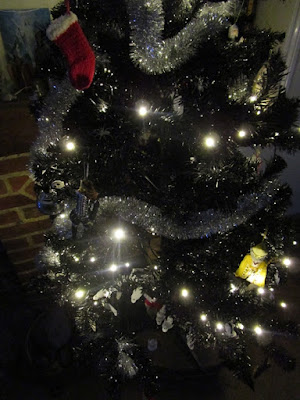
Sixteen years into my ministry, and eleven into my incumbency, and I have only just recognised a peculiar feature of parish life: the link between undertakers and Christmas trees. Our local undertakers are Galliards, who like many of their breed have been around for donkeys' years. I've always got on well with them: they're informative and co-operative, and don't simply arrange dates for funerals and then check whether I can do them afterwards. And they've always provided the church with a Christmas tree.
I had always thought of this as a local arrangement but suddenly became aware that it isn't. The South Yorkshire church currently served by my old vicar from High Wycombe, Fr Barkley, also has a Christmas tree provided by the undertaker's, and it isn't the only one. How has this come about? The companies don't get much publicity out of it (I decided the time had come to put a photo of our tree on Facebook, as much to promote the church as Galliards), and the connection isn't intuitive. The only thing I can think of is that undertaking often grew out of allied trades: carpenters, for instance, made coffins and branched out into arranging funerals, so there was a link with wood, trees, and Christmas decorations.
In fact our tree was a little dumpy and wonky this year: I had to put it on a little table to bring it up to most people's eye level. Rick the verger and Andy from the congregation wedged it level and draped it with gaudy tat so it looks presentable. I also made sure I photographed it from a clever angle. Not angel.
(As well as the church Christmas tree, Fr Barkley used to have a personal one delivered to the Rectory on behalf of the Lord of the Manor, along with a brace of pheasants. Sadly that custom no longer pertains. As the good Father says, "times is 'ard".
I realised I actually enjoyed reading my friends' blogs, and so have made my own, with an oblique nod to 4th-century theologian Theodore of Mopsuestia. Christian and Gothic matters will probably predominate. Names are changed to protect the furtive.