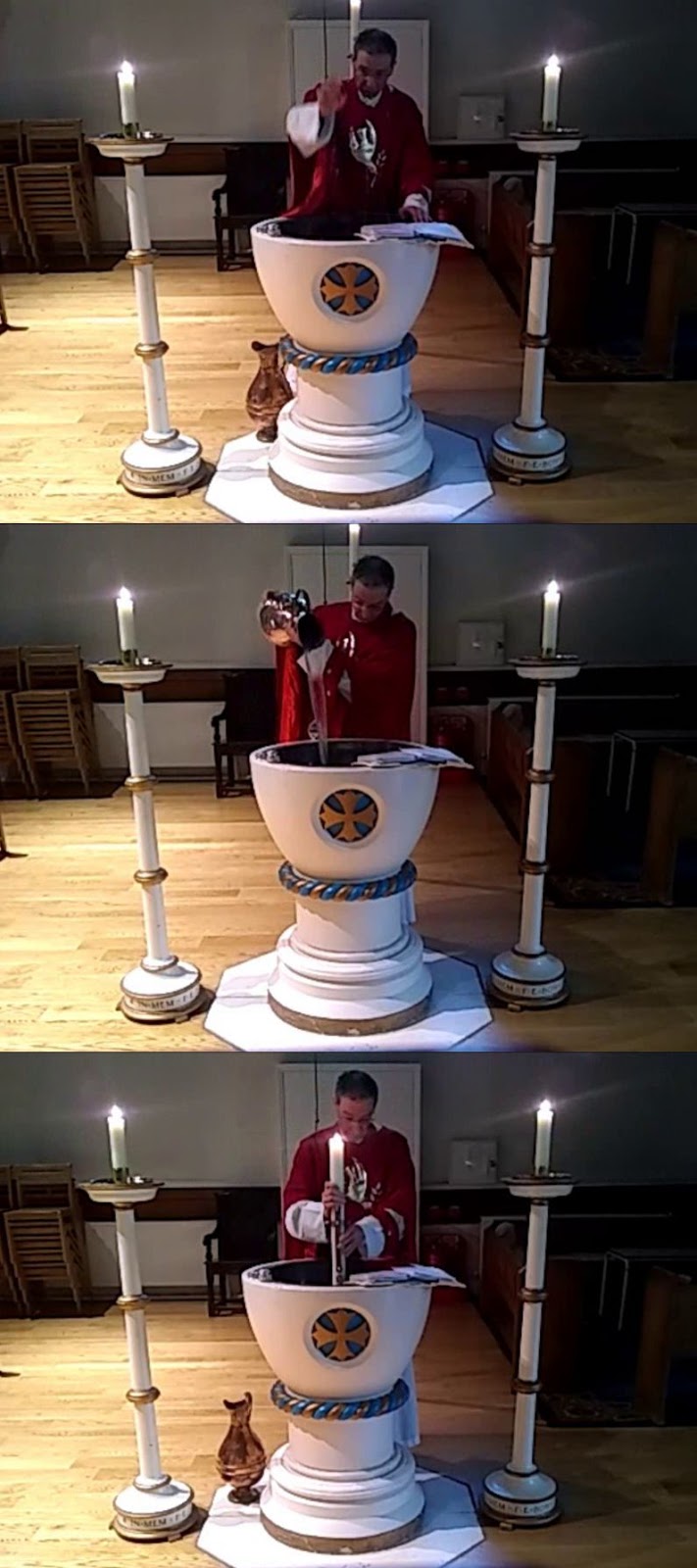
Like the Paschal Liturgy, Pentecost Day presents another challenge - at least it does at Swanvale Halt, where I've adopted the practice of transferring the full-scale Blessing of the Font from the Easter Vigil to Pentecost Day, celebrating the Church being equipped for its mission by the coming of the Holy Spirit. Of course at the moment, as with everything else, I'm doing it on my own and so the 8am mass required me to carry my phone through the church from its now-customary station near the high altar to the font where the ceremonies took place. At least the journey presented fewer trip hazards than my adventures on Easter morning. Instead of a homily I described what I was doing and why for the benefit of the video and those bold souls who might be watching it - the Litany of the Saints, the scattering of the water, the Sufflation and infusion of the Oils, dipping the Paschal Candle in the water, and the Commission of the (absent) People. Apart from the phone slipping and so not being exactly positioned where I wanted, it all went fine.
It couldn't last. Having put my potatoes in the oven to roast for lunch, after about twenty minutes I was disturbed by a mysterious odour whose nature I couldn't quite tie down. I then remembered I'd been trying to get grease off the roasting dish, and had left it to soak, so the aroma was the combined perfume of heated vegetable oil and washing-up liquid. I prepared new potatoes. A shameful waste, I know, but I couldn't think of them in the same way.
Sunday, 31 May 2020
Saturday, 30 May 2020
'Vanishing Dorset', by George Wright (2008)
One of the hazards of the COVID restrictions, like drinking too much or putting on what the Germans call coronaspeck, is (for me) buying books. I have one on the way and may, depending what my bank account looks like when I check, be buying more later on. One of them has been George Wright's 2008 volume of photographs, Vanishing Dorset.
'In 1983', he says, 'I went to live in an old farmhouse, up a potholed track, over a flooding stream, in a remote corner of West Dorset'. It was a wonderful place for Wright to retreat to from his globetrotting life as a photographer. Eventually, though, everything changed: 'when the newly formed village hall committee decided against allowing live music, I realised ... it was time to move on.'
But in the meantime he had documented some of the places he visited and people he met in the villages round about. The oldest of these images dates from 1980, and that's an outlier: most are from the 1990s or the second half of the 1980s. It's hardly a bygone age; it was when I wad doing most of my visiting of Dorset churches, barrows, and other historic sites. Yet Wright's photographs make this landscape appear antediluvian and its denizens barely like contemporary humans at all. It may just be the way they're dressed, these old boys in their cloth caps and drab overcoats, and ladies in stubby brown shoes and thick stockings, but they could be another race, albeit one no less individual than ours - in some ways, more so. Mr Chick of Rampisham used to serenade his pigs, shirtless, on an electronic organ. They were, apparently, very fond of 'Fly Me to the Moon'. These characters move through a backdrop of derelict farms and impractical cottages. The chaps at James Foote the forage merchants at Dorchester look very little different from the sort of Edwardian shopholders you see in photographs, standing outside their stores. Wright keeps the most elegaic photo to last: the Trysting Tree at Wytherston, in one 1986 shot proud and upright and carved with initials and hearts, and opposite it in 2008 lopped and segmented, lying by the road. Things do change.
'In 1983', he says, 'I went to live in an old farmhouse, up a potholed track, over a flooding stream, in a remote corner of West Dorset'. It was a wonderful place for Wright to retreat to from his globetrotting life as a photographer. Eventually, though, everything changed: 'when the newly formed village hall committee decided against allowing live music, I realised ... it was time to move on.'
But in the meantime he had documented some of the places he visited and people he met in the villages round about. The oldest of these images dates from 1980, and that's an outlier: most are from the 1990s or the second half of the 1980s. It's hardly a bygone age; it was when I wad doing most of my visiting of Dorset churches, barrows, and other historic sites. Yet Wright's photographs make this landscape appear antediluvian and its denizens barely like contemporary humans at all. It may just be the way they're dressed, these old boys in their cloth caps and drab overcoats, and ladies in stubby brown shoes and thick stockings, but they could be another race, albeit one no less individual than ours - in some ways, more so. Mr Chick of Rampisham used to serenade his pigs, shirtless, on an electronic organ. They were, apparently, very fond of 'Fly Me to the Moon'. These characters move through a backdrop of derelict farms and impractical cottages. The chaps at James Foote the forage merchants at Dorchester look very little different from the sort of Edwardian shopholders you see in photographs, standing outside their stores. Wright keeps the most elegaic photo to last: the Trysting Tree at Wytherston, in one 1986 shot proud and upright and carved with initials and hearts, and opposite it in 2008 lopped and segmented, lying by the road. Things do change.
West Bay in 1986 - just three years before my dad's photograph here.
Thursday, 28 May 2020
A Trip to the Beach!
I wasn't the only soul who decided to use the sunshine to go to Earling Bridges. Some came well-equipped for river exploration.
Earling has some appealing old houses.
The journey home took me past the epilepsy home in Hornington; the old chapel appears shyly through the trees.
But the first leg of the walk took me past the Dark House which I first saw in 2009 and again in 2016. The steel fences have been removed so you can view the building in its austere 1930s splendour, but signs now warn you that the whole site is alarmed and arrests of trespassers have been made. Nothing is happening to it apart from its continued dereliction, and sure enough the chimney on the right looks about to topple!
Tuesday, 26 May 2020
An Age of Delusion, Yet Again
You
might have thought, given what I’ve said in the past and my interest in the
interior arrangements of church buildings, that I am a steadfast defender of
the stone and brick steeple houses we Anglicans inhabit. I mainly am, but I
also recognise that they are burdens as well. The Body of Christ needs
somewhere to meet, but it doesn’t necessarily have to be so large, so old, or
so expensive as it often is. While at theological college I remember writing
about the notion of ‘cell church’ which had a vogue at one time – a form of
Christian community in which small groups become not adjuncts to the church
which allow greater discipleship, but the basic structure in which people live
their Christian lives, only gathering together in larger numbers on special
occasions. Some evangelical Anglican churches went for that, although I don’t
know that any actually disposed of their old church buildings; they did, after all,
still need them, and might not have been allowed simply to abandon them anyway. I
heard a story of a church in Coventry diocese which, driven from their old
building after a fire, found their new home in a school hall so congenial that
they refused to return once the church was repaired. The diocese didn’t like
that at all. But ‘selecting cell’ (as Mission-Shaped Church – remember that? put
it) would shift the focus towards a different way of doing things in which the
building becomes less important. I remember writing an essay on ecclesiology at
Staggers and musing how historic parish churches might turn into ‘network
cathedrals’ linking a variety of forms of Church life into the Apostolic
structure. Certainly that might mean not needing as many of them.
I’ve
long thought a reckoning was coming, driven by strain on resources; not even I
think that decades of numerical and therefore financial reduction can go
unrecognised indefinitely. In our
diocese the line is now that if a church can’t cover the costs of a stipendiary
clergyperson, it won’t get one unless the diocese decides there are special
circumstances, and had it not been for the unnecessarily punitive and capitalist
language our bishop used when introducing the new policy (‘we must move away
from a system that penalises success and rewards failure’) I wouldn’t have minded
so much.
This
is also the strategy adopted in Chelmsford, where Stephen Cottrell has been
bishop for ten years. Becoming Bishop of Reading by accident in 2004 when the
Oxford Diocese’s evangelical powerhouses played merry hell at the prospect of
celebrity gay parson Jeffrey John taking up that post, +Stephen’s first
episcopal task was coming to St Stephen’s House for our Founder’s Day. He comes
from the Catholic tradition, but most of us don’t practice being bishops before
the pointy hat drops on our head and it was most amusing to see him being
pointed in the right direction by the House Sacristans who knew more about
being a bishop than he did.
Now
in the process of being translated to York, future Archbishop Cottrell is, we
learned over the weekend, being charged with running a commission to
restructure the Anglican Church. The Sunday Times had spoken to ‘a source
familiar with Cottrell’s thinking’ and reported them as saying ‘The crisis is
going to lead to a massive shrinkage in the number of cathedrals, dioceses and
parish churches … [the COVID emergency] has vastly accelerated a dramatic
change in the way the Church of England will do its stuff because of declining
attendance and declining revenues.’ The photograph of +Stephen shows him looking
unconscionably smug, which he never used to be, unless sixteen years of
bishoping have made him so. It was a shame we had to find out this way, and
shows yet again that the bishops really have very little idea how to manage the
system of which they are in charge or the people who make it up. Bishop Philip
North (him again) Tweeted that he didn’t recognise the report, and that
discussing closing dioceses ‘would lead to years of pointless debate and
introspection at a time when we need to be looking outwards, naming injustice
and addressing a nation with a message of hope’. The cynic in me whispers that, this being the Church of England, ‘years of pointless debate and introspection’
is presumably just what we will opt for.
‘We
are at a crossroads,’ an unnamed bishop told the Sunday Times, ‘everything’s a
blank sheet of paper. It is allowing us to get back to that question of first
principle, what it means to be the church. People haven’t stopped gathering for
worship. They’ve been doing it over Zoom or over YouTube’. I want to scream,
This isn’t ‘gathering’! It’s a replacement for gathering, a weak, etiolated
stopgap, a plug in the hole left by the shutting-down of genuine Christian
community. People hate it, and they only do it because it’s the best they’ve
got. Getting back to first principles is fine, but you wouldn’t have thought
that one of the principles in question would be that of human beings actually
physically being together.
What I think ‘the Church’ means is something like ‘the community called into existence by the saving work of Jesus Christ, organised around the sacraments and gathering to proclaim his coming Kingdom’. There is no 'new way of being church' which doesn't include those things. No, you don’t need lovely old buildings to do them, but I wonder what the Body of Christ here in Swanvale Halt might look like without the Steeple House. It’s worth thinking about, but, I suspect, far from a panacea. We would presumably meet in houses or pub rooms. Instead of the infants school and other institutions coming to us for their celebratory events, we would have to beg use of their facilities when they’re not using them, the same as Slimming World or a pilates class. We would instantly lose our visibility; and I’m far from convinced that a lot of reticent Anglicans are suddenly going to become the Durutti Column of guerrilla evangelists that the theory envisages. We know that even the most outgoing evangelical churches rarely bring any new souls to faith, but largely shuffle them around between each other, or breed them. I worry that I am deluded in thinking I can have much effect through my work to communicate the Gospel, but if I am I’m not alone. Bishops keep talking as though our current situation is something wonderful rather than a mutilation of what we are supposed to be: ‘Now’s our chance to reimagine church’ that article Bishop Graham Tomlin Tweeted the day the churches were locked to the communities in which they sit. I think the bishops are in for a rude awakening if they think that shutting that inconvenient Gothic building in the centre of the estate is going to revive the Faith in England any time soon.
In this mood I sat with my early-morning tea and
read John 22. ‘It is the Lord!’ cries Peter, and leaps into the water of the
Sea of Galilee to swim to the beach where he’s glimpsed Jesus. It is indeed, I
found myself thinking, and that’s what matters. As Jesus speaks to Peter over
breakfast, joking whether he loves him more than he does the fish – that’s my
take on the text, anyway – I thought of Philip Pullman’s The Good Man Jesus and
the Scoundrel Christ, and other desperate atheist attempts to shut the
experience of the apostles into a box they can understand, and to defuse its
danger. Christ is risen and everything else is relative. I will carry on doing
what I can do here to tell everyone that, to proclaim the Kingdom, to make sure
Swanvale Halt Church makes its contribution to its parish and the wider Church
as long as it can. Sometimes I weary of it; sometimes I think I’ve barely
started.
Two slogans for you:
Labels:
bishops,
changes,
COVID19,
evangelism,
mission planning,
money
Sunday, 24 May 2020
Battling with the Tech
Ascension Day is one of the occasions in the year when Churches Together in Hornington & District tries to hold a joint service. This year I and the Roman Catholic priest were going to do Evensong & Benediction together but this being impossible it was suggested we hold Compline over Zoom. My heart sank a bit.
In fact although I was leading the service someone far more technologically literate from the RC congregation set it all up. I think the main problem I have with liturgy done via Zoom is the claustrophobic feel it has - in real life you are not quite so close to your fellow worshippers. Until the time for interaction comes, I don't really want to look at them: it's quite enough to know they're there. Christian communities always face the hazard of turning in on themselves and liturgy over Zoom can mark another step in that direction, shifting the balance from community being the context in which worship happens to worship becoming the language in which community is expressed. (We will leave aside how far this is genuine community: I am coming to the conclusion that 'if you can turn it off, it's not Church').
However you can avert most of this by the simple expedient of showing something other than lots of people's faces, or even the face of the person leading (mine doesn't appear on the photo here). For Compline we displayed a copy of the liturgy so people could follow it. How many warbled their way through Te Ante Lucis Terminum along with me I don't know, given that they were muted. I was far too busy coping with the Catholic lady who was reading the responses and alternate psalm verses for the benefit of the congregation. She was uncomfortably slow for my tastes, but I slowed down to try to shadow her. Then it occurred to me that she was in turn slowing down even further to coincide with me. It was like a liturgical slow bicycle ride.
In fact although I was leading the service someone far more technologically literate from the RC congregation set it all up. I think the main problem I have with liturgy done via Zoom is the claustrophobic feel it has - in real life you are not quite so close to your fellow worshippers. Until the time for interaction comes, I don't really want to look at them: it's quite enough to know they're there. Christian communities always face the hazard of turning in on themselves and liturgy over Zoom can mark another step in that direction, shifting the balance from community being the context in which worship happens to worship becoming the language in which community is expressed. (We will leave aside how far this is genuine community: I am coming to the conclusion that 'if you can turn it off, it's not Church').
However you can avert most of this by the simple expedient of showing something other than lots of people's faces, or even the face of the person leading (mine doesn't appear on the photo here). For Compline we displayed a copy of the liturgy so people could follow it. How many warbled their way through Te Ante Lucis Terminum along with me I don't know, given that they were muted. I was far too busy coping with the Catholic lady who was reading the responses and alternate psalm verses for the benefit of the congregation. She was uncomfortably slow for my tastes, but I slowed down to try to shadow her. Then it occurred to me that she was in turn slowing down even further to coincide with me. It was like a liturgical slow bicycle ride.
Friday, 22 May 2020
Before and After
'We've had some cases of COVID in the parish,' the vicar of Tophill, on the other side of Hornington from Swanvale Halt, 'and they all seem to be related to a single funeral which was held in the church just before lockdown began. Trace the instances back, and everyone seemed to have been at that.' We were having a virtual Deanery meeting over Zoom, each of us bringing coffee and biscuits to our computer screens. We noted that though the Government is talking about possibly, possibly, reopening places of worship from the start of July, nobody has any real idea how that will work. We'd discussed it at a virtual Swanvale Halt PCC meeting the evening before, and while we'd begun planning how many people could realistically fit in the church building sitting 2 metres apart - possibly sixty or so - hope was expressed (if hope is the word) that the diocese 'will send out reams and reams of instructions about it.' The clergy were less sanguine. 'I think the national Church has looked at the horrific complexity of how to arrange reopening, and aren't saying anything,' suggested a colleague. Revd Tophill said their PCC 'are assuming we will never "get back to normal". This is is it, no carol services, no concerts, no school leavers' days, from now on, ever. That's the base we start from.' Tophill has an admirably courageous approach to much in Church life but I suspect this is extreme, and that the urge to recover communal events will be very strong indeed.
On the hill later on I met Martin, an occasional congregant who works for the Mental Health Foundation. We discussed what happens next, a bit breathlessly on his side as he'd been running. 'The question now is how we convert goodwill and aspiration into action,' he said 'they have to be embodied in institutions and decisions.' The MHF is developing a way of pre-assessing policy in relation to kindness, and working on aspects of wellbeing economics.
In the evening I rang a bell out of the upstairs window which has been my way of joining in with the weekly Clap for Carers. Some people I know hate this ritual, regarding it as hypocritical and beside the point. I've thought of it as a way of levering political awareness into unwilling minds: you will struggle to make the NHS anything other than an inclusive and progressive cause. This week watching ministers take part and then having to be shamed into treating healthcare workers decently does make the point rather inescapable. But I'm relieved that signs it's coming to an end will remove the ambiguity for me.
On the hill later on I met Martin, an occasional congregant who works for the Mental Health Foundation. We discussed what happens next, a bit breathlessly on his side as he'd been running. 'The question now is how we convert goodwill and aspiration into action,' he said 'they have to be embodied in institutions and decisions.' The MHF is developing a way of pre-assessing policy in relation to kindness, and working on aspects of wellbeing economics.
In the evening I rang a bell out of the upstairs window which has been my way of joining in with the weekly Clap for Carers. Some people I know hate this ritual, regarding it as hypocritical and beside the point. I've thought of it as a way of levering political awareness into unwilling minds: you will struggle to make the NHS anything other than an inclusive and progressive cause. This week watching ministers take part and then having to be shamed into treating healthcare workers decently does make the point rather inescapable. But I'm relieved that signs it's coming to an end will remove the ambiguity for me.
Tuesday, 19 May 2020
Cumulative Effect
It’s been a
long while since, as happened on Friday, I took two funerals in a day. The
crematorium has been working at a distinctly elevated rate and our village
undertakers were responsible for no fewer than nine of the day’s ceremonies.
Oddly, it’s hard to ascribe the apparent upsurge to COVID. Since the emergency
began I’ve carried out one funeral of someone who clearly died because of it,
and another of a member of the congregation who died with it, but given his
record of being dragged back from the brink repeatedly over the last couple of
years there was every likelihood that he wouldn’t have left hospital after
being admitted with yet another seizure. All the other deaths seem unrelated.
So last week we
lost Miriam, one of the longest-standing church members, a former churchwarden
and treasurer who knew absolutely everything there was to know about the church’s
life, past and present: she’d fallen over at home, broken an ankle and hip and
never recovered from the resultant operation. No Wuhan Distemper involvement
there. But then there’s Daphne, former congregant (she and her husband moved
away 18 months ago), who had a stroke, and Richard, who died yesterday of a
heart attack. Neither has any apparent link to the virus, and yet the rate of
death within a relatively limited network of souls does appear to me to be
elevated from normal. Is low-level stress and uncertainty hitting people who
would normally not be dying? I start to wonder about vague things like the
sudden increase in my tinnitus over the last couple of months, and the sense of
‘cerebral congestion’ I seem to feel. Heaven knows what people who are actually
under real strain feel.
It is
Rogationtide, when the Church prays especially for the fruitfulness of the
earth, prosperity for communities, and divine protection for localities. There
will be no Beating of the Bounds in Anglican parishes this year. But yesterday
I went into the churchyard and prayed a Litany in time of plague, invoking the
prayers of a variety of relevant saints (patrons of nurses and hospitals and so
on) culled from a Roman Catholic website and adding petitions for the sick, the
dying, the dead, and against this sign of wrath under which we labour. The sun
shone and the birds sang as though there was nothing wrong at all.
Marion the
curate said her phone had auto-corrected ‘Rogation’ to ‘Rotation Sunday’, a
liturgical observance which I think has a great deal of mileage in it.
Subscribe to:
Posts (Atom)