Sunday, 14 August 2022

Payback

While we were keeping today as the Ninth Sunday after Trinity, the Roman Catholic parish were observing the Assumption of the BVM. But, disaster! Deacon Justin had turned up in a white-and-blue dalmatic, while Fr Jeffrey had left the parish’s Marian kit in Hornington. ‘We have a white-and-blue set’, I offered, showing Fr Jeffrey the vestments in question. ‘And it’s a nice lightweight one, too’, he said enthusiastically. Indeed it is, and in my view the very best of the church’s own kit, a beautiful ivory damask from the late 1940s. The Assumption is, in the immortal words of Bishop Mervyn Stockwood, ‘not an assumption we share’, but I was delighted to see the vestments used.

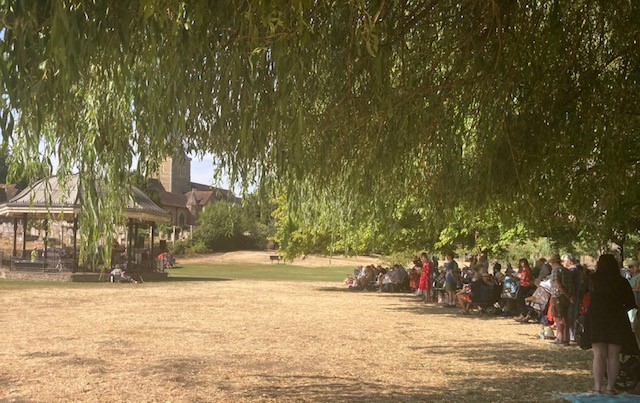
In fact we had no main service at all, observing whichever observance, being invited instead to Hornington Bandstand for the Churches Together summer service. It was the usual hymn-sandwich which I see, in the terms of traditional moral theology, as materia exercitandi virtutis: it had the benefit of being short. We did consider whether to move the service into the parish church because of the heat, but decided to stick it out – we’d had to shift the Jubilee one in June indoors, and it would have been a shame to have to do so again. If some worshippers succumbed, well, there are others. I was given Psalm 8 and preached on drought, the fragility of civilisation, and apocalyptic. My punishment was to be collared afterwards by a woman who wanted to convince me that the ‘killer injections’ (otherwise known as the covid vaccines) were about to murder hundreds of thousands of people. Served me right for ignoring Our Lady. 

Friday, 12 August 2022

St Christopher's, Hinchley Wood

Hinchley Wood church is dedicated to St Christopher, patron saint of travellers, because the first services here took place from 1933 in a ballroom attached to Esher Filling Station. Its altar was donated by the House of Compassion in Thames Ditton and, in the general sub-Dearmer manner of the time, it was surrounded by curtains in the liturgical colours hung on rails. The first baptism took place using a milk pan lent by a local dairy owner.

The new church, sort of small-town Italy filtered through post-War modernism, dates from 1953 and it shows rather beautifully what had become expected of a parish church in the Church of England at that time. The font is older than the church itself, having been donated by Holy Trinity, Claygate; there was a wooden reredos (if you can call it that) and before long a Lady Chapel with the sacrament reserved. The church has a variety of very striking glass, both stained and engraved. The piscina and sedilia are typical of the mid-20th century, as are the twin pulpits facing one another across the church - let us remind ourselves of Stoneleigh, for instance. The statue of St Christopher carrying the Christ Child outside the church dates from 1975.


The church underwent a major reordering a couple of decades ago. You can just about see the outline of the old pews on the floor, while a new altar sits on a circular carpeted dais (I know I'm wasting my time complaining that the old altar is completely visible from the whole of the church, so eastward-facing is perfectly reasonable in this space) adn the reredos stands in an aisle - the aisles are so narrow it's very hard indeed to get a picture! The old altar frontals (that green one is so very, very 1960s, but they aren't all like that) are displayed around the walls, a unique decision as far as I know.


It's fun to learn that the makeshift spirit of St Christopher's early days survived in the permanent church - one of its first churchwardens organised a collection of silver from the congregation that was then melted down and used to make the cross and candlesticks, borrowing a precedent from the ancient Israelites!

Thursday, 11 August 2022

Animal Behaviour

Yesterday morning I was pretty sure the goldfish were in spawning mode. The remaining adult male fish was chasing one of the females around persistently and aggressively. He's a bit of a bully anyway, but that normally comes out at mealtimes when he will attempt to drive the other adult fish away from whatever food I may have put in the pond; similar behaviour early on Spring or Summer days is likely to be related to spawning, and sure enough the female fish looked fat and full of eggs. 

We've already noted what bad parents goldfish are: they view both eggs and fry as extra protein and will gaily eat them if they notice them around, which is why my two juvenile fish have done pretty well to survive to the point that they are too big for their parents to gobble up. I gather the reason why some goldfish go black until they are big enough not to be treated as a foodstuff by the adults is that it makes them harder to spot. But goldfish romance leaves much to be desired, too. If females have eggs to lay, the males will chase them around the pond or tank to 'encourage' them to do so, and this encouragement is quite rough. The females will be bumped and butted, knocked against surfaces, nipped, and chased to exhaustion before they finally lay their eggs ready for the males to fertilise. Presumably the reason why the female doesn't just save herself a lot of trouble by laying as soon as any male fish show an interest, is that a male capable of chasing her around for hours is likely to make a genetically sounder mate. I don't think the males get much out of the process either, as they always seem pretty worn out after it's all over too.

Just before heading down to the church, I went back outside to see if I could take a photo of the fish, but they were all calm by then so I imagined the eggs must have been laid, not that I can see them anywhere. In the process I managed to sit straight in a pool of pigeon guano on the surround of the pond, even though I'd noticed it earlier on. The natural world had its revenge.

Monday, 8 August 2022

Unity Breaking Out

When I suggested to S.D. last week that Archbishop Justin should trumpet as a great step forward the fact that the Anglican bishops at the Lambeth Conference were refraining from knifing each other in the way they would have done during the Church's formative conflicts over Christology or iconoclasm - look how far we've come in 1600 years! That's progress for you - I was joking, but this does indeed seem to be the lesson of the Conference. On Sunday the RC parish priest, Fr Jeffrey, told me warmly in the vestry that the compromise statement on how the Anglican Communion was to manage same-sex relationships was 'a move in the right direction', a declaration which made me blink a bit. Which direction was that? Surely not the one he's not officially supposed to approve of? But then, stricte dictu, he shouldn't really be genuflecting in front of our aumbry whenever he passes it!

Some of ++Justin's statements make one gasp with their ineptness ...


... BUT his brief summary of The State We're In was, I thought, rather deft. The African Churches oppose homosexuality, he said, because they will be shredded if they don't: for them, it's an existential question. Meanwhile, the Western Churches, by and large, strain to take a liberal position for exactly the same reason: they face scorn, rejection and irrelevance if they don't. You could even argue (though I don't think ++Justin did) that, in a context where African states are harrassing and persecuting LGBT+ advocacy groups and people physically attack neighbours who come out as members of sexual minorities, to insist that, yes, gays are disgusting and horrible but really we shouldn't be stoning them to death is perhaps as far as the Churches can realistically go. You can hope people might be heroes, but I fear you can't demand it.

When African bishops argue that their Churches are growing 'because they are Scriptural' this is, of course, a fantasy. Their Churches are growing because Africa is being polarised between Islam and that which isn't Islam - i.e., different brands of Christianity in different places - and in this crossfire the old animist religions are vanishing. Religions almost never grow for reasons unconnected with politics and community relations. But recognising that is perhaps a step too far, just for the moment.

Saturday, 6 August 2022

Home From Home

Edgar is in respite some miles away from Swanvale Halt. Back in May he had an operation to correct an ‘essential tremor’ he’s had for many years and this was entirely successful, so he now has a usable right hand for the first time in a long while. However, he reacted unusually badly to his medication and had to stay in hospital longer than expected, and at home, having been doing very well for some days, took a tumble and broke his ankle. Back to hospital for Edgar, then, and finally out – but not to his and wife Jennifer’s impractical house with its ground-floor garage and lots of stairs, but to a care home in a leafy part of the county.

The staff are kind but overworked and management could be more effective than it is. The place ran out of insulin last week and the manager had to drive Jennifer all the way back to Swanvale Halt to pick up Edgar’s entire supply. Edgar is currently the only resident without dementia and, he says, once the staff got used to not treating him the same way, now pop in to see him suspiciously often as they can expect a reasonable conversation. It would be better to move him to a different home just up the hill from me, but Edgar is a tall gentleman and that particular establishment doesn’t have any extendable beds! All the care facilities in the area are packed, as are the hospitals: normally the kind of physiotherapy and rehabilitation Edgar needs would be handled at Milford, but they have no beds at all.

I spent about 45 minutes with Edgar, having not seen him for several weeks. And as I drew back I realised that the one thing I’d decided I needed to talk to him about – his role as the church’s licensee for events where alcohol is served – I’d completely forgotten!

Thursday, 4 August 2022

Intimations of Mortality in a Leading London Gallery

The idea was that I would meet S.D. at Tate Britain, but at first we managed to miss one another – I had, inexplicably, the wrong time and the wrong entrance, and at one stage we were both waiting for one another in different places. Neither of us had a mobile number for the other! But we did coincide eventually, and began our lunch in the Tate cafĂ© rather hungrier than we intended to be. S.D. had a triple-bypass operation earlier in the year and two cataract removals, so feels a bit fragile and is having to get used to pacing himself rather more than usual. ‘I’ve reached the point where getting through each day, and then waking up in the morning, counts as a success’. I admitted I already felt like that, and that it would be better to leave something to look forward to in the future.

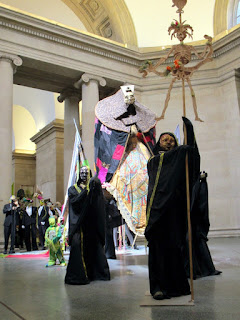
S.D. is covering for one of the Canons at Westminster Abbey as Canon in Residence (‘I only have to  read the first lesson at Mattins and Evensong, and be on hand in case the place burns down’), so as he left I looked round the shop. On the way we passed the Tate’s monumental current installation, ‘Procession’ by Hew Locke, a witty and thoroughly scary investigation of politics and social identity through something that looks like a religious event (‘Just like St Mary’s Bourne Street’ – that’s S.D., not Hew Locke) but with no liturgical content.


Usually I can be relied on to leave a gallery or museum shop with a handful of postcards but I thought 85p was a bit cheeky. I looked at the books. At the moment, as far as books are concerned, I am battling my way through three: Andrew Hickey’s The Mind Robber (one of Obverse Books’ ‘Black Archive’ volumes about individual Dr Who stories), Brian Bailey’s Great British Ruins from 1984 (a nice easy come-down bedtime read), and Airhead by Emily Maitlis, recounting the real experience of being a leading BBC news interviewer. I only got hold of that because there was a pile of copies in one of the churches I visited recently, with the instruction to take one away for free, but it has nice, short chapters and is physically light, making it an ideal train read – and very revealing of Maitlis and her interviewees. In the Tate shop there were hundreds of fascinating titles I would like to read, but I know I never would (I congratulated myself for owning a couple already). Analyses of colonialism and feminist art, of cultural trends and social phenomena: some of these are important, and in fact they might change the way you look at the world. Most of them will have been laboured over with commitment and dedication. But who will read them? Will they happen to find their way into the mind of someone who might have their worldview shifted by them, might as a result go on to do something which would affect their own life and others’?

It is no surprise that at my time of life I might think about what I have done with it. I know I’ve wasted a lot of time, but am I wasting it now? I’m not necessarily haunted by the thought that I might not have gone to the right places, had the most worthwhile experiences, or read the most enjoyable books from the Tate shop: that’s a consumerist approach to life I don’t endorse. But have I produced the most worthwhile things? Who will have listened to all my sermons, or read all the things I have written? I know what Father Somerset Ward would say, which is that our main concern should be to pray, so that our minds can be shaped after the mind of Christ: that there is no other way of pouring our own contribution into the life of the world that goes with the flow of the heavenly will. One can hope!
Tuesday, 2 August 2022

Alternative Readings

My copy of Celebrating the Seasons is a bit worn and battered now. It was brought out as a companion volume to Celebrating Common Prayer, the Daily Office book produced in the 1990s by the Anglican Franciscans and which became the model for the daily prayer services included in Common Worship from 2000 which most of us use now. Celebrating the Seasons is a compendium of spiritual readings for each day of the liturgical year; most of them are extracts from sermons or scriptural commentaries though there is also a bit of poetry or hymnody. The most refreshing feature is that the readings come from the whole scope of Christian history, from St Irenaeus of Lyons and the Desert Fathers, through medieval mystics such as Mechtilde of Magdeburg and Puritan divines to modern poets including RS Thomas. I've used these passages alongside my daily morning Bible reading as a means of trying to find some thoughts to help shape the day.

But I have been reading them for years now so they are perhaps unhelpfully familiar! Just lately I remembered that a few years ago I was given Celtic Daily Prayer, the office book of the Northumbria Community, and when I was planning our Forest Church I looked to see whether there was any helpful material - there wasn't, but I found in the book two cycles of daily readings. Where Celebrating the Seasons concentrates on theological meditation, Celtic Daily Prayer is more experiential, including far more material that reflects the lives of the saints. At least, the saints in the 'Celtic tradition' - a phrase I usually shy away from, as the people who use it customarily leave out how tough the holy people in that tradition were, and major instead on the 'hello clouds, hello sky' stereotype of Celtic spirituality. But my few days' reading in this book so far has produced an account of St Columba scorning the idea of going to sleep on straw as self-indulgent luxury and instead taking his rest on a stone with another as a pillow, so I think the authors are not unaware of what Celtic Christians were really like. 

I will, for a while anyway, put aside the thumbed pages of Celebrating the Seasons and try something different. It's not too radical a step!