Thursday, 28 January 2021

A Circular Book

When did Geza Vermes’s Jesus and the World of Judaism find its way onto my bookshelves? It dates to 1983, has some loose pages (more since I actually tried to read it) and however long it is since it appeared in the library I have never really consulted it. As it turns out, its outlook makes it of very limited use and I have seldom come so close to simply abandoning a book!

Geza Vermes’s personal history is illuminating: he came from a Jewish background and spent time as a Roman Catholic priest (a member of an order specifically dedicated to praying for the conversion of the Jews) before renouncing Christianity and turning to a non-religious sort of Judaism later in life, and teaching at Newcastle followed by Oxford. At the time Vermes was writing, it was easy enough when reading any sort of Biblical exegesis to ignore the fact that Jesus was a Jew; he was part of shifting that perception, but it was pretty clear that he came to the conclusion that Jesus was only a Jew.

I say ‘came to the conclusion’, but it wasn’t a position drawn from evidence: it was a belief derived from Vermes’s own conflicts and then read into the texts he knew so well. His work was part of the ‘quest for the historical Jesus’ movement that tried to uncover what we could know for certain about him; all very well, but there is an unavoidable circularity: the evidence you deem admissible in this search is already pre-determined by who you think Jesus is. So for Vermes, Jesus is a 1st-century Jewish reformer and nothing more; anything which suggests otherwise (the Gospel of John, the Epistles) is ‘Hellenic’ influence imposed on his original, and very limited, message, and should be discounted. Even material in Matthew, Mark and Luke which tends to hint at a divine significance to Jesus’s acts is also to be excised as representing later impositions by Christians. Once you’ve done this, you examine what’s left to find your ‘historical Jesus’ and, wonder of wonders, you get a Palestinian preacher with nothing groundbreaking to say at all: you wonder why anyone got so excited about the man. Again and again, Vermes says in various ways ‘we can trust that this passage or saying is authentic because it conflicts with the doctrine of the Church’. You can see the point of that, but its inverse – that anything in the New Testament which coincides with the doctrine of the Church must therefore be a false imposition – leads to the dismantling of the very texts you claim to investigate. The trouble is (as scholars have pointed out increasingly over the last few decades) that all our evidence about Jesus is already part of the Church’s proclamation, part of the kerygma, and you can’t disentangle him from the doctrinal presentation of him. Vermes recognises this objection, even in 1983, but swipes it away as it tends to undercut his entire project and leave him with nothing to say.

I didn’t entirely give up on Jesus and the World of Judaism because I realised there are chapters which usefully talk about the contribution of Jewish texts to understanding his context; but I did, at one point, literally shut the book in frustration and put it to one side. It was here, as Vermes discusses the Parable of the Wise and Foolish Virgins. For him, any hint of patience, or waiting, of readiness or preparation for the Judgement, indicates a later interpolation by a Church facing up to the indefinite delay of the Parousia. It can’t come from Jesus, it just can’t:

The parable of the ‘wise’ virgins – supposedly wise, but to my mind cunning and selfish – reflects an insistence on the part of the church to be constantly ready; it contributes nothing to an active participation in the work for the kingdom of God … Did Matthew or his later editor not realise that this parable is a travesty of Jesus’s teachings on generosity and confident prayer contained in the same gospel?

And so this approach leads you not to try to work out what Jesus’s teachings were from the texts, but to judge the texts by the version of Jesus you want to believe in. The writers of the texts are fools, who know Jesus so much less well than you do. I'm afraid I can see little reason for me spending time on this.

Tuesday, 26 January 2021

It All Becomes Clear

My grapplings with technology are a minor theme of this blog and last year I related how my main image-processing program, CorelDraw, decided that it was no longer prepared to speak to Windows 10 and I would have to bring in its younger cousin which was better equipped for the system's new demands. 

I mentioned this to Dave, the Diocesan Mission Enabler, a few weeks ago. Our conversation was one of the earlier ones he had with parish incumbents, calling round to find out how things were going. It was a congenial enough chat, in which I described how the life of the church had developed since the pandemic began, the mixture of remote and in-person worship (when that was possible) and the sense that for a long while people had really been just hanging on and coping, but since the summer had gradually been finding it easier to manage again, negotiating their way around the maelstrom of change.

Some while later Dave sent me an email letting me know about an alternative to CorelDraw, Canva. 'Lots of churches use it', he told me. Canva turned out to be an online image-processing and design package, which is all very well but as your designs and documents are pinged into The Cloud to be stored (though you can download them) and I've already paid not only through the nose but other orifices for it, Canva doesn't bring me much advantage.

Lots of churches do use it, though. I suddenly realised that all the wonderful shiny posters and fliers I've seen on church websites, noticeboards and leaflet holders look so professional not because they've been designed by members of congregations up and down the diocese who work in advertising or something, but because they've been based on the templates Canva supplies. I'm not sure whether my feelings of relief at not being so inferior after all are outweighed by the sense that it's a bit of a cheat ...

Sunday, 24 January 2021

Weather Change

Who can resist snow photos? I can't.


A friend of mine confesses to not usually liking snow but being quite excited to see it this morning: I think it's because anything breaks the monotony at the moment. Snow is irresistible but I am also quite happy to see the back of it as its appeal quickly wears thin once a chilly night coats the pavements in a crackly carapace of ice.

Friday, 22 January 2021

Narrow Escape Parts One and Two

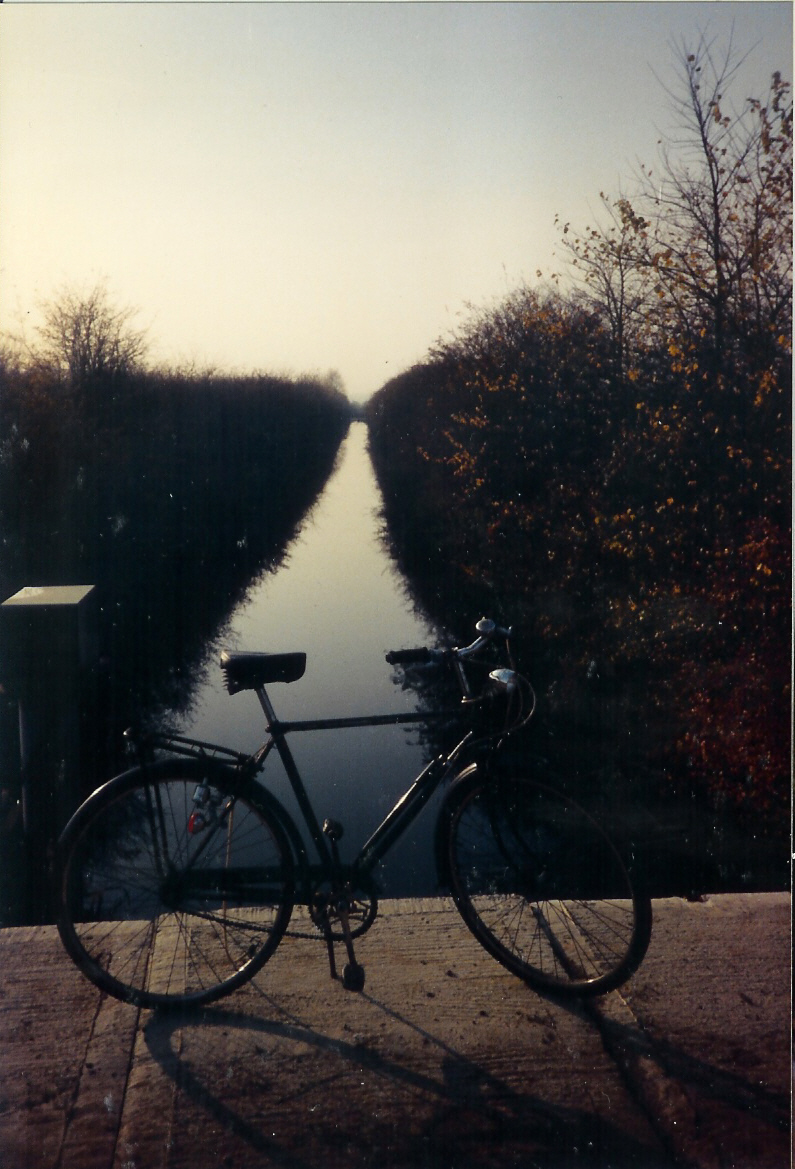
A little while ago I mentioned the Instructions of Fr Reginald Somerset Ward. In a little tract on 'Gratitude' he advises Christians should identify at the end of each day a specific list of mercies for which to thank God. Mine today will have to include the occasions when, on my newsletter delivery round, I almost fell off my bicycle - once on mud by the roadside, and once on a slippery drain cover. I'm not sure these will count as one item or two, though: I suppose it will depend how many more I can think of.

This isn't my current location, or even my current bicycle. On this long-ago occasion, the thing I was grateful for was that it didn't fall off the bridge.

Wednesday, 20 January 2021

Musique Concrete

It has taken several years for me to finish the task of working through the draft book of music for the sacred Office I use, or try to use, making sure the office hymns are in order, there are antiphons attached to all the proper days, and the psalms are properly pointed for the plainchant tones; and thanks to the epidemic I have achieved it! A copy now sits in my house and another in the Lady Chapel at church to be used when appropriate (that is, when I am alone).

There are, as far as I know, no official tones or music set for much of the material in Common Worship, so I have them made up myself. This process has been made a bit easier once I discovered, in brief, how plainchant works, and the antiphons, in particular, make more sense now.

That doesn't mean I know how they go. It's all very well sitting playing around with my borrowed piano and coming up with something that sounds nice to me, but if I am going to use them - even on my own - it will take rehearsal time first and I wouldn't recommend anyone being present until then!

Monday, 18 January 2021

Brazen Images

Mr Jenrick, the Communities Secretary, thinks that monuments to controversial figures 'are almost always best explained and contextualised, not taken and hidden away'. Oddly, I feel that they are almost always best taken and hidden away, not explained and contextualised. We've talked about this before, but the government's proposed legislation in this area brings the topic up again. 

Of course when you put it as I have deliberately done, my position sounds entirely unreasonable. In fact I would much rather monuments and statues were only removed after proper public debate and accountable decision-making, because that's how we develop our self-understanding as a society. However it's worth remembering that the authorities in Bristol had talked for years about de-plinthing Edward Colston, the removal of whom sparked this whole current debate off, and had never quite got round to it. Equally, any fair-minded person baulks a bit about our public art being subject to the passing whims and enthusiasms of crowds and 'town hall militants', as Mr Jenrick puts it, but we should recall that it is often passing whims and enthusiasms which result in statues being there in the first place. Coming from a background in history I'm fairly relaxed about public art changing on a regular basis as this is what's always happened, and who may move from hero of the decade to persona non grata is an interesting reflection of social change, rather than an outrage to be resisted. 

One of my favourite instances comes from that comfortingly mad tome A272, an Ode to a Road by Dutch folly enthusiasts Pieter and (the late) Rita Boogart. On their journey along and around that thoroughly English thoroughfare they came across, in monumentally bronze equestrian form, Field Marshal Lord Strathnairn. This statue was originally erected in 1895 in Knightsbridge, outside Harrods, in fact, but was eventually removed as an obstruction to traffic. It was spotted in a scrapyard in 1965 by a Mr Northcott who was told that if he could move the damn thing, he could have it for free, and move it he did, to Foley Manor near Liphook where it stands resolutely if irrelevantly at the entrance to the drive. Like almost every military man of his day, Hugh Rose, 1st Baron Strathnairn, was implicated in a variety of Imperial escapades including the Crimean War and suppressing the Indian Revolt, but on a personal level seems to have been quite a good egg to judge by some of the anecdotes concerning him. In his current location, though, the locals have neither knowledge of nor interest in the identity and achievements of this once-lauded general. They know him only, so the Boogarts relate, as 'The Banana Man', owing to the fruit-like appearance of his plumed helmet. In his case 'contextualisation' would be rather a shame.

The closest public statues to me are in Guildford, and it's interesting to think of the objections that might be raised to any of them. The Surrey Scholar by Alan Sly (2002) at the bottom of the High Street depicts a young chap running to a lecture, and the only quibble might be against his sex: perhaps a female scholar would be preferable. Then there are two sculptural depictions of Alice of Wonderland fame, Alice and the White Rabbit (Edwin Russell, 1984) and Alice Through the Looking Glass (Jeanne Argent, 1990); again, surely no problem with these unless we are very sensitive about the Revd. Charles Dodgson's familiar relationships with small girls. Somewhere on the University of Surrey campus nearby is a statue of Alan Turing, which I've never seen, and he is definitely safe.

I'm not quite so confident for George Abbot (Faith Winter, 1993). who stands at the top of the High Street, the only real and genuinely local figure of the lot: Turing stayed in Guildford in the summer as a child, which is a bit tenuous. Abbot (d.1633) has the distinction of being the only Archbishop of Canterbury to have killed someone while in office, and had the statue depicted him with one hand clapped to his mouth and a crossbow in the other having just realised he's accidentally despatched a deer-keeper while out hunting, it would be far more interesting than the staid figure we actually see. 

Seeing that ++Abbot had written a tome entitled Geography, or a Brief Description of the Whole World in 1599 I thought, well, a sixteenth-century clergyman almost certainly had some unpalatable opinions which might be found therein, and so it proved. The African races get off lightly, Abbot merely remarking that the inhabitants of the coastal states of West Africa are 'blacker than all other men', but he describes the Jews as 'runnagates', 'scattered upon the face of the earth', 'a curse upon them and their children for killing Christ'; and as for the Muslims, his salacious account of the founding of Islam and the character of its prophet culminates in the statement that he was 'much given to lasciviousness, and all uncleanness of body, even with very beasts'. Oh dear. You won't tell anyone, will you, so poor Archbishop Abbot can remain unmolested on his plinth?

Saturday, 16 January 2021

Real and Unreal Music

Musical instruments, crocheted depictions of the Nativity, Swahili with Duolingo – how many ways have people used their enforced quietude, if they’ve been able to muster up the enthusiasm, over the last ten months or so? (I haven’t). Perhaps it’s been the unusual circumstances of the time which have prompted PJ Harvey to crack on with a project her chief lieutenant John Parish mentioned as far back as 2016, the reissue of her back catalogue. Starting in July, each album has reappeared, tidied up and accompanied by a vinyl issue and, in most cases, the demo versions of the album songs. We already had these for PJH’s first album, Dry from 1992, as the first 5000 copies had been issued with an extra CD containing the demos, and in 1993 Rid of Me had been succeeded by 4-Track Demos which included some of the preliminary versions of that album's tracks along with a range of other songs.

The demo versions for Dry were already two years old and more by the time the album was released, and they are interesting because Harvey's voice has developed audibly by the time of the final treatments; some of the demos for the songs on Rid of Me sound completely different from the album, recorded as they were not in Steve Albini’s snowbound Minnesota hideaway studio in an atmosphere of exhaustion and hysteria but by Harvey on her own in a flat over a restaurant in West Bay, with bits from her landlord’s mother-in-law’s collection of old Georgian 78s added. But most of the demos that are being released now aren’t really that much removed from the album versions; we know that, at least for To Bring You My Love and Is This Desire? the final recordings mostly lifted her vocals direct from the demos with the odd tweak here and there.

The main exceptions are some of the tracks on Is This Desire? For this album Harvey was experimenting with electronic and synthesised sounds and in a couple of instances followed them to very heavy places indeed; ‘unlistenable’ has been a word not only confined to some critics but even current in the fanbase, and I appear to be the only person on earth who likes the brutal, unforgiving soundscape of ‘Joy’ whose savage nihilism appeals to a dark little corner of my heart. Obviously this couldn’t be produced live, and concerts included a version which was utterly different, featuring a muscular guitar riff and drums that were almost jazzy, while Harvey virtually reproduced the album vocal, like two separate songs being performed in parallel.

Well, the real fans now have their undiluted versions of the songs, which feature just Harvey and her guitar; and many clearly prefer them, while I find it as hard to see the point in those as I do in that of buying expensive vinyl discs just for the clunk and the hiss. There’s an issue here about authenticity, which has always been a valuable quality in ‘rock’, and which is almost the feature, allegedly, which distinguishes it from ‘pop’. Authentic rock has got guitars in it and connects with some sort of experience, though applying it to Polly Jean Harvey who has always fought very shy indeed of any sort of identification between her music and her own story is problematic if not completely beside the point. Perhaps, even when we accept that there's no genuine experience in an artwork - especially music - we still want to get close to the authentic personality, and we the idea that the initial sketches for Harvey's work, just her and a guitar, allow us to draw nearer than the finished treatments do; and vinyl is more authentic than a download. We'll see what happens when she gets round to reissuing 2007’s nightmarish White Chalk, which didn’t have a single guitar on it. (And of course what all of us really want are the b-sides, out-takes and musical doodlings which the maestra must have kicking about somewhere).

I haven’t bought any of the reissues, with one exception: the demo of ‘The Dancer’, the final track from To Bring You My Love. This is because it is a genuinely separate experience from the album version. Across a quarter of a century some more astute critics have pointed out that, far from being ‘Americana’ as lazier writers have described the rest of the recording, ‘The Dancer’ is more influenced by flamenco than anything else. And the demo has Harvey whooping, clapping and clacking castanets: the song’s overwrought Gothicism, the devastating, gut-shredding climax to the album’s haunted soundscape, emerges in the demo as a joke, a deft wielding of clichĂ©, a glorious pastiche. Talk about authenticity.