Friday, 16 August 2013

Perp Revival i'the North

When I did some research into the history of the Anglo-Catholic movement some years ago I ended up lamenting the fact that so little information existed about the role of the movement in the North of England. There was the story of St Saviour's, Leeds, paid for by Dr Pusey and others; Fr Ommanney and his work at St Matthew's Carver Street in Sheffield; and that was about it. All the talk otherwise was about the great Papalist churches in north and east London; the shrine churches of the West End; and the seaside strongholds in Bournemouth, Brighton, and other such places. But I knew it couldn't be the whole story. My old vicar in High Wycombe came from South Yorkshire and referred to the 'Biretta Belt' of churches there - Temple Newsam, Goldthorpe, Swinton, and others - and I kept coming across other references. There was precious little written about them, though.

Now there is, gradually. This week I was in receipt of a very welcome bundle of books and pamphlets from the Anglo-Catholic History Society, including Stephen Savage's Mission Accomplished: Five Lost Churches of Leeds, published a couple of years ago. This contains the astonishing picture you can see to the right:

This is Fr Nicholas Greenwell, first vicar of St Barnabas Little Holbeck, probably in the mid-1860s. The reason I find it so astonishing is the juxtaposition of vesture and clergyman. Fr Greenwell is wearing the full Eucharistic vestments, including maniple, at a time when doing so was something liable to get a priest into trouble (and, a few years later, in prison in some cases). He is also a very Victorian looking gentleman in his whiskers and slick hair, quite unlike his clean-shaven and Popish contemporaries in the South such as Fr Lowder of Wapping. It's that combination that I find interesting, and surprising. I can't remember seeing anything of the sort elsewhere.

Fr Greenwell had been curate at Leeds Parish Church under the great old-fashioned High Churchman Walter Farquhar Hook, but in churchmanship St Barnabas galloped far ahead of the mother church in the city centre and became an inspiration to other churches in the area. From the same milieu - the church of St James, in fact - came Fr Richard Twigg, who moved to Wednesbury and became known as 'The Apostle of the Black Country'; him I knew about, but I had no idea of his background. Slowly the story gets pieced together, it seems.

Tuesday, 13 August 2013

Beyond the Fringe

Today I feel thoroughly ashamed of myself.

A friend I hadn't heard from for ages sent me an email. After some awful experiences in his parish he's been bought off by his diocese and left the Church of England. He's joined the Celtic Orthodox Church, which I had to admit I'd never heard of. And this, I'm very sorry to say, sparked off one of my periodic fits of wandering around the internet delving into the murky world of fringe churches.

Now a walk around any large town will usually throw up any number of churches, some big, some small, in the Evangelical or Pentecostal ambit. Keeping themselves far more to themselves are fringe churches of a different order. Pick any of the words 'Catholic', 'Old', 'Orthodox', 'British', 'Liberal', 'Celtic' or 'Apostolic', and combine any number of them in any order, and you will, eventually, find a Church operating under that banner. There are dozens of them, usually composed mainly of bishops (if you have your own Church, the last thing you want to bother being is an ordinary layperson, isn't it? Not if you can be a bishop, or even an archbishop, and get to dress up) who are commonly very precise about who consecrated them as bishops and where their line of succession comes from, usually leading back to either the fraudulent Arnold Mathew or the deluded Jules Ferrete, and rather less precise about what they get up to day by day. My friend's Celtic Orthodox Church is actually one of the more respectable, because it does appear actually to have a couple of congregations and some genuine sense of continuity with something which is more than just a list of names of chaps who had hands laid on their heads by other chaps at some point in the past. I was very surprised to learn that the C.O.C. was once at one with the folk who now make up the British Orthodox Church, from whom they were estranged in 1997 when him what is now Mar Seraphim, the Archbishop of Glastonbury, led the majority of the Church into union with the Coptic Orthodox. The B.O.C. is very sensible indeed, and in fact makes a point of being sensible, as if to expunge the corporate memory of their origins in a bunch of Theosophists.

When I am in one of these reprehensible cycles of deluded fascination I almost always find myself straying in particular directions. One these involves hunting for a character who, when I was in Lamford, used to call himself the Abbot-Bishop of Hersham and whose name I can't remember, but who our organist once saw conduct a funeral at Woking Crem., bedecked in the most outrageous ecclesiastical garb which included ermine. He had some connection to the shadowy Order of Port Royal but he seems nowadays to have disappeared.

From there it's a short step to Bishop Jonathan Blake. He is now Presiding Archbishop of the Open Episcopal Church. Fr Jonathan came to public prominence when he married the unfortunate late Jade Goody to her partner, but I remember him (though have never met him) from twenty years ago when I lived in Chatham and he was an Anglican priest over the river Medway in Strood and was in the process of leaving the Church of England (with the bishop of Rochester's fulsome assistance) after being unable to keep his trousers on, an element in his spiritual progress he never talks about much. I remember you only had to mention his name to our Rector, Campbell, to watch him go episcopal purple from the neck up. Well, Fr Jonathan does seem to be very sincere about his ministry and his Church does actually seem to have a few members below the rank of Patriarch. And from Jonathan Blake we segue seamlessly in the direction of ...

... Bishop Sean Manchester. Like Mar Seraphim, Sean Manchester is also Archbishop of Glastonbury (there's a Roman Catholic one, too, it's a crowded place). You may have heard it said that most of the Internet consists of pornography or cat photographs. A good part of the rest of it is phantom blogs and websites set up by Sean Manchester and David Farrant under an assortment of assumed names to slag each other off. I'd never heard of Bp Manchester before reading a fascinating article in the Folklore magazine some years ago about the saga of the Highgate Vampire. That was when Mssrs Manchester and Farrant met and fell out, and they have devoted an impressive amount of the intervening forty years stalking and berating one another in no uncertain terms.  It's all quite entertaining, but you do feel like a good hot shower and rub down after reading any of the fake blogs operated by either gentleman. Bp Manchester stands out from the other episcopi vagantes - 'wandering bishops', that's the term for them - in that he is not an ecclesiastical and spiritual liberal, far from it, but prides himself on being more conservative than the Roman Catholics (except that he's married). I came across a very, very long thread on the Fortean Society message boards in which, during the course of several concurrent discussions about ecclesiastical niceties, whether vampires were real, and naturally, how evil David Farrant is, somebody asked a poster called Exorcistate (who was clearly Bp Manchester himself) whether the bishop did normal things like marry or baptise people, and whether he had a congregation. Well, said Exorcistate, His Grace has serious concerns about security and so his ministry has to be exercised with great discretion. You can take that as a No, then. Years ago Sean Manchester was interviewed for Udolpho, the magazine of the Gothic Society, in the course of which he claimed he was the heir of Lord Byron and therefore the legitimate owner of Newstead Abbey. He does seem to be quite intelligent and good-humoured. He is also the only person I have ever seen, bishop or otherwise, wearing a biretta with a suit.

Well, that's my penance done for wasting so much time on this grubby and unedifying world. Back to the grubby and unedifying world of the Church of England.

What amazes me, by the way, is that almost all these Churches seem to have a branch in Bournemouth ...

Chant, or Shan't

As I go on I become more convinced of the suggestion that the normative musical form of Christian worship is, at least in Western Christendom, plainchant. 'Normative', of course, doesn't mean 'normal'; it does mean that it sets the standard for other forms of music used in worship. The crucial elements are the absence of clear rhythm and its single melodic line, which erode the sense of time and allow an alignment with the eternal nature of God. Plainchant is also unaccompanied song, and puts primacy on the human voice.

When I was at St Stephen's House the House Musicians always went into despair when whoever was responsible for leading Morning and Evening Prayer for the week chose to have the student body sing the canticles in Anglican Chant rather than plainchant. Anglican Chant, at least from the 18th century is a bit like plainchant's boorish cousin who wants to dominate all the conversation at the family gathering. It's also easier to sing because you can slur notes, wobble about and hide behind harmonies. Plainchant is supposed to be pure and sung in unison, and if you get it wrong it sounds awful. It's good training.

I'm not very good at it, but I want to try and at least remind the people of Swanvale Halt that such a thing as plainchant exists, so when we keep one of the big feast days on a day which isn't a Sunday I try to use one of the Office Hymns, which I sing as an introit so the people can pray with it. Last Tuesday was of course the Transfiguration so I introduced the mass in the morning with this hymn from the English Hymnal, sung to the melody Coelestis Gloriae. It took me ages to get my head around, mainly because I couldn't find an example of it to guide me anywhere online, but finally it clicked and after a lot of practice I was able to make my way through the whole thing pretty bearably. Unfortunately on the day I ended up on the wrong note to start the second stanza and went badly awry though I managed to get it back on the right track for the third.

The next time we do a bit of plainchant will be on Michaelmas Day at the end of September when I've set the Office Hymn, 'Christ the fair glory of the holy angels', as our communion hymn to the tune Iste Confessor which I already know as it's used for the office hymn at Candlemas, so we'll see how that works out. The choir are confident they can do it!

Monday, 5 August 2013

Saints Alive

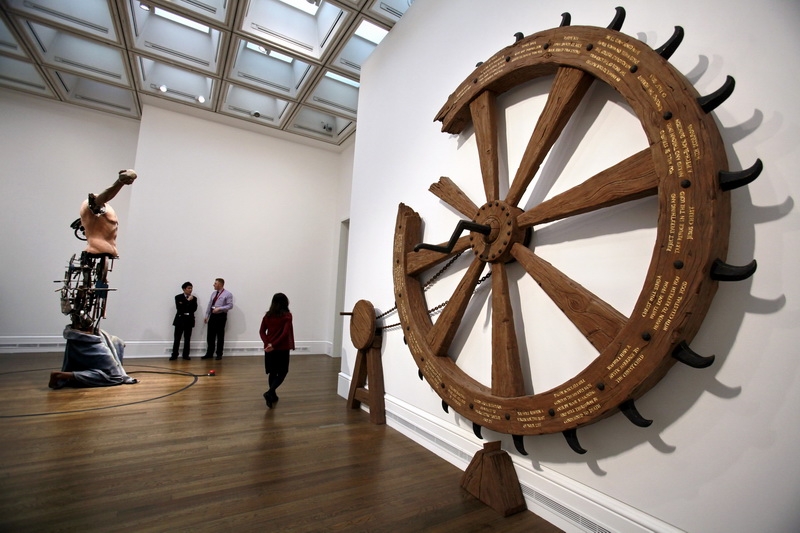
It's ages ago now, but we went to the National Gallery and quite by chance realised that Michael Landry's exceedingly odd but also exceedingly fun exhibition Saints Alive was on, as it still is (and is free to go in to) until 24th November. The bland description of 'a display of kinetic sculptures made from recycled materials' belies how wickedly amusing and strangely devout, in a mad way, the show is. Mr Landry was given virtual carte blanche to come up with a display interpreting the art of the Gallery, and while wandering around was struck, as he explains, by the religious content of so much of the collection and in particular the presence of Christian saints. From there he looked into their legends and, as we could have told him, some of those legends are very bizarre indeed.

So here you are greeted by a gigantic statue of St Apollonia who, when the visitor presses a pad, yanks out one of her own teeth with a pair of pincers. Through a doorway you come across a fibreglass torso atop a strange contraption of gears, wheels and chains which beats itself on the chest very dramatically with a stone, representing St Jerome attempting to combat sexual distractions. Further along St Peter Martyr's cranium is being perpetually chopped with a scimitar, while the upper body of St Francis of Assisi sits atop a collection box - pop in a coin and he will obligingly beat himself on the head with a crucifix. The most extreme contribution is the one inspired by St Thomas which, obedient to St John's Gospel Chapter 20 verse 27, consists of an arm endlessly jabbing into the side of Christ with such vigorous force that the entire thing actually lifts off the ground and clatters back down again with a bang. By November I expect Jesus will actually have a hole in his side. St Catherine is represented by an enormous spiked wheel (what else?) which you can have a go at turning, comparatively mild compared to the rest of it. There are any number of collages decorating the walls too.

I actually thought this was a huge hoot and not at all blasphemous, but then that's me.

Thursday, 1 August 2013

Readers and Their Doings

Our Reader is brilliant. She is an academic person but when she preaches manages to wear her learning very lightly at the same time as giving people plenty of good content. It’s a great gift.

But what are Readers for? Not long after I arrived I had a consultation with Lillian about what her role in the parish might be. It wasn’t going to be taking funerals, and most of our services are Eucharistic so the scope for her to lead worship was limited. We worked out a preaching schedule and she leads Taize services every other month, and has started a Bible study group.
The trouble with Readers – who you are not supposed to call Readers, they have been Licensed Lay Ministers in this area since 2001 – is that their distinctive role has been eroded over the years from both ends. What I mean is this. In its late-Victorian origin, the Anglican office of Reader, inspired by the ancient Minor Order of Lector, was intended to enable laypeople literally to read the Scriptures in a liturgical setting where previously that job had been the reserve of clergy and parish clerks. Readers got a badge and that was it. Gradually in the 20th century they became ‘clericalised’, still laypeople but allowed to dress up like clergy – first in a cassock and surplice, then with their distinctive blue preaching scarf. However, over recent decades the fact that laypeople are allowed to deliver the readings in services, and that a new category of non-stipendiary local clergy has been established, has meant that the Reader no longer looks quite so special. He or she is a sort of sub-vicar who can’t do anything that no one else can. One incumbent in this diocese was reported as having decided to put two parishioners who expressed a sense of vocation forward as Ordained Local Ministers rather than Readers on the grounds that OLMs would be more useful and training Readers was a waste of time; in Lamford an OLM had been ‘tried out’ by one of the previous incumbents as a Reader to ‘see how she did’ while another gentleman who had been rejected for the priesthood was advised by the same Rector to train as a Reader instead (sensibly he refused). The response to this unclarity has been to up the educational qualifications, and Readers now undergo a rather rigorous four-year theological training (probably a bit more involved than mine was!).

 At college we discussed Readers and wondered whether it might not be sensible, given that we were all being constantly told how special and wonderful the Diaconate was, to ordain all the existing ones as Deacons and have done with it. The trouble was that Deacons obviously have sacramental and pastoral roles as well as preaching and teaching ones. So that didn’t quite add up either.
 
On Tuesday I was out at a meeting for local vocations advisors, of whom I have the inestimable honour of being one, and we were addressed by the Warden of Readers for the diocese. She described Readers as ‘lay theologians’ whose ministry was specifically to make links between the lay world beyond the Church and the tradition they are charged with interpreting and reflection on. That would not result in a role which could be easily constrained, but which might lead to all sorts of involvement with groups and structures in and beyond the Church. That was the first time I’d heard it described in such terms and I’m grateful for it. Look for people who ask questions and want to make connections, we were advised: they may be your Readers.

Tuesday, 30 July 2013

Missionary Context

I'm reading at the moment into the life of someone with a connection to Swanvale Halt who spent much of her life as a missionary in India and was instrumental in the establishment of the Church of South India in 1947. She had a great concern with encouraging the ministry of native Indians and the independence of the Indian Church from the missionary societies and colonial Churches in which its origins lay. Coming from the Anglican stable, the worship she was used to in the Diocese of Dornakal would of course at first have been straight Book of Common Prayer no matter how incongruous that might seem. But there were para-liturgical celebrations which had more of a local flavour:

There emerged gradually a collection of Telugu Christian lyrics ... These were sung not only at divine worship but also at field work ... The [Easter] vigil was kept decorating every little chapel with beautifully cut out patterns in brightly coloured paper ... Then there was the Christian Home Festival, usually kept around Lady Day, for which a big wooden Cross was erected, outlined with little clay lamps. Each family lit its own little lamp from the Cross and proceeded singing from house to house where they lighted more lamps and received a blessing ... Supremely of course the Harvest Festival held sway ... All through the night village parties converged on the nearest big centre, singing as they came following their brightly coloured cross. The eucharist was celebrated early but the service of Ingathering came at mid-day, attended by all ages and kinds, chickens, ducks, kids and calves ... the climax came when all the produce was carried, pushed or dragged up to be offered, received and blessed ...

This is what we have become fond of calling 'inculturation', the adaptation of European Christian motifs and ceremonies to other cultural circumstances.

It occurs to me that this early- and mid-twentieth century collision of colonial Christianity with indigenous conditions was the Western Church's basic experience of such religious adaptation; it required only a slight and easy mental shift to view the inherited culture of the Church, whether Catholic or Anglican, as requiring a similar sort of 'inculturation' within a context in which traditional religion was theoretically familiar but from which in reality it had become estranged. Hence the jettisoning, from the mid-1960s, of the Book of Common Prayer and the old Roman Missal, plainchant and familiar hymnody, to be replaced by Folk Masses, guitars and puppets. All that stuff Pope Benedict and the folk of the New Liturgical Movement reacted against. The colonial experience is the key to understanding it.

Monday, 29 July 2013

Heartless

The former incumbent of our next-door parish once made the more sensitive members of Chapter gulp with a statement that 'a parish priest needs to know when to be a bastard'. I suppose the corollary of that is that they need to know when not to be, too.

I found myself in the bastard's position last week over Micky. Micky had taken up residence a couple of weeks before in the churchyard, initially with a bicycle, although that had mysteriously disappeared. He had a habit of grasping my hand in a vice-like grip which belied his appalling aroma, clouds of accompanying flies, and incomprehensible speech (which, however, I discovered could be effectively deciphered by various local residents). He lived in the big rhododendron bush and had been observed by the denizens of the old people's flats on the other side of the churchyard taking a dump there, which I'd already upbraided him for. I had swabbed down the benches in the churchyard after he'd wee-ed over them, and been very grateful for the fact that he never tried to sleep in the church itself. I was not sure quite where responsibility for the piles of lager cans lay between Micky or the other drinkers who were magnetically drawn to the Garden of Remembrance to accompany him. I was rather more sure of the complaints I had from people whose relatives' ashes were buried there.

On Sunday morning a week ago I came to church to take the 8am mass on a hot, bright day. Micky was rather harmlessly sat on a bench minding his own business. However on going home for breakfast I spotted him enthusiastically urinating up the wall of Boots the Chemist as families went by on their way to the Roman Catholic mass at 8.45. People live in the flats above that, I thought.
Coming down again for the 10am I found him lying in the church porch, his lager cans on the ground. I said it was time for him to move on. 'You look on me as a lower form of life' he said.

Now let us not be falsely sentimental, for Christ is the enemy of false sentiment. Micky's life - a life he doesn't want to leave as there is a very pleasant and well-resourced hostel four miles away he could go to if he wanted -  is just incompatible with the life my parishioners lead, and I can be of no good to him. But being bounced into being the representative of communal self-righteousness is not at all congenial.